On this page
- 01Key takeaways
- 02What does 'never outsource' actually mean?
- 03Why does getting the never list wrong cost so much?
- 04How do you tell if a process should never be outsourced?
- 05Which business processes should stay in-house?
- 06What can you outsource inside a process you keep?
- 07What does it cost to keep a process in-house?
- 08How do you keep control of what stays in-house?
- 09Guides on the never-outsource foundations
- 10Guides on leadership and direction
- 11Guides on money and control
- 12Guides on people and culture
- 13Guides on customer relationships
- 14Guides on access, data and systems
- 15Guides on legal and regulatory duties
- 16Guides on sales, brand and delivery
- 17Guides on never-outsource rules by sector
- 18Guides on keeping control in practice
- 19When is it fine to outsource something on this list?
- 20What does this look like in practice?
- 21Never-outsource checklist
- 22Next step
- 23Sources and further reading
- 24Frequently asked questions
Key takeaways
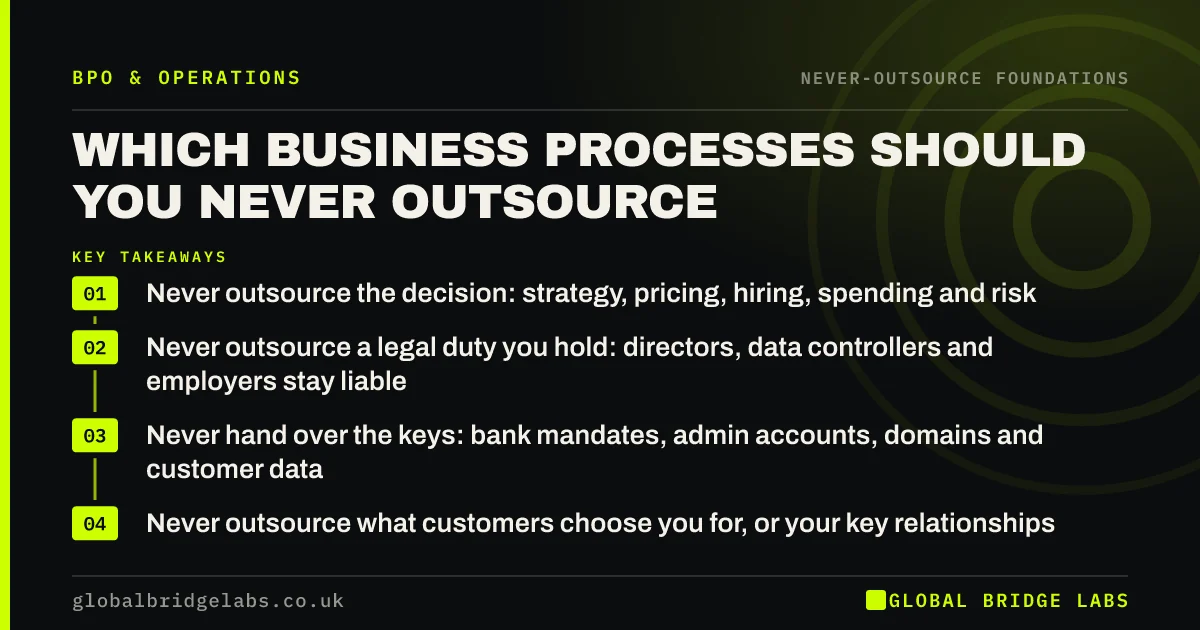
The business processes you should never outsource are the ones where the decision, the legal duty, the keys or the customer relationship would leave with them: strategy, approving money, hiring and firing decisions, regulated sign-offs, admin accounts and your key relationships. Almost every one of them still contains admin that can move. Keep the decision, outsource the preparation.
- Never outsource the decision: strategy, pricing, hiring, spending and risk.
- Never outsource a legal duty you hold: directors, data controllers and employers stay liable.
- Never hand over the keys: bank mandates, admin accounts, domains and customer data.
- Never outsource what customers choose you for, or your key relationships.
- Most kept processes are still mostly admin, and that admin can move.
Want your own never-outsource list drawn up in 30 minutes? Message us on WhatsApp.
Chat on WhatsApp →What does 'never outsource' actually mean?
A process you should never outsource is one where the business must keep the decision, the accountability or the control, because handing it to a provider would leave you exposed, dependent or indistinguishable. It rarely means the whole process stays in-house. It means one step, usually the approval, judgement or relationship, never leaves.
That distinction matters because owners who treat whole departments as untouchable end up doing hours of admin that a provider could do well. The goal is a short, precise list of decisions and duties that stay with named people, with everything around them open for outsourcing.
This guide is the process-level 'never' list. For deciding which processes to hand over, start with our guide to which business processes you should outsource; for the task-by-task view, see what tasks a small business can outsource; and for situations where outsourcing is the wrong move altogether, see when not to outsource.
Why does getting the never list wrong cost so much?
Getting it wrong costs in both directions. Outsource a decision and you lose control of the business: a provider sets priorities, approves payments or speaks for you, and you find out when something breaks. Keep too much and the owner stays the bottleneck, doing work worth £9–£18 an hour offshore or £20–£35 onshore (indicative market ranges) instead of the work only they can do.
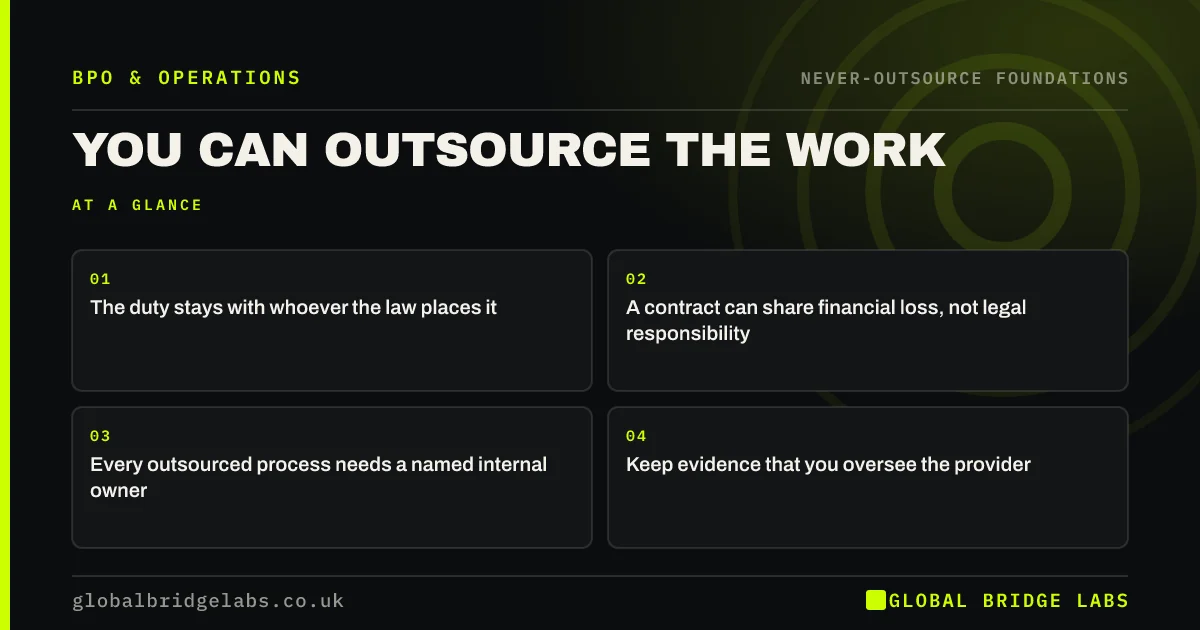
The legal side is unforgiving. UK GDPR keeps the data controller accountable for processors it appoints, the FCA's SYSC 8 rules say a regulated firm keeps full responsibility for outsourced functions, and company directors remain responsible for filings their accountant submits. A contract moves the work, never the duty.
How do you tell if a process should never be outsourced?
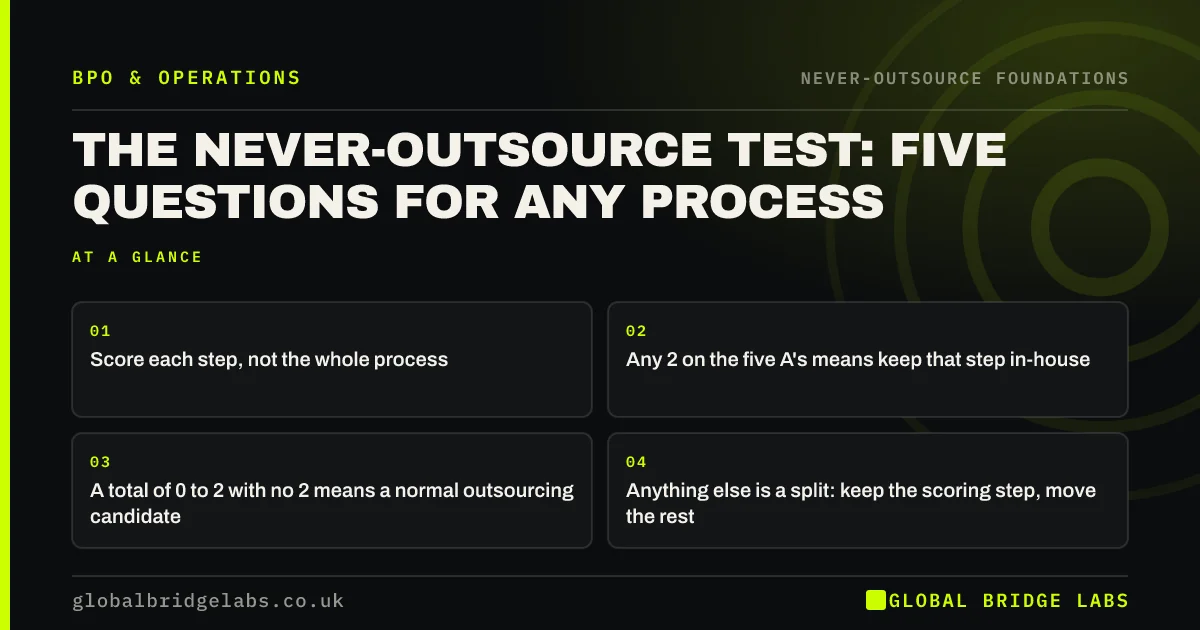
Use the GBL Never-Outsource Test: five questions, each scored 0 (no), 1 (partly) or 2 (fully). Is the business legally Accountable for it? Is it an Advantage customers choose you for? Does it carry Authority to commit money, people or the company? Does it hold Access to money, systems or data? Does it build an Asset you would lose?
Any score of 2 means that step stays with a named person inside the business. A total of 0 to 2 with no 2 means the process is a normal outsourcing candidate. Anything in between is a split: keep the step that scored, move the rest.
- Accountable: the law or a regulator holds you to it.
- Advantage: customers choose you because of it.
- Authority: it commits money, people or the company.
- Access: it holds the keys to money, systems or data.
- Asset: it builds knowledge, IP or relationships you would lose.
Which business processes should stay in-house?
The processes that most often score a 2 fall into seven groups. As a GBL rule of thumb, in SMEs of 10 to 50 people they add up to 10 to 15 decisions and duties, not whole departments.
- Direction: strategy, goals, investment, acquisitions, risk appetite and partnerships.
- Money: payment authority, discounts, credit limits, write-offs, payroll sign-off and fraud checks.
- People: line management, pay decisions, redundancy, succession and investigations.
- Customers: escalations, exceptions, key contracts, crisis response and customer data.
- Keys: admin accounts, domains, email, phone numbers, code and software subscriptions.
- Duties: director, data controller, MLRO, safeguarding, right to work and contract signing.
- Advantage: closing sales, brand voice, final quality checks and the core service itself.
What can you outsource inside a process you keep?
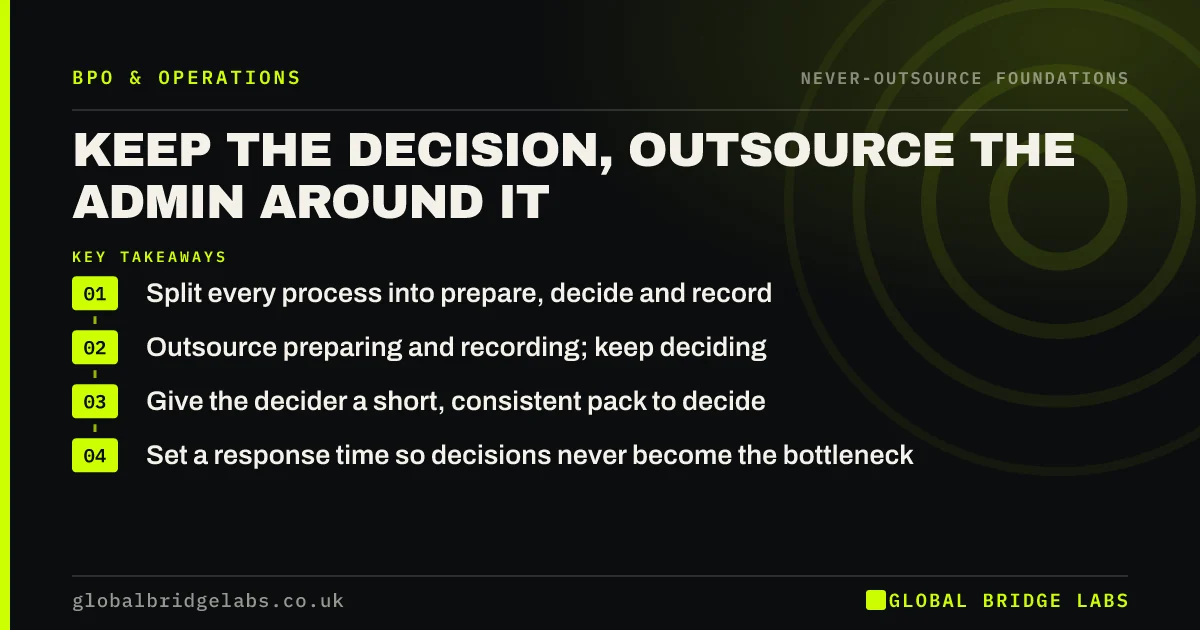
Usually most of it. Inside a kept process, the preparation, data gathering, chasing, drafting, record keeping and reporting can move; the approval, judgement and relationship stay. A payroll run is a good example: a provider calculates, files and reconciles, and a director approves the totals before money leaves the account.
Across our client work, moving that surrounding admin is where the gains come from: back-office cost per task down 42% and 31 hours a week returned to owners and managers. Those are results across engagements, not a promise for any one process.
- Outsource part of a core process without losing control
- Payroll: outsource the run, keep the sign-off
- See client work
Want to see which parts of your kept processes could move? Message us on WhatsApp.
Chat on WhatsApp →What does it cost to keep a process in-house?
Keeping a decision in-house costs little: a few hours a month of owner or manager time. Keeping the admin around it costs much more. An illustrative example: 15 hours a week of finance and customer admin done by an owner valued at £50 an hour is about £39,000 a year of capacity. The same hours bought from a managed offshore team at the indicative £9–£18 an hour cost roughly £7,000 to £14,000.
Those figures are market ranges, not a GBL price list; Global Bridge Labs (GBL) does not publish prices. The real saving depends on volume, complexity and how cleanly the kept decisions are separated from the admin. For your own numbers, our guide to BPO cost per hour in the UK sets out the ranges in more detail.
Want the cost of your kept admin worked out? Message us on WhatsApp.
Chat on WhatsApp →How do you keep control of what stays in-house?
Write it down and build it into systems. A keep list names each kept decision, its owner and deputy. Red lines and a decision rights matrix tell providers exactly where their authority ends. Admin accounts, bank mandates and customer data stay in the company's name. And one person per outsourced process stays able to judge the provider's work, the intelligent client role.
Then review it. Boundaries drift as providers become trusted and owners get busy. A one-hour review each year, and after any big change, catches decisions that have slipped outside and items that no longer need protecting.
- Keep list: what stays, who owns it, why.
- Red lines and decision limits in the contract.
- Accounts, mandates and data in the company's name.
- An intelligent client for each outsourced process.
- A yearly review of the whole list.
Guides on the never-outsource foundations
Start here: the test, the split between decisions and admin, and the limits of what any contract can transfer.
- The never-outsource test: five questions for any process
- Keep the decision, outsource the admin around it
- You can outsource the work, never the accountability
- The intelligent client: know enough to manage a provider
- Outsourcing red lines: write them down before you sign
- A never-outsource list that is too long costs you
- Processes only the owner should run
- Things people say you can never outsource, tested
- Irreversible decisions: why they stay with you
Guides on leadership and direction
Advisers can inform direction-setting, but the choices stay with the owners and directors.
- Should you outsource business strategy?
- Company goals: a process the leadership keeps
- Investment decisions: why capital allocation stays inside
- Buying a business: advisers advise, you decide
- Board packs: outsource the preparation, keep the story
- Risk appetite: a decision no provider can make for you
- Strategic partnerships: who should negotiate them?
- Can you outsource company culture?
- Should you outsource innovation?
- Business plan writers: what to hand over and what to write
Guides on money and control
Finance admin outsources well. Authority over money does not.
- Bank mandates and payment authority: keep the keys
- Discount approval: who can change your prices?
- Customer credit limits: outsource the checks, keep the call
- Writing off bad debt: a decision you keep
- Financial controls that never leave the business
- Investor relations: why founders keep the conversation
- Tax returns: your accountant files, you are responsible
- Payroll: outsource the run, keep the sign-off
- Fraud controls: the checks that must stay inside
- Insurance cover: your broker advises, you decide
Guides on people and culture
HR admin can move. Managing, paying and parting with people stays with you.
- Can line management be outsourced?
- Redundancy: advisers help, managers deliver the news
- Pay rises and bonuses: decisions that stay in-house
- Staff communications: outsource the format, not the message
- Succession planning: a process the owners keep
- Employee assistance programmes: support, not a substitute
- Whistleblowing: outsource the hotline, own the response
- Training on your own methods: why it stays in-house
- Workplace investigations: when an outsider is better
- Exit interviews: outsource them for honest answers?
Guides on customer relationships
Routine service outsources well. Exceptions, escalations and the relationship stay close.
- Escalations the owner should take personally
- Customer insight: someone inside must read the feedback
- Goodwill gestures and exceptions: who can say yes?
- Negotiating customer contracts: never fully hand it over
- Service recovery: put things right from the top
- Service standards: you set them, a provider meets them
- Product recalls: run the response from inside
- Crisis spokesperson: who speaks for the business?
- Customer data: always own the list
- Onboarding a major client: why senior people lead it
Guides on access, data and systems
Providers can run your systems. The accounts, data and decisions stay in your name.
- Admin accounts and master passwords: never hand them over
- A digital asset register: know what you own online
- Data controller duties you cannot outsource
- Data breaches: who decides whether to report?
- Software subscriptions: own the account, share the access
- Source code and repositories: keep ownership
- Technology decisions: outside advice, inside choice
- AI rules for your business: who sets them?
- Business email: who controls the mailboxes?
- Business phone numbers: keep them in your name
Guides on legal and regulatory duties
Specialists can support these roles. The duty itself stays with the business and its named people.
- FCA firms: critical functions you can outsource, not offload
- Director duties: what you can delegate and what you cannot
- Can you outsource your MLRO?
- Outsourced DPO: hand over the role, keep the duty
- Safeguarding: the lead stays inside your organisation
- Who can sign contracts on behalf of your company?
- Right to work checks: can someone else do them for you?
- Companies House filings: your accountant files, you answer
- Letters from a regulator: who should reply?
- Company policies: outsource the drafting, own the policy
Guides on sales, brand and delivery
What customers buy from you, and why, is the last thing to hand over.
- Closing sales: can someone else close your deals?
- Brand voice: an agency can write in it, you must own it
- Marketing budget: agencies spend it, you decide it
- The final quality check: why the last look stays inside
- Your core service: should the thing you sell stay in-house?
- Trade secrets: what never leaves the building
- Founder-led sales: when to hand them over
- Bid or no bid: the decision before the tender
- Referral partners: relationships the owner keeps
- Expert content: a writer drafts, the expert signs off
Guides on never-outsource rules by sector
Regulated and specialist sectors have their own non-negotiables.
- What a law firm should never outsource
- What an accountancy practice should never outsource
- What a clinic should never outsource
- What an online shop should never outsource
- What a trades business should never outsource
- What a logistics company should never outsource
- What a restaurant or hotel should never outsource
- What an estate or letting agent should never outsource
- What a financial adviser or broker should never outsource
- What a recruitment agency should never outsource
Guides on keeping control in practice
Write the list down, put it in the contract and review it once a year.
- Never-outsource checklist: 20 checks before you hand over
- A keep list: record what stays in-house and why
- Outsource part of a core process without losing control
- When your provider starts making your decisions
- Contract clauses that keep control with you
- A decision rights matrix for outsourced work
- Review what you keep in-house once a year
- Document the processes you keep, not just the ones you move
- Mistakes owners make about what to keep in-house
- A 60-day plan: set your red lines, then outsource the rest
When is it fine to outsource something on this list?
When you outsource the expertise and keep the decision. A small firm can use an outsourced data protection officer, an external HR adviser or a fractional finance director, provided a named person inside still decides, signs and answers for the outcome. The risk is not the outside help; it is letting the outside help become the decision-maker by default.
There are also cases where an outsider is better than an insider: an independent workplace investigation, an anonymous whistleblowing line or honest exit interviews. Independence is the point there, and the business still decides what to do with the findings.
What does this look like in practice?
A pattern we see: an owner says 'finance stays in-house' and keeps doing invoices, reconciliations and payment runs at night. When we map the process, the only steps that need the owner are approving payments, setting credit limits and reviewing the monthly numbers. Everything else moves, the owner keeps tighter control than before because approvals are now explicit, and evenings come back.
Never-outsource checklist
Use these steps to write your own list in an afternoon.
- List your recurring processes and the decisions inside each.
- Score each decision on the five A's: accountable, advantage, authority, access, asset.
- Mark every step that scores a 2 as 'keep', with a named owner.
- Mark the rest of the process as 'can move'.
- Write your red lines into any outsourcing contract.
- Keep admin access, bank mandates and domains in the business's name.
- Review the list once a year, or after any big change.
Next step
Send us your list of processes, or just describe a typical week. We will mark the decisions and duties that must stay with you, and show you the admin around them that a UK–Sri Lanka team could take on.
Message us on WhatsApp for your never-outsource list, or book a 30-minute consultation.
Chat on WhatsApp →Sources and further reading
- FCA Handbook SYSC 8: Outsourcing · Financial Conduct Authority
- Controllers and processors · Information Commissioner's Office
- Being a company director · GOV.UK
- The Sourcing and Consultancy Playbooks · Cabinet Office
Frequently asked questions
What should a business never outsource?
A business should never outsource its key decisions (strategy, spending, hiring and pricing), legal duties it holds as an employer, director or data controller, control of its accounts and data, its key customer relationships, and the thing customers choose it for. The admin around each of these can usually be outsourced.
Can you outsource a core business process?
Often, in part. Most core processes contain admin, data entry, scheduling and reporting that a provider can run. What stays in-house is the step that makes it core: the judgement, the approval, the customer relationship or the know-how. Split the process rather than keeping or outsourcing it whole.
Is it risky to outsource finance or HR?
Outsourcing finance or HR admin is common and usually low risk with good controls. The risk comes from outsourcing the authority: letting a provider approve payments, change bank details, make hiring decisions or handle dismissals without a manager. Keep approvals and people decisions with named staff and the admin can move safely.
How many processes should stay in-house?
As a rule of thumb, in SMEs of 10 to 50 people, the never list is 10 to 15 decisions and duties rather than whole departments. If your list covers entire functions, it is probably too long, and the owner is likely doing admin that could be done more cheaply and more consistently elsewhere.
Written by

Global Bridge Labs (GBL) is a UK–Sri Lanka partner for social media, websites and BPO. Everything here comes from client delivery, not theory.