On this page
Key takeaways
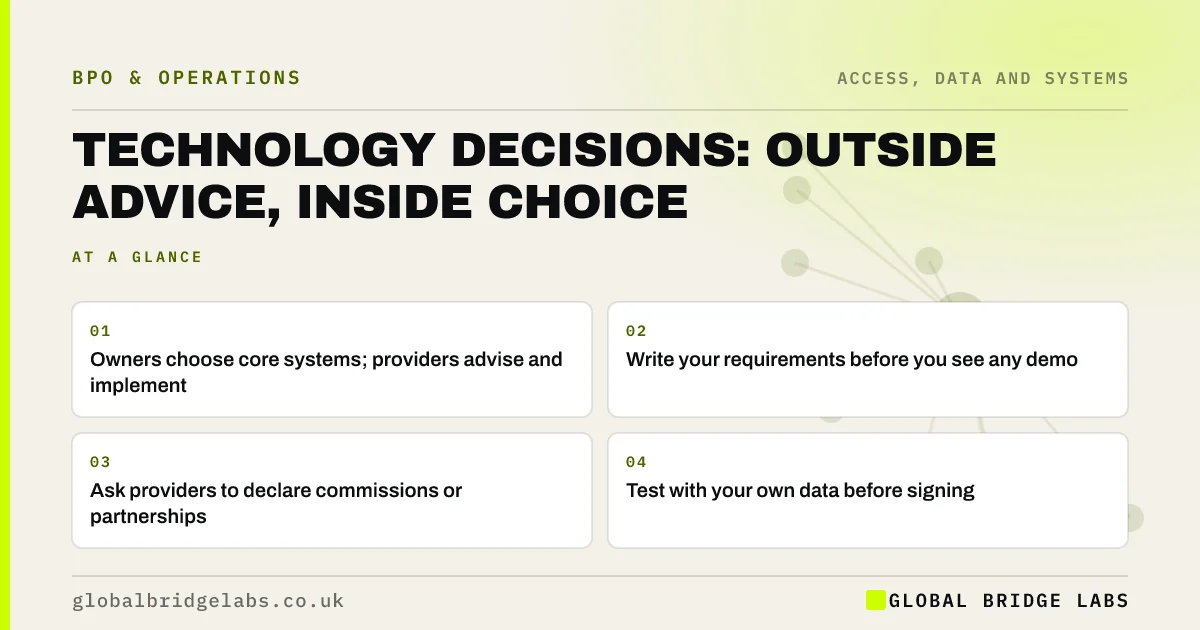
Technology decisions in a small business, such as which accounting, CRM or operations system to run on, should be made by the owners with advice, not handed to an IT provider. Core systems shape how you work for years. Providers can compare options, run trials and implement, but may benefit from the choice, so the business decides.
- Owners choose core systems; providers advise and implement.
- Write your requirements before you see any demo.
- Ask providers to declare commissions or partnerships.
- Test with your own data before signing.
Want a neutral requirements list before choosing a system? Message us on WhatsApp.
Chat on WhatsApp →Why should the business make technology choices?
Because a core system decides how work flows, what data you keep and what it costs for years, and switching is expensive. An IT provider may favour tools it resells or knows best. The owners know how the business should work and what it can afford.
How do you choose a core system?
Start from the work, not the software.
- Map the process the system must support.
- Write must-have and nice-to-have requirements.
- Shortlist two or three options.
- Trial with real data and real users.
- Check exit terms and data export.
What can IT providers do?
A lot of the work: researching options, running demos, setting up trials, migrating data, configuring the system, training users and supporting it afterwards. Good providers welcome a clear brief and say when they have a commercial interest.
What about security decisions?
A provider can implement security, but the business decides how much risk to accept, what to spend and who gets access. The NCSC's Small Business Guide sets out the basics every owner should understand well enough to ask the right questions.
What does this look like in practice?
A pattern we see: a provider recommends a system it resells, and the business adapts its processes to the tool. Owners who write requirements first and trial two options choose systems that fit how they work.
Technology decision checklist
- Map the process first.
- Write requirements before demos.
- Ask about provider commissions.
- Trial with real data.
- Check exit and data export terms.
Next step
Before your next system decision, write one page of requirements and share it with every supplier. Compare answers against it.
Message us on WhatsApp, or book a 30-minute consultation.
Chat on WhatsApp →Sources and further reading
- Small Business Guide: cyber security · National Cyber Security Centre
- Shadow IT · National Cyber Security Centre
Frequently asked questions
Should my IT provider choose our software?
Your IT provider should advise, research options and implement, but the choice of core systems should stay with the owners. Systems shape how the business works for years, and providers may have commercial reasons to prefer certain products.
How do small businesses choose software?
By mapping the process the software must support, writing requirements, shortlisting two or three options, trialling them with real data and users, and checking costs, contract length and how easily data can be exported if they later want to switch.
Who is responsible for cyber security in a small business?
The owners or directors are responsible for deciding how much risk to accept and what to invest. IT providers can implement and monitor security controls, but accountability for protecting the business and its data stays with its leadership.
Written by

Global Bridge Labs (GBL) is a UK–Sri Lanka partner for social media, websites and BPO. Everything here comes from client delivery, not theory.