On this page
- 01Key takeaways
- 02Why should the core of innovation stay in-house?
- 03What innovation work outsources well?
- 04How do you keep the know-how?
- 05When does open innovation make sense?
- 06What does this look like in practice?
- 07Innovation outsourcing checklist
- 08Next step
- 09Sources and further reading
- 10Frequently asked questions
Key takeaways
Should you outsource innovation? Outsource the specialist work, such as prototyping, testing, research and design, but not the innovation itself. Deciding which problems to solve, which ideas to back and what you learn from customers must stay in-house, because that is where your future advantage comes from. Make sure the know-how and intellectual property come back to you.
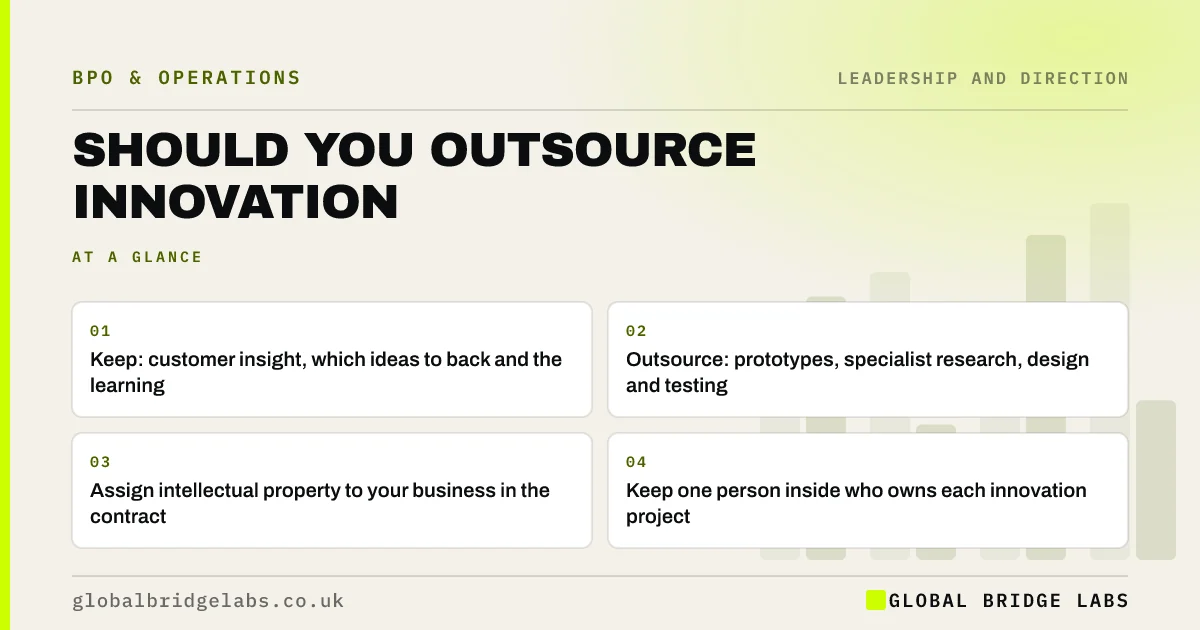
- Keep: customer insight, which ideas to back and the learning.
- Outsource: prototypes, specialist research, design and testing.
- Assign intellectual property to your business in the contract.
- Keep one person inside who owns each innovation project.
Want a second view on what to keep in an innovation project? Message us on WhatsApp.
Chat on WhatsApp →Why should the core of innovation stay in-house?
Because innovation is how a business builds its next advantage, and advantage that a provider holds can be sold to your competitors. The insight about what customers struggle with comes from your own conversations. The bets about which ideas to fund reflect your strategy. Hand those over and you rent your future.
What innovation work outsources well?
Work that needs skills or equipment you do not have, for a defined period.
- Building prototypes and proofs of concept.
- Specialist research, such as materials or data science.
- User testing and market research.
- Design and engineering to your brief.
How do you keep the know-how?
Assign intellectual property to your business in writing, require documentation and handover at each stage, keep code and designs in your own systems, and have an in-house project owner who attends every review. Grants such as those from Innovate UK may also have conditions on who owns and exploits the results.
When does open innovation make sense?
When a partner brings something you could never build alone, such as a university lab or a specialist firm, and the agreement is clear on who owns what. Collaboration works best when each side contributes something and both understand what they take away.
What does this look like in practice?
A pattern we see: a firm commissions a prototype, receives files nobody inside can maintain, and starts again with the next supplier. Firms that keep an in-house owner and insist on documentation build on each project instead.
Innovation outsourcing checklist
- Name an in-house owner for each innovation project.
- Keep customer insight and idea selection inside.
- Outsource defined specialist work to a brief.
- Assign IP to your business in writing.
- Require documentation and handover each stage.
Next step
List your current improvement ideas and mark which need skills you do not have. Those are the parts to buy in; the rest, and the choices, stay with you.
Message us on WhatsApp, or book a 30-minute consultation.
Chat on WhatsApp →Sources and further reading
- Innovate UK · UK Research and Innovation
- How copyright protects your work · GOV.UK
Frequently asked questions
Can innovation be outsourced?
Parts of it can. Prototyping, specialist research, design and testing can be outsourced to people with the right skills. Deciding which problems to solve, which ideas to back and what you learn from customers should stay in-house, because those choices create your future advantage.
Who owns the IP when you outsource development?
It depends on the contract. Without a written assignment, copyright in work created by a contractor may stay with the contractor. Make sure your contract assigns intellectual property to your business and that designs, code and documentation are handed over at each stage.
What is open innovation?
Open innovation means working with outside partners, such as universities, suppliers or specialist firms, to develop new ideas rather than relying only on internal teams. It works best with clear agreements on what each side contributes and who owns and can use the results.
Written by

Global Bridge Labs (GBL) is a UK–Sri Lanka partner for social media, websites and BPO. Everything here comes from client delivery, not theory.