On this page
- 01Key takeaways
- 02Why can't controller duties be outsourced?
- 03Which decisions stay with the controller?
- 04What can a processor do for you?
- 05What evidence should you keep?
- 06What does this look like in practice?
- 07Data controller checklist
- 08Next step
- 09Sources and further reading
- 10Frequently asked questions
Key takeaways
Data controller responsibilities stay with your business even when a provider handles the data. As controller, you decide why and how personal data is used, choose lawful bases, tell people what you do, answer their rights requests and must be able to show compliance. Providers act as processors on your instructions under a written contract.
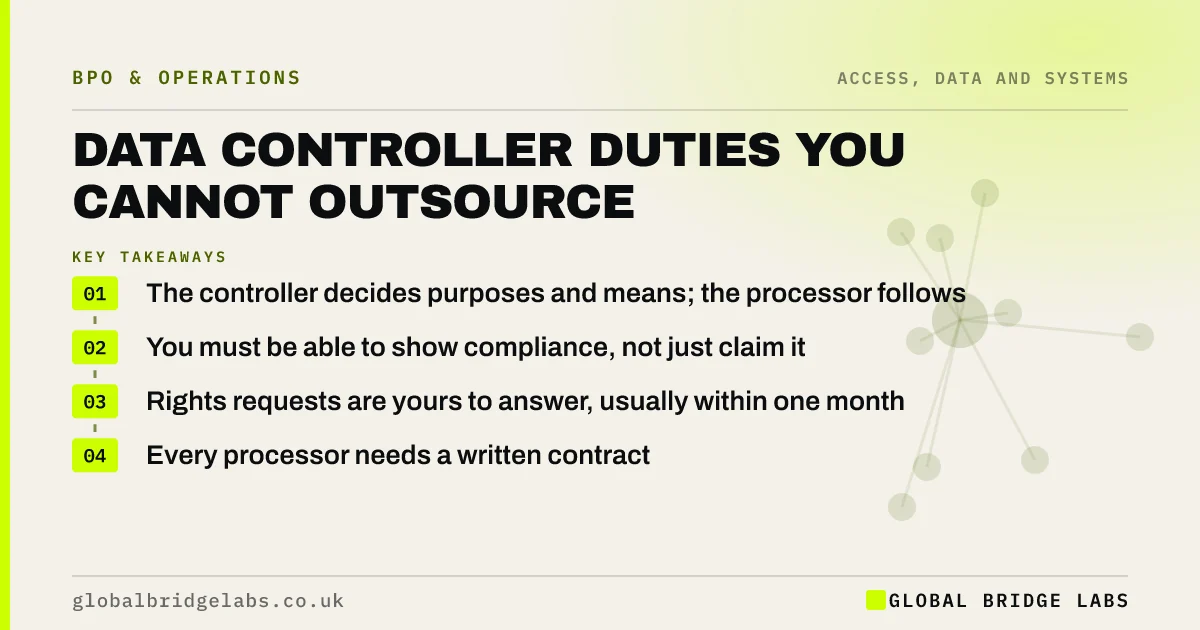
- The controller decides purposes and means; the processor follows.
- You must be able to show compliance, not just claim it.
- Rights requests are yours to answer, usually within one month.
- Every processor needs a written contract.
Want your controller and processor roles mapped? Message us on WhatsApp.
Chat on WhatsApp →Why can't controller duties be outsourced?
Because UK GDPR places accountability on the controller. A processor can be liable for its own failures, but the controller remains responsible for choosing processors that give sufficient guarantees and for how the data is used overall. The ICO will look first to the controller.
Which decisions stay with the controller?
The decisions that define the processing.
- What data to collect and why.
- The lawful basis for each use.
- How long to keep it.
- Who it is shared with.
- Whether to report a breach.
- How to answer rights requests.
What can a processor do for you?
Handle the data on your instructions: run the service, store records securely, help you answer subject access requests, notify you of breaches without undue delay and delete or return data at the end. A good processor also prompts you when instructions are unclear.
What evidence should you keep?
A record of processing, signed processor contracts, privacy notices, rights request logs, breach logs and evidence that you checked each processor's security. Most UK businesses that process personal data must also pay the ICO data protection fee unless exempt.
What does this look like in practice?
A pattern we see: a business assumes its outsourced provider 'does GDPR'. When a customer asks for their data, nobody knows who should respond. A simple log and a named internal owner settle that before it matters.
Data controller checklist
- Name an internal owner for data protection.
- Keep a record of processing.
- Sign contracts with every processor.
- Log rights requests and breaches.
- Check the ICO fee is paid.
Next step
List every provider that touches personal data for you, and check you have a signed processor contract for each.
Message us on WhatsApp, or book a 30-minute consultation.
Chat on WhatsApp →Sources and further reading
- Controllers and processors · Information Commissioner's Office
- A guide to subject access · Information Commissioner's Office
Frequently asked questions
What are the responsibilities of a data controller?
A controller decides why and how personal data is processed, must have a lawful basis, tell individuals what it does, respond to their rights requests, keep data secure, use processors under written contracts, report qualifying breaches and be able to demonstrate compliance with UK GDPR.
Can a data controller outsource its obligations?
It can outsource processing work to processors, but not its accountability. The controller remains responsible for decisions about the data, for choosing suitable processors and for showing compliance. Processors have their own, narrower obligations.
How long do you have to answer a subject access request?
Usually one month from receipt. This can be extended by up to two further months for complex or numerous requests, provided you tell the person within the first month. A processor can help gather the data, but the controller is responsible for responding.
Written by

Global Bridge Labs (GBL) is a UK–Sri Lanka partner for social media, websites and BPO. Everything here comes from client delivery, not theory.