On this page
Key takeaways
Outsourcing provider overreach happens when a provider starts making decisions that belong to you: setting priorities, offering discounts, choosing suppliers or speaking for the business. It usually grows from helpfulness and slow internal decisions, not bad intent. Spot it early, reset the boundary in writing, and fix the delays that pushed the provider to decide.
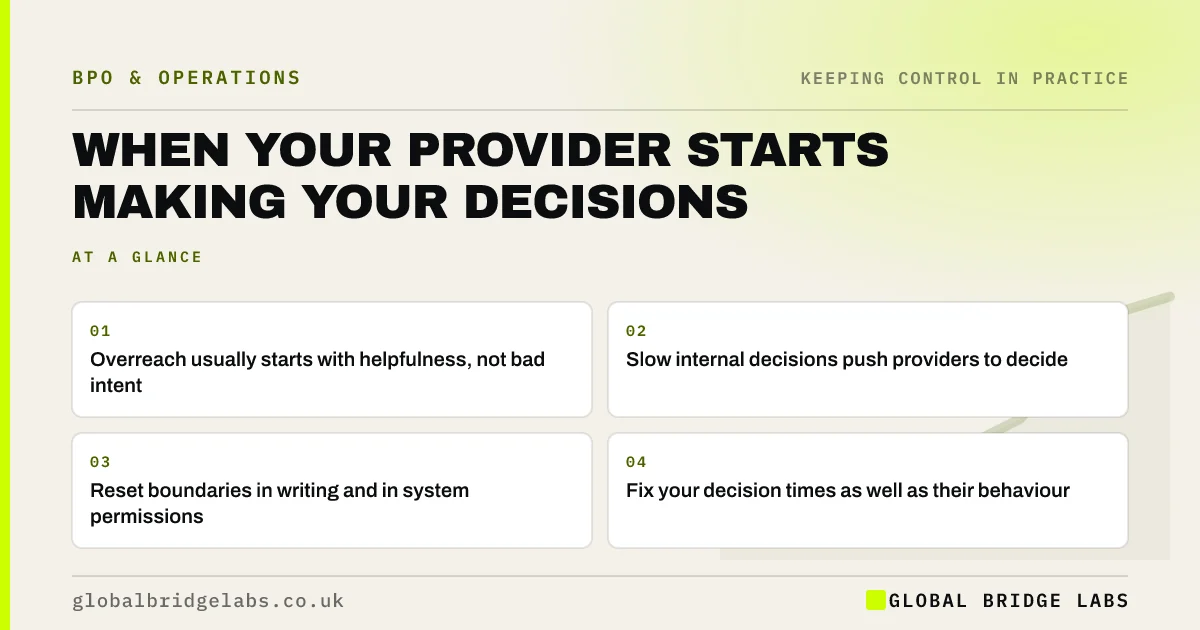
- Overreach usually starts with helpfulness, not bad intent.
- Slow internal decisions push providers to decide.
- Reset boundaries in writing and in system permissions.
- Fix your decision times as well as their behaviour.
Feel your provider is running more than it should? Message us on WhatsApp.
Chat on WhatsApp →What are the signs of overreach?
Watch for these.
- You learn of decisions after they are made.
- The provider sets priorities you did not agree.
- Customers mention offers you did not approve.
- Only the provider knows how the process works.
- Scope has grown without a change request.
Why does it happen?
Usually because decisions inside the business are slow or unclear. A provider facing an angry customer and no reply from you will act. Over time, acting becomes normal. Unclear red lines and missing escalation routes make it more likely.
How do you reset the boundary?
Calmly and in writing. Thank the provider for keeping things moving, confirm which decisions are yours, update the work instructions and permissions, and agree response times for escalations so they are not left waiting. Treat it as a process fix, not a dispute.
How do you prevent it recurring?
Keep an intelligent client inside who knows the process, review a sample of decisions monthly, and revisit the keep list yearly. If knowledge has drifted to the provider, document the process again with your own people involved.
What does this look like in practice?
A pattern we see: a provider starts approving small exceptions because the owner rarely replies to escalations. Agreeing a same-day response time and writing the limits down resets the relationship within a month.
Overreach checklist
- List recent decisions the provider made.
- Mark any that should have been yours.
- Update instructions and permissions.
- Agree escalation response times.
- Review a sample of decisions monthly.
Next step
Ask your provider for a list of decisions they made last month. Mark which ones you expected to make yourself.
Message us on WhatsApp, or book a 30-minute consultation.
Chat on WhatsApp →Sources and further reading
- The Sourcing and Consultancy Playbooks · Cabinet Office
- Contracts and liabilities between controllers and processors · Information Commissioner's Office
Frequently asked questions
What should I do if my outsourcing provider oversteps?
Confirm in writing which decisions belong to you, update work instructions and system permissions to match, agree response times for escalations, and review a sample of decisions regularly. Treat it as fixing the process rather than as a dispute.
Why do outsourced teams make decisions they should not?
Usually because escalation is slow or unclear and they are trying to keep customers happy or work moving. Clear limits, fast escalation routes and agreed response times from the business remove most of the pressure to decide.
How do I stop scope creep with a provider?
Write the scope clearly, require change requests for new work, review the work done against the scope monthly and keep a list of decisions reserved to the business. Scope creep is easier to prevent than to reverse.
Written by

Global Bridge Labs (GBL) is a UK–Sri Lanka partner for social media, websites and BPO. Everything here comes from client delivery, not theory.