On this page
- 01Key takeaways
- 02Why split decisions from admin?
- 03What goes in the prepare, decide and record steps?
- 04How do you stop the decision becoming a bottleneck?
- 05When should the preparation stay in-house too?
- 06What does this look like in practice?
- 07Prepare, decide, record checklist
- 08Next step
- 09Sources and further reading
- 10Frequently asked questions
Key takeaways
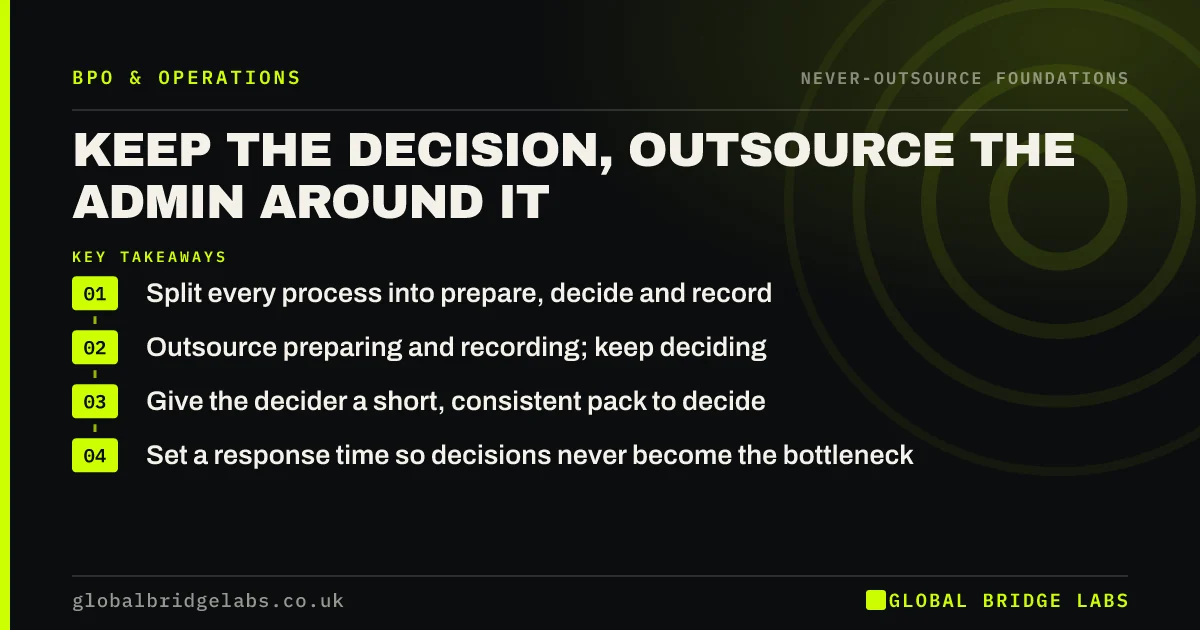
To outsource admin and keep decisions, split each process into three parts: prepare, decide and record. A provider prepares the information and records the outcome; a named person in your business makes the decision. This works for payments, hiring, pricing, refunds and most other processes owners think they must keep whole.
- Split every process into prepare, decide and record.
- Outsource preparing and recording; keep deciding.
- Give the decider a short, consistent pack to decide from.
- Set a response time so decisions never become the bottleneck.
Want a process split into prepare, decide and record? Message us on WhatsApp.
Chat on WhatsApp →Why split decisions from admin?
Because the admin is usually most of the hours and the decision is usually most of the risk. Owners who keep the whole process spend their time on chasing and typing, not deciding. Owners who outsource the whole process lose control of the decision. Splitting keeps the risk inside and moves the hours out.
What goes in the prepare, decide and record steps?
Prepare means gathering what the decider needs: the invoice and purchase order, the shortlisted CVs, the customer history. Decide means the yes, no or change, made by a named person. Record means updating the system, sending the outcome and filing the evidence. Only the middle step needs your judgement.
- Payments: provider matches and batches, director approves, provider reconciles.
- Hiring: provider sifts and schedules, manager interviews and chooses, provider issues paperwork.
- Refunds over a limit: provider prepares the case, manager decides, provider processes.
How do you stop the decision becoming a bottleneck?
Agree a decision time, such as same working day for payments and 48 hours for hires, and a standard pack so the decider can say yes or no in minutes. Set limits below which the provider can act without asking. Without these, keeping the decision simply moves the queue to the owner's inbox.
When should the preparation stay in-house too?
When preparing the decision requires judgement that only insiders have, such as reading a key customer's mood or knowing which supplier is about to fail. In those cases the provider can still gather the facts, but an insider shapes the recommendation.
What does this look like in practice?
A pattern we see: a director spends Friday afternoons on purchase approvals. Once the provider sends one consolidated list each morning with documents attached and a clear recommendation, approvals take 15 minutes and nothing waits until Friday.
Prepare, decide, record checklist
- Map each process into prepare, decide and record.
- Name the decider for each decision.
- Agree the pack the decider receives.
- Set limits the provider can act within.
- Agree a decision response time.
- Log every decision in the system of record.
Next step
Pick the process that takes most of your week and write down which single step really needs you. That step is what you keep.
Message us on WhatsApp to split your process, or book a 30-minute consultation.
Chat on WhatsApp →Sources and further reading
- The Sourcing and Consultancy Playbooks · Cabinet Office
- FCA Handbook SYSC 8: Outsourcing · Financial Conduct Authority
Frequently asked questions
Can I outsource admin but keep control?
Yes. Split each process so the provider prepares information and records outcomes while a named person in your business makes the decision. Add limits the provider can act within, an agreed response time and a log of decisions, and you keep control with far less of your own time.
What is the difference between decisions and admin?
A decision commits the business: approving a payment, choosing a candidate, agreeing a price or a refund. Admin prepares and records those decisions: collecting documents, chasing, data entry, filing and reporting. Decisions carry the risk; admin usually carries most of the hours.
Will keeping decisions slow the outsourced team down?
Only if decisions have no deadline. Agree a response time for each type of decision, give the decider a standard pack and set limits below which the provider can act alone. Decisions then become faster than when everything sat in one person's inbox.
Written by

Global Bridge Labs (GBL) is a UK–Sri Lanka partner for social media, websites and BPO. Everything here comes from client delivery, not theory.