On this page
- 01Key takeaways
- 02What makes a decision irreversible?
- 03Why should irreversible decisions never be outsourced?
- 04How do you sort decisions quickly?
- 05What can advisers and providers do?
- 06What does this look like in practice?
- 07Irreversible decisions checklist
- 08Next step
- 09Sources and further reading
- 10Frequently asked questions
Key takeaways
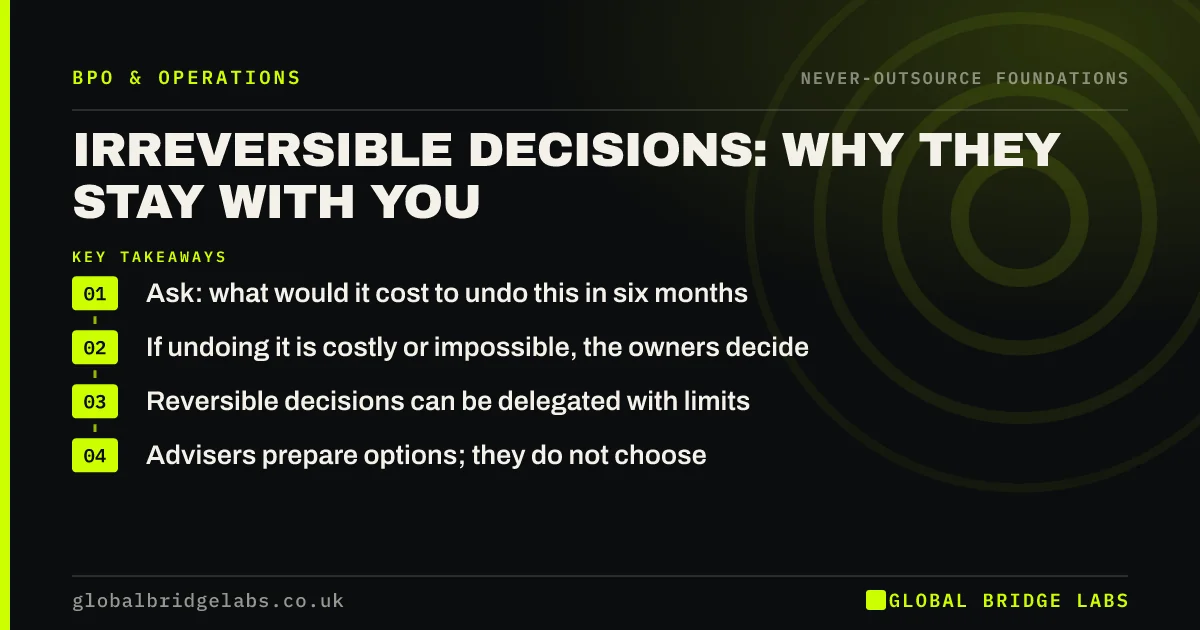
Irreversible business decisions, the ones that are costly or impossible to undo, should always be made by the owners or directors, never by a provider. Signing a long lease, making redundancies, selling a division, dropping a product line or switching core systems are examples. Advisers and outsourced teams can prepare the analysis; the people who live with the result decide.
- Ask: what would it cost to undo this in six months?
- If undoing it is costly or impossible, the owners decide.
- Reversible decisions can be delegated with limits.
- Advisers prepare options; they do not choose.
Facing a one-way decision and want a structured view? Message us on WhatsApp.
Chat on WhatsApp →What makes a decision irreversible?
A decision is irreversible when undoing it would cost far more than making it, or cannot be done at all. Long contracts, redundancies, legal commitments, public statements and data deletion all fall here. Many everyday decisions, such as a supplier trial or a marketing test, are reversible and can be delegated freely.
Why should irreversible decisions never be outsourced?
Because the provider does not live with the consequences. Their contract ends; your business carries the lease, the tribunal claim or the lost customers. Irreversible decisions also tend to be the ones where the owner's knowledge of the business, the people and the risk matters most.
How do you sort decisions quickly?
Ask two questions: how much would it cost to reverse, and how soon would we know it was wrong? Low cost and fast feedback means delegate. High cost or slow feedback means the owners decide, with time to think and, where useful, outside advice.
- Cheap to reverse, fast feedback: delegate with limits.
- Costly to reverse, fast feedback: senior decision, quick review.
- Costly to reverse, slow feedback: owners decide, take advice.
What can advisers and providers do?
Gather facts, model options, test assumptions and set out the risks. A good adviser makes a one-way decision better informed. The mistake is letting their recommendation become the decision by default, without the owners weighing it against what they know.
What does this look like in practice?
A pattern we see: businesses that treat a system switch as a reversible IT task find themselves locked into a platform for years. Those that recognise it as a one-way decision involve the owners, test with real data and agree an exit route before signing.
Irreversible decisions checklist
- Ask what it would cost to undo in six months.
- Ask how soon you would know it was wrong.
- Keep costly, slow-feedback decisions with the owners.
- Use advisers to prepare options, not to choose.
- Record the decision and the reasons.
Next step
List the decisions you expect to make in the next year and mark which are one-way. Those are the ones to keep firmly on your desk.
Message us on WhatsApp, or book a 30-minute consultation.
Chat on WhatsApp →Sources and further reading
- Being a company director · GOV.UK
- The Green Book: appraisal and evaluation in central government · HM Treasury
Frequently asked questions
What is an irreversible business decision?
It is a decision that is very costly or impossible to undo, such as signing a long lease, making redundancies, selling part of the business, switching core systems or making a public commitment. These should be made by the owners or directors, with outside advice where useful.
Should advisers make big decisions for a business?
No. Advisers can gather facts, model options and point out risks, which makes big decisions better informed. The decision should stay with the owners or directors, who carry the legal duties and live with the outcome long after the adviser's engagement ends.
Which decisions can be delegated?
Decisions that are cheap to reverse and give fast feedback, such as small purchases within budget, routine scheduling, marketing tests or standard refunds within a limit. Delegate them with clear limits and a log, and keep costly or slow-feedback decisions with senior people.
Written by

Global Bridge Labs (GBL) is a UK–Sri Lanka partner for social media, websites and BPO. Everything here comes from client delivery, not theory.