On this page
Key takeaways
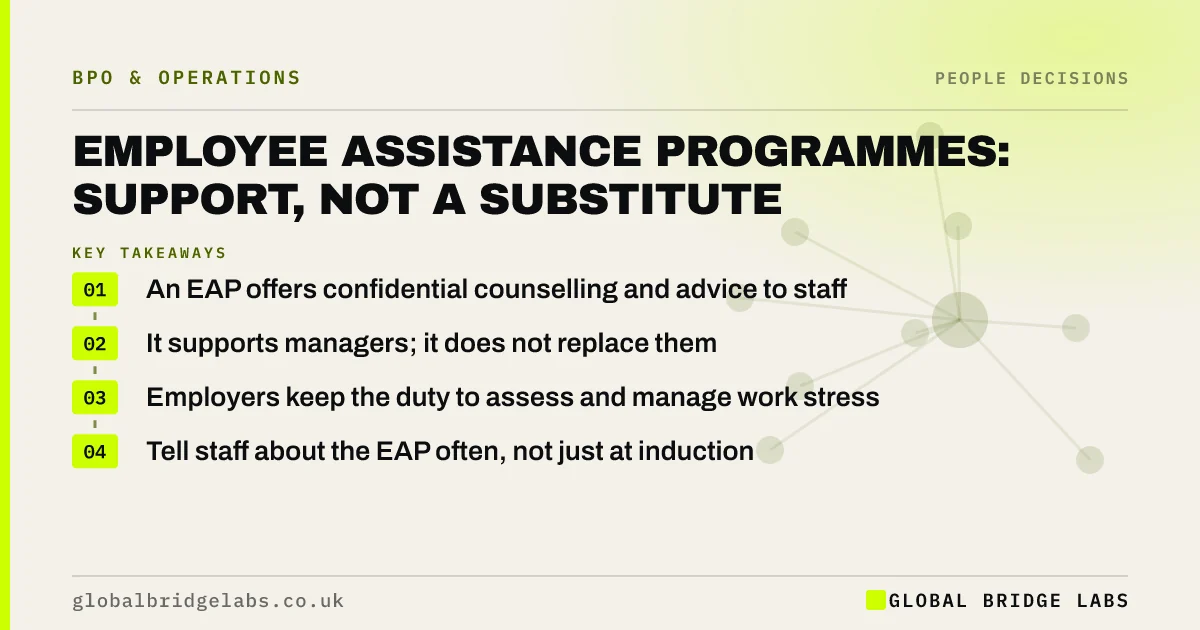
An employee assistance programme (EAP) for a small business is an outsourced, confidential service offering staff counselling and advice, often by phone or online. It is a useful support, but it does not replace managers. The employer keeps its duty to manage work-related stress, and managers still need to notice problems, talk to people and adjust work.
- An EAP offers confidential counselling and advice to staff.
- It supports managers; it does not replace them.
- Employers keep the duty to assess and manage work stress.
- Tell staff about the EAP often, not just at induction.
Want help comparing what wellbeing support to buy in? Message us on WhatsApp.
Chat on WhatsApp →What does an EAP provide?
Most offer a confidential helpline, a set number of counselling sessions, and advice on money, legal and family matters. Some include manager advice lines and support after traumatic incidents. Providers usually report anonymised usage, never individual details.
Why can't an EAP replace managers?
Because many causes of stress are about the work itself: workload, control, support, relationships, role and change, the six areas in the HSE's Management Standards. Only the business can change those. An EAP helps the person cope; managers fix what is causing the pressure.
What duties stay with the employer?
Employers must assess the risk of work-related stress and act to reduce it, as with any other health and safety risk. They must also make reasonable adjustments for disabled employees under the Equality Act. Buying an EAP does not discharge either duty.
- Assess work-related stress risks.
- Act on the causes found.
- Make reasonable adjustments where required.
- Manage absence fairly and supportively.
How do you get value from an EAP?
Promote it regularly, train managers to mention it during difficult conversations, and review anonymised usage to spot trends. If usage is near zero, staff probably do not know it exists or do not trust it is confidential.
What does this look like in practice?
A pattern we see: an EAP is bought, mentioned once in the handbook and rarely used. Firms that remind staff quarterly and train managers to refer people see it used, and spot workload problems earlier.
EAP checklist
- Check what counselling and advice is included.
- Promote the EAP at least quarterly.
- Train managers to refer staff.
- Keep doing stress risk assessments.
- Review anonymised usage yearly.
Next step
If you have an EAP, ask three staff whether they know how to use it. If you do not, list what support staff can access today.
Message us on WhatsApp, or book a 30-minute consultation.
Chat on WhatsApp →Sources and further reading
- Work-related stress and how to manage it · Health and Safety Executive
- What are the Management Standards for work-related stress? · Health and Safety Executive
Frequently asked questions
What is an employee assistance programme?
An employee assistance programme, or EAP, is a confidential service paid for by the employer that gives staff access to counselling and advice on personal, work, money, legal and family issues, usually by phone or online. Employers receive anonymised usage reports only.
Does an EAP meet an employer's wellbeing duties?
No. Employers still have to assess and reduce work-related stress risks, manage absence fairly and make reasonable adjustments where required. An EAP supports individuals; it does not address the causes of stress within the work itself.
Is an EAP worth it for a small business?
It can be, as an affordable way to give staff confidential support that a small employer could not provide itself. It works best when promoted regularly and paired with managers who talk to their teams and act on workload problems.
Written by

Global Bridge Labs (GBL) is a UK–Sri Lanka partner for social media, websites and BPO. Everything here comes from client delivery, not theory.