On this page
- 01Key takeaways
- 02Why should the owner take these calls?
- 03Which escalations reach the owner?
- 04What does the service team prepare?
- 05How do you stop the owner being swamped?
- 06What does this look like in practice?
- 07Owner escalation checklist
- 08Next step
- 09Sources and further reading
- 10Frequently asked questions
Key takeaways
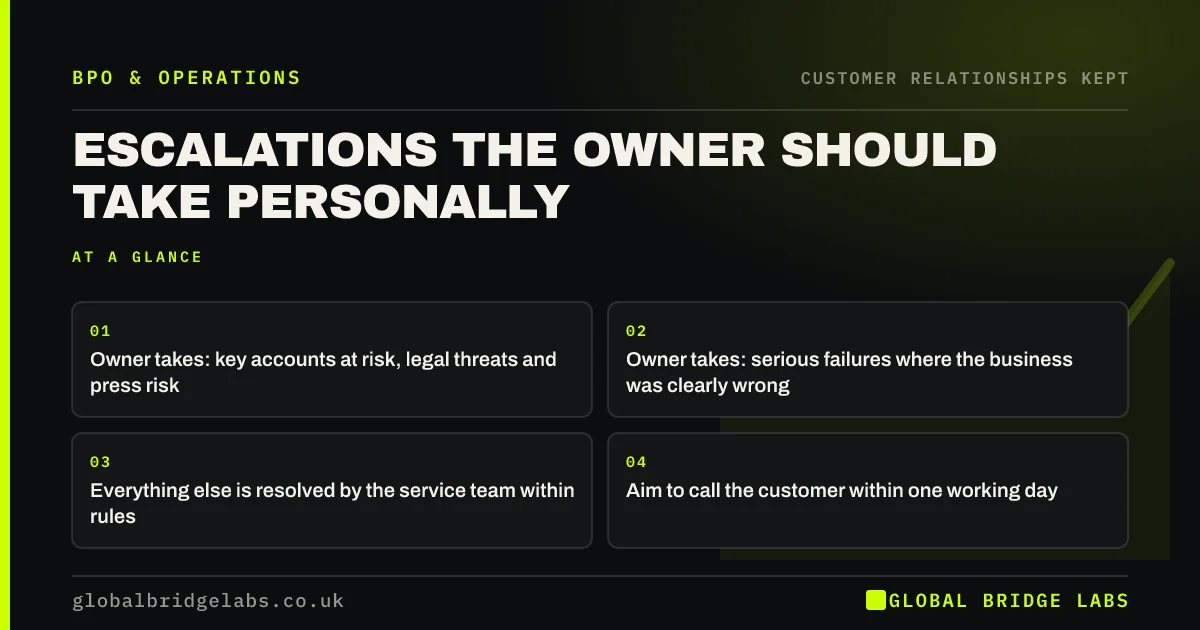
The complaints the owner should handle are a small set: key clients at risk, threats of legal action or regulator involvement, anything that could reach the press, and cases where the business got something seriously wrong. An outsourced service team can resolve routine complaints within rules. These few escalations need someone with authority to put things right and the standing to apologise.
- Owner takes: key accounts at risk, legal threats and press risk.
- Owner takes: serious failures where the business was clearly wrong.
- Everything else is resolved by the service team within rules.
- Aim to call the customer within one working day.
Want an escalation path that brings you only the calls that matter? Message us on WhatsApp.
Chat on WhatsApp →Why should the owner take these calls?
Because some situations need authority and accountability that only the owner has. A key client wants to hear that the business takes them seriously. A legal threat needs someone who can decide on settlement. A serious failure needs an apology that carries weight. Delegating these sends the wrong signal at the worst moment.
Which escalations reach the owner?
Write the triggers down so the team knows exactly when to escalate.
- Top 10 to 20% of customers by revenue unhappy.
- Mention of solicitors, courts, ombudsman or regulator.
- Risk of press or viral social media attention.
- Injury, safety or data breach.
- Compensation above the manager's limit.
What does the service team prepare?
A one-page brief: who the customer is, what happened, what has been said so far, what the customer wants and the options. With that, the owner can call within hours and be fully informed. After the call, the team records the outcome and follows up.
How do you stop the owner being swamped?
Keep the triggers narrow and give managers clear authority below them. If the owner receives more than a few escalations a month, the triggers are too wide or the underlying service has a problem worth fixing.
What does this look like in practice?
A pattern we see: either every complaint reaches the owner or none do until it is too late. Clear written triggers and a one-page brief mean the owner sees two or three cases a month, each in time to make a difference.
Owner escalation checklist
- Write the escalation triggers.
- Give managers authority below them.
- Prepare a one-page brief for each case.
- Call the customer within one working day.
- Record the outcome and lesson.
Next step
Write the five situations in which you would want a call tonight. Those are your escalation triggers.
Message us on WhatsApp, or book a 30-minute consultation.
Chat on WhatsApp →Sources and further reading
- UK Customer Satisfaction Index · Institute of Customer Service
- Our approach to resolving complaints · Financial Ombudsman Service
Frequently asked questions
When should a business owner deal with a complaint personally?
When a key customer is at risk, legal action or a regulator is mentioned, the issue could reach the press, someone has been harmed, or the business has clearly got something seriously wrong. Routine complaints should be handled by the service team within agreed rules.
Can complaints be handled by an outsourced team?
Routine complaints can, using clear rules on what the team can offer and when to escalate. The few complaints that need authority, such as key accounts, legal threats or serious failures, should be escalated with a prepared brief to a manager or the owner.
How quickly should the owner respond to an escalation?
Within one working day is a sensible target for owner-level escalations, sooner where there is a safety or press risk. A prepared brief from the service team makes a fast, informed call possible.
Written by

Global Bridge Labs (GBL) is a UK–Sri Lanka partner for social media, websites and BPO. Everything here comes from client delivery, not theory.