On this page
- 01Key takeaways
- 02Why must write-offs be approved internally?
- 03When should you write off a debt?
- 04What can an outsourced team prepare?
- 05What about VAT bad debt relief?
- 06What does this look like in practice?
- 07Bad debt write-off checklist
- 08Next step
- 09Sources and further reading
- 10Frequently asked questions
Key takeaways
The bad debt write-off decision accepts that money owed will not be paid. A director or owner should approve every write-off, because it affects profit, tax and the customer relationship. An outsourced team can prepare the case: the chasing history, the amount, any VAT bad debt relief due and the recommended next step. Then it records the decision.
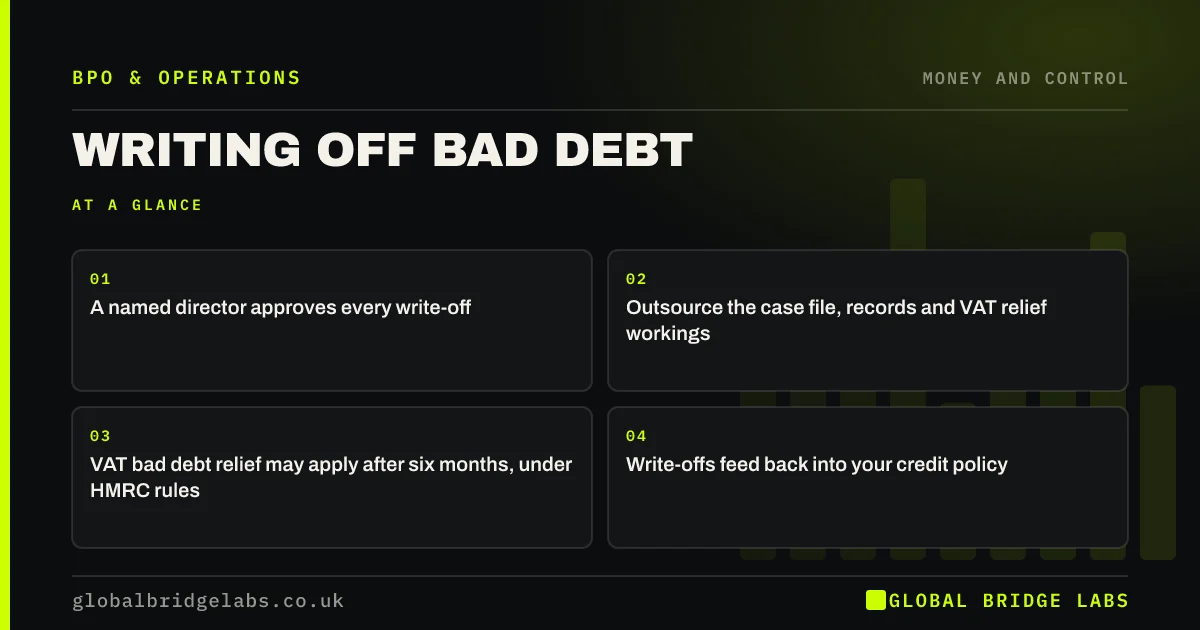
- A named director approves every write-off.
- Outsource the case file, records and VAT relief workings.
- VAT bad debt relief may apply after six months, under HMRC rules.
- Write-offs feed back into your credit policy.
Want your aged debt reviewed for write-off cases? Message us on WhatsApp.
Chat on WhatsApp →Why must write-offs be approved internally?
Because a write-off gives up money, changes reported profit and can end a customer relationship. It is also an area where errors or fraud can hide: a fake write-off can disguise a diverted payment. An internal approver who sees each case keeps the process honest and learns which customers or terms cause losses.
When should you write off a debt?
When collection has failed and the cost of further action outweighs the likely recovery: the customer has become insolvent, cannot be traced, or the amount is too small for legal action. Many firms review debts over 90 days each month and decide case by case.
- Customer insolvent or dissolved.
- Customer cannot be traced.
- Legal action would cost more than it recovers.
- A settlement for less has been agreed.
What can an outsourced team prepare?
A short case for each debt: the invoices, the chasing history, any promises made, the customer's status on Companies House, the cost of further action and the VAT position. After approval, it posts the write-off, claims any VAT relief through the return and updates the customer record.
What about VAT bad debt relief?
If you accounted for VAT on a sale and were not paid, HMRC's bad debt relief may let you reclaim that VAT once the debt is over six months overdue and written off in your accounts, subject to conditions and time limits. Check the current HMRC guidance or ask your accountant before claiming.
What does this look like in practice?
A pattern we see: old debts sit in the ledger for years because nobody decides. A quarterly review with prepared cases clears them, recovers VAT where it applies and shows which terms keep causing losses.
Bad debt write-off checklist
- Review debts over 90 days monthly.
- Prepare a short case for each write-off.
- A named director approves each one.
- Check VAT bad debt relief conditions.
- Feed lessons back into the credit policy.
Next step
Run an aged debt report and count invoices older than six months. Each one needs a decision: chase, settle or write off.
Message us on WhatsApp, or book a 30-minute consultation.
Chat on WhatsApp →Sources and further reading
- Sending a VAT Return · HM Revenue & Customs
- Late commercial payments: charging interest and debt recovery · GOV.UK
Frequently asked questions
Who should approve a bad debt write-off?
A director or owner, or a senior manager with written authority up to a set amount. Write-offs affect profit and tax and can hide errors or fraud, so each should be approved by someone independent of the person who recorded the sale or handled the collection.
When should a business write off a bad debt?
When collection has failed and further action would cost more than it is likely to recover, for example when the customer is insolvent, cannot be traced or the debt is too small for court action. Review older debts monthly and decide case by case.
Can I reclaim VAT on a bad debt?
Often, yes. HMRC's VAT bad debt relief may let you reclaim VAT you paid on an unpaid sale once the debt is over six months overdue and written off in your accounts, subject to conditions and time limits. Check current HMRC guidance before claiming.
Written by

Global Bridge Labs (GBL) is a UK–Sri Lanka partner for social media, websites and BPO. Everything here comes from client delivery, not theory.