On this page
Key takeaways
An independent workplace investigation is one of the few people processes where an outsider is often better. When a complaint involves a senior person, or everyone knows everyone, an external investigator can gather facts fairly. But they only find facts. A manager inside the business still decides the outcome, runs any hearing and takes responsibility for it.
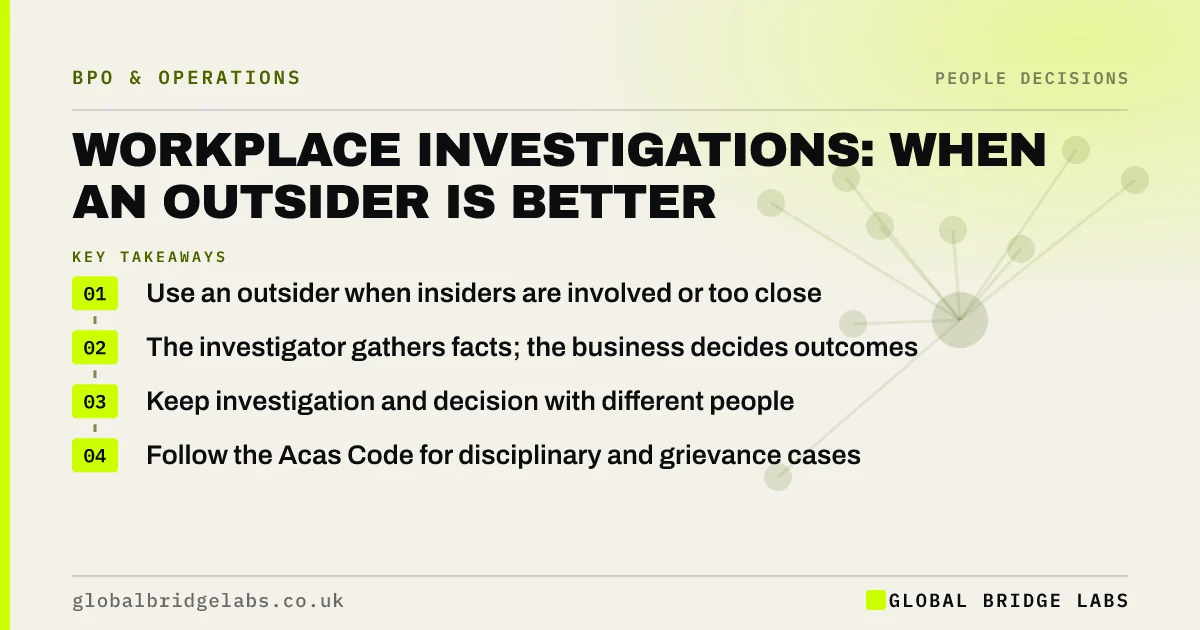
- Use an outsider when insiders are involved or too close.
- The investigator gathers facts; the business decides outcomes.
- Keep investigation and decision with different people.
- Follow the Acas Code for disciplinary and grievance cases.
Need admin support around an investigation? Message us on WhatsApp.
Chat on WhatsApp →When is an outside investigator better?
When the business cannot find someone independent: the complaint is about an owner or senior manager, the team is small and close, the allegations are serious, or a fair process will be scrutinised later. Acas guidance says investigators should not be involved in the matter, which is hard in a small firm.
What does an investigator do?
They agree terms of reference, interview the people involved and witnesses, gather documents, and write a report setting out the facts found and the evidence for them. Some recommend whether there is a case to answer; they should not decide the sanction.
- Agree the scope and questions.
- Interview and gather evidence.
- Write a factual report.
- Say whether there is a case to answer.
Why does the decision stay inside?
Because the employer is responsible for the outcome and must be able to explain it at a tribunal. A manager who was not the investigator reads the report, holds any hearing, considers the employee's response and decides. That separation is part of a fair process under the Acas Code.
What admin can be outsourced?
Scheduling interviews, preparing letters from templates, taking notes, organising evidence and keeping a secure record. Handle this information with care: it is personal data, often sensitive, and must be stored and shared securely.
What does this look like in practice?
A pattern we see: a small firm asks a colleague of the accused to investigate, and the outcome is challenged as biased. An external investigator for the facts, with an internal manager deciding, holds up better.
Investigation checklist
- Check whether anyone inside is truly independent.
- Write clear terms of reference.
- Separate investigator and decision-maker.
- Store evidence securely.
- Record the decision and reasons.
Next step
Before your next grievance arrives, decide who could investigate fairly, and which outside investigator you would call if nobody could.
Message us on WhatsApp, or book a 30-minute consultation.
Chat on WhatsApp →Sources and further reading
- Investigations at work · Acas
- Discipline and grievance · Acas
Frequently asked questions
When should you use an external workplace investigator?
When nobody inside is independent of the matter, the complaint involves a senior person, the allegations are serious, or the process is likely to be scrutinised. An external investigator can gather facts fairly in situations where a small team is too close.
Can an external investigator decide disciplinary outcomes?
They should not. The investigator establishes facts and reports on whether there is a case to answer. A manager in the business, who was not the investigator, should hold any hearing and decide the outcome, so the employer can explain its decision.
What does the Acas Code say about investigations?
The Acas Code of Practice on disciplinary and grievance procedures expects employers to carry out necessary investigations without unreasonable delay and, where practicable, to use different people for investigation and the disciplinary hearing.
Written by

Global Bridge Labs (GBL) is a UK–Sri Lanka partner for social media, websites and BPO. Everything here comes from client delivery, not theory.