On this page
- 01Key takeaways
- 02Who is responsible if the accountant makes a mistake?
- 03What should directors check before approving?
- 04Which deadlines should you track yourself?
- 05What can be outsourced safely?
- 06What does this look like in practice?
- 07Tax responsibility checklist
- 08Next step
- 09Sources and further reading
- 10Frequently asked questions
Key takeaways
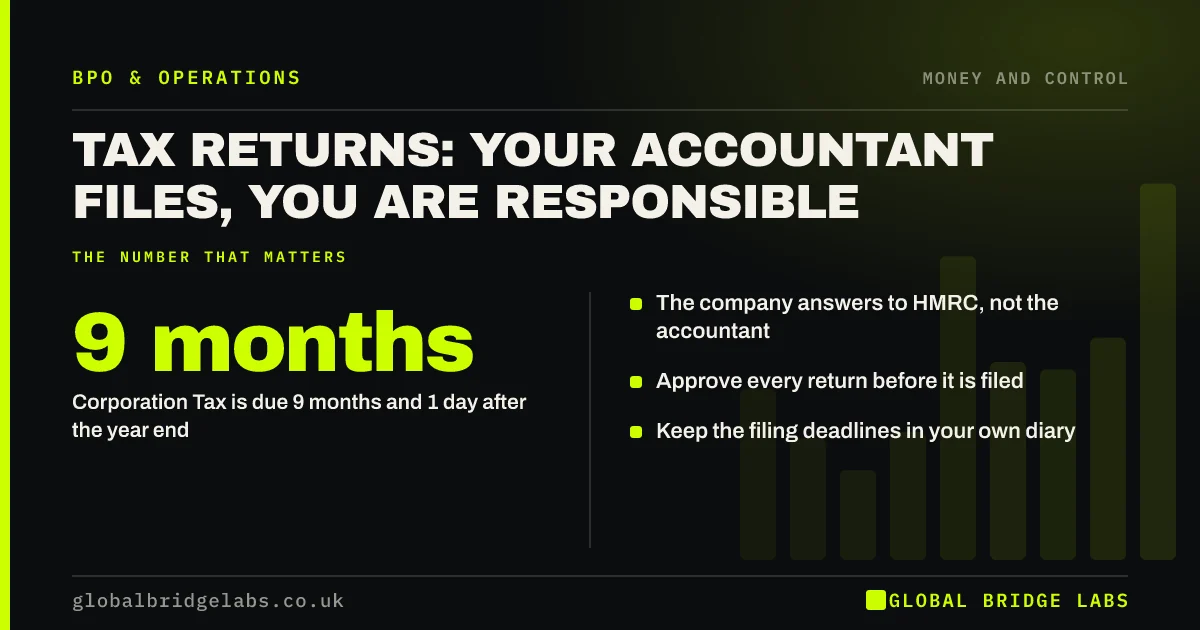
Directors keep responsibility for the company's tax returns even when an accountant prepares and files them. HMRC treats the company as responsible for what it submits and charges penalties for late or careless returns. Outsource the preparation, but read and approve each return, provide complete records on time and keep the deadlines in your own diary.
- The company answers to HMRC, not the accountant.
- Approve every return before it is filed.
- Corporation Tax is due 9 months and 1 day after the year end.
- Keep the filing deadlines in your own diary.
Want your records ready for your accountant every month? Message us on WhatsApp.
Chat on WhatsApp →Who is responsible if the accountant makes a mistake?
The company remains responsible to HMRC for the tax and any penalties. Taking reasonable care, such as giving the accountant complete records and checking the return, can reduce penalties for errors. You may have a claim against the accountant under your engagement terms, but that is a separate matter from what HMRC charges.
What should directors check before approving?
You do not need to be a tax expert to ask sensible questions.
- Do turnover and profit match the management accounts?
- Are large or unusual items explained?
- Are reliefs and allowances claimed ones you recognise?
- Is the tax due in line with what you expected?
Which deadlines should you track yourself?
For a private limited company: annual accounts to Companies House 9 months after the year end, Corporation Tax payment 9 months and 1 day after, the Company Tax Return 12 months after, and VAT returns one month and seven days after each period. Late filing penalties apply automatically.
What can be outsourced safely?
Bookkeeping, reconciliations, year-end preparation, return preparation and filing. These are where an accountant or outsourced finance team adds real value. The approval, the completeness of records and the decision on tax planning choices stay with the directors.
What does this look like in practice?
A pattern we see: records arrive at the accountant in a rush near the deadline, mistakes slip in and nobody checks the return. Monthly bookkeeping by an outsourced team and a 30-minute director review before filing remove most of that risk.
Tax responsibility checklist
- Put all filing and payment deadlines in your diary.
- Keep records complete and up to date monthly.
- Review each return against the accounts.
- Ask about anything you do not recognise.
- Approve the return in writing before filing.
Next step
Find your company's next four tax and filing deadlines and put them in your own diary, with a reminder a month before each.
Message us on WhatsApp, or book a 30-minute consultation.
Chat on WhatsApp →Sources and further reading
Frequently asked questions
Am I responsible if my accountant makes a mistake on my tax return?
Yes, as far as HMRC is concerned. The taxpayer, here the company, is responsible for the return and any tax and penalties. Showing reasonable care, such as providing complete records and checking the return, can reduce penalties, and you may have a separate claim against the accountant.
Should directors check the company tax return?
Yes. Directors should read and approve each return before filing, checking that figures match the management accounts, large items are explained and reliefs claimed are ones they recognise. It is a short review that protects the company from avoidable errors.
When is Corporation Tax due?
For most small companies, Corporation Tax must be paid 9 months and 1 day after the end of the accounting period, and the Company Tax Return filed within 12 months. Larger companies pay in instalments. Check HMRC guidance for your company's dates.
Written by

Global Bridge Labs (GBL) is a UK–Sri Lanka partner for social media, websites and BPO. Everything here comes from client delivery, not theory.