On this page
- 01Key takeaways
- 02Why use a third party for exit interviews?
- 03What should exit interviews ask?
- 04Why does acting on findings stay in-house?
- 05How do you handle leavers' data?
- 06What does this look like in practice?
- 07Exit interview checklist
- 08Next step
- 09Sources and further reading
- 10Frequently asked questions
Key takeaways
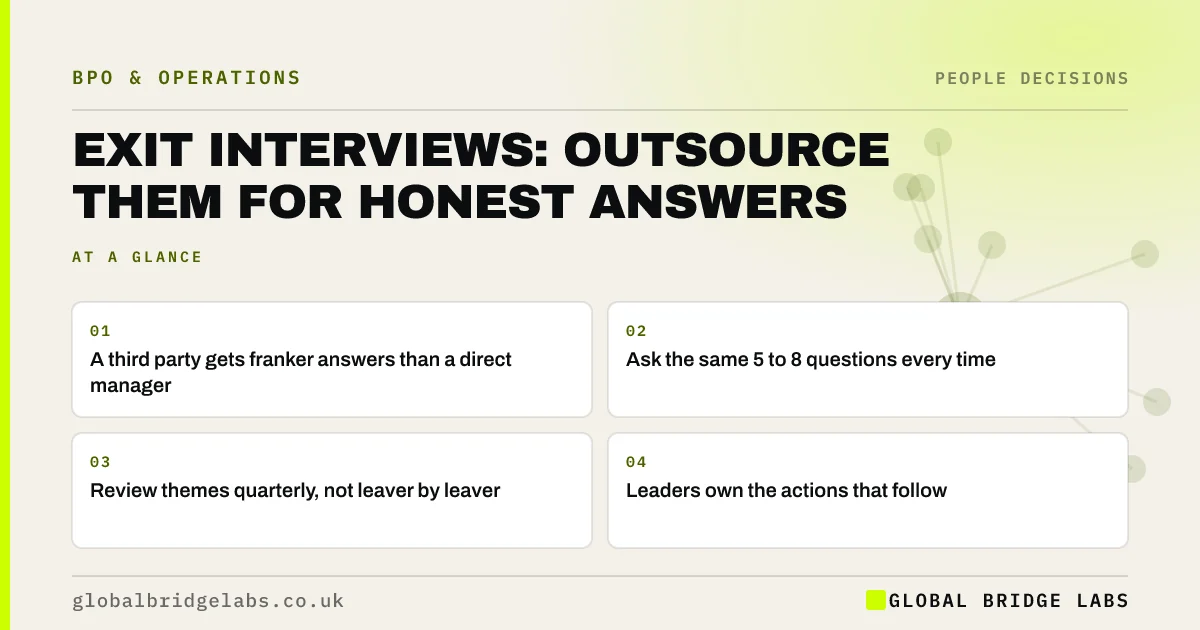
Outsourced exit interviews often get more honest answers, because leavers speak more freely to someone outside their management line. A third party can run the interviews and summarise themes across leavers. Acting on what they find, from a problem manager to a pay gap, stays with the business. Without action, the interviews are wasted.
- A third party gets franker answers than a direct manager.
- Ask the same 5 to 8 questions every time.
- Review themes quarterly, not leaver by leaver.
- Leaders own the actions that follow.
Want exit interviews run and summarised for you? Message us on WhatsApp.
Chat on WhatsApp →Why use a third party for exit interviews?
Leavers rarely criticise their own manager to that manager. They want a reference and a friendly exit. An independent interviewer, by phone or a short online survey, makes it easier to say what really drove the decision. Independence is the point, which is why this is a process worth outsourcing.
What should exit interviews ask?
Keep it short and consistent so you can compare answers.
- What was the main reason you decided to leave?
- What could we have done to keep you?
- How was your relationship with your manager?
- How did pay and benefits compare?
- Would you recommend us as an employer?
Why does acting on findings stay in-house?
Because the fixes are leadership decisions: coaching or moving a manager, changing pay, adjusting workloads. A provider can spot patterns across leavers, but only the business can change the conditions behind them. Share the themes with managers and track whether turnover falls.
How do you handle leavers' data?
Tell leavers how their answers will be used and whether they will be attributed. Store responses securely and report themes rather than quotes when a small team could identify the person. The ICO's employment guidance applies to this information like any other personal data.
What does this look like in practice?
A pattern we see: internal exit interviews record 'better opportunity' for almost everyone. Independent interviews across a year often show a clearer pattern, such as one team or one part of the pay structure, that leaders can address.
Exit interview checklist
- Use a third party or anonymous survey.
- Ask the same short questions every time.
- Explain how answers will be used.
- Review themes quarterly.
- Assign actions to named leaders.
Next step
Look at your last five leavers. If you cannot say why each left, start independent exit interviews with the next one.
Message us on WhatsApp, or book a 30-minute consultation.
Chat on WhatsApp →Sources and further reading
- Employment information · Information Commissioner's Office
- Vacancies and jobs in the UK (latest bulletin) · Office for National Statistics
Frequently asked questions
Should exit interviews be done by a third party?
Often, yes. Leavers tend to be more candid with someone outside their management line, especially about their manager. A third party or anonymous survey can gather honest reasons and report themes, while the business stays responsible for acting on them.
What questions should an exit interview ask?
Ask the main reason for leaving, what could have kept them, how they found their manager, how pay and benefits compared, and whether they would recommend you as an employer. Keep the same five to eight questions so answers can be compared over time.
Are exit interviews confidential?
They should be handled carefully. Tell leavers how answers will be used, store them securely as personal data, and report themes rather than identifiable quotes in a small business. Promising complete anonymity may not be realistic if the team is very small.
Written by

Global Bridge Labs (GBL) is a UK–Sri Lanka partner for social media, websites and BPO. Everything here comes from client delivery, not theory.