On this page
- 01Key takeaways
- 02Why must a leader speak for the business?
- 03What can advisers and providers do?
- 04What should a crisis statement include?
- 05How do you prepare before a crisis?
- 06What does this look like in practice?
- 07Crisis spokesperson checklist
- 08Next step
- 09Sources and further reading
- 10Frequently asked questions
Key takeaways
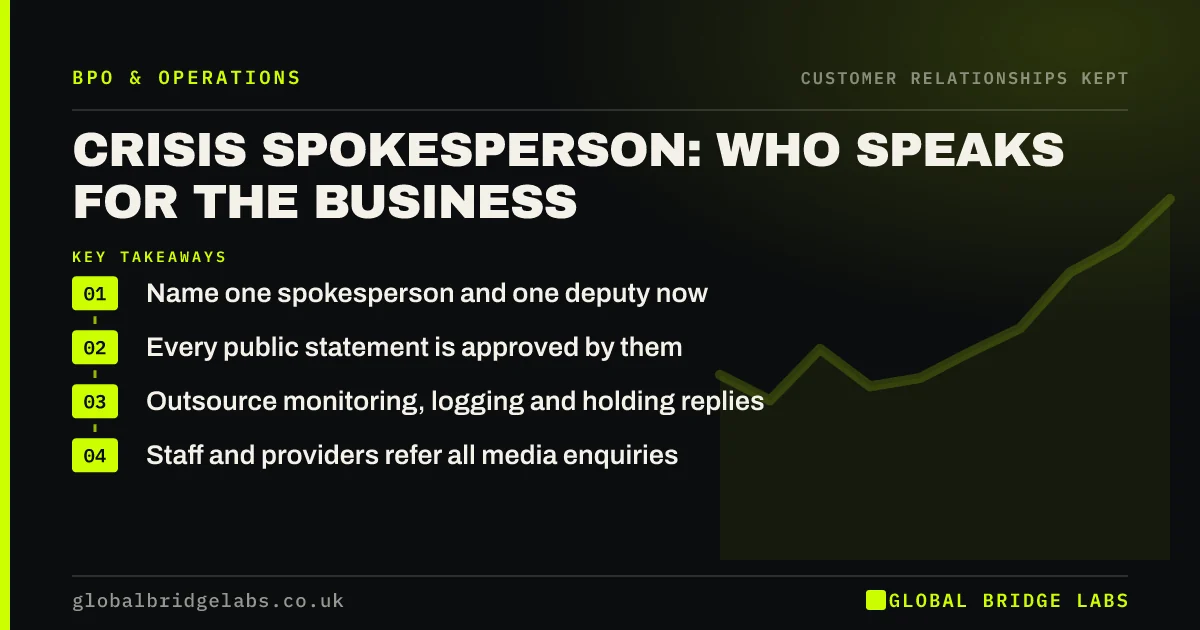
Your business crisis spokesperson should be a named leader, usually the owner or managing director, who approves every public statement. PR advisers can draft and coach, and an outsourced team can monitor channels, log enquiries and send holding replies. Nobody outside the business should speak for it, because statements in a crisis can create legal and reputational commitments.
- Name one spokesperson and one deputy now.
- Every public statement is approved by them.
- Outsource monitoring, logging and holding replies.
- Staff and providers refer all media enquiries.
Want monitoring and holding replies ready for a bad day? Message us on WhatsApp.
Chat on WhatsApp →Why must a leader speak for the business?
Because a crisis statement commits the business: it may admit facts, promise action or affect legal claims. Customers, staff and journalists want to hear from someone accountable. A statement from an agency or a provider looks evasive, and a careless one can make things worse.
What can advisers and providers do?
They make the spokesperson faster and better prepared.
- Draft statements and Q&A for approval.
- Coach the spokesperson for interviews.
- Monitor social media and reviews.
- Log enquiries and send approved holding replies.
- Brief customer service teams on what to say.
What should a crisis statement include?
What happened, as far as you know; who is affected; what you are doing; what people should do; and when you will update. Avoid speculation and blame. Take legal advice where injury, data breaches or regulators are involved, and keep the first statement short.
How do you prepare before a crisis?
Name the spokesperson and deputy, agree who approves statements, prepare holding statements for likely scenarios, and tell staff and providers to refer all media enquiries. A one-page plan reviewed once a year is enough for most SMEs.
What does this look like in practice?
A pattern we see: an employee or agency replies publicly in the first hour and contradicts the owner's later statement. A rule that every public reply goes through one person, with approved holding lines ready, prevents it.
Crisis spokesperson checklist
- Name a spokesperson and deputy.
- Agree statement approval in advance.
- Prepare holding statements.
- Tell staff and providers to refer enquiries.
- Review the plan yearly.
Next step
Write the name of your spokesperson and deputy, and send it to your team and any agencies today.
Message us on WhatsApp, or book a 30-minute consultation.
Chat on WhatsApp →Sources and further reading
- Small Business Guide: response and recovery · National Cyber Security Centre
- Defamation Act 2013 · legislation.gov.uk
Frequently asked questions
Who should speak for a business in a crisis?
A named senior leader, usually the owner or managing director, with a deputy. They approve every public statement. PR advisers can draft and coach, but customers and journalists expect to hear from someone accountable for the business.
Can a PR agency speak on behalf of a business?
An agency can issue statements the business has approved and handle media logistics, but it should not decide what the business says. In a crisis, statements can create legal and reputational commitments, so approval must stay with a named leader.
What should a first crisis statement say?
Briefly state what has happened as far as you know, who is affected, what you are doing about it, what people should do, and when you will update them. Avoid speculation and blame, and take legal advice where injury, data or regulators are involved.
Written by

Global Bridge Labs (GBL) is a UK–Sri Lanka partner for social media, websites and BPO. Everything here comes from client delivery, not theory.