On this page
- 01Key takeaways
- 02Why can't accountability be outsourced?
- 03Which duties stay with your business?
- 04What does a contract actually transfer?
- 05How do you show you are still in control?
- 06What does this look like in practice?
- 07Accountability checklist
- 08Next step
- 09Sources and further reading
- 10Frequently asked questions
Key takeaways
Accountability cannot be outsourced: a contract can move work and share some financial risk, but regulators, customers and courts still look to your business. Directors stay responsible for filings, employers for right to work and pay, data controllers for personal data, and FCA firms for outsourced functions. Keep oversight, evidence and a named owner for every outsourced process.
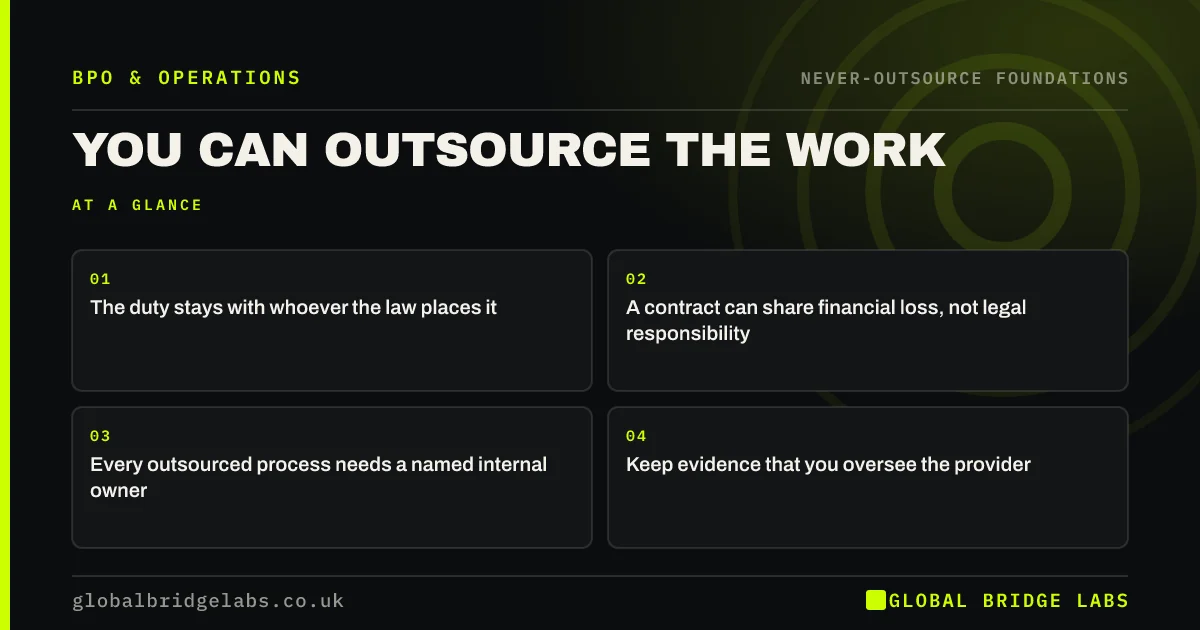
- The duty stays with whoever the law places it on.
- A contract can share financial loss, not legal responsibility.
- Every outsourced process needs a named internal owner.
- Keep evidence that you oversee the provider.
Want to check where accountability sits in your outsourcing? Message us on WhatsApp.
Chat on WhatsApp →Why can't accountability be outsourced?
Because the law attaches duties to roles, not to whoever does the work. UK GDPR makes the controller accountable for showing compliance, even when a processor handles the data. HMRC holds the employer responsible for payroll filings made by a bureau. Directors answer for company filings their accountant submits. The provider may owe you damages; it does not take your place.
Which duties stay with your business?
The common ones for UK SMEs are below. Each can have its work outsourced, with oversight kept in-house.
- Data protection as controller, including breach decisions.
- Payroll, PAYE and pension duties as employer.
- Right to work checks before employment starts.
- Company filings and accounts as directors.
- Health and safety as employer.
- Regulatory duties, such as FCA, SRA, CQC or anti-money laundering rules.
What does a contract actually transfer?
Work, service levels and, through indemnities and liability caps, some of the financial loss. That is valuable: it gives you leverage and recovery. But the regulator's fine, the customer's complaint and the director's personal exposure land on you first. Treat indemnities as a cushion, not a transfer.
Want a short list of accountability clauses for your contract? Message us on WhatsApp.
Chat on WhatsApp →How do you show you are still in control?
Name an internal owner for each outsourced process, review a sample of the work each month, keep reports and meeting notes, and make sure you can get your data and records back at any time. Regulators typically ask what oversight you had, not just what the contract said.
What does this look like in practice?
A pattern we see: a business assumes its payroll provider 'handles compliance'. When a pension contribution is missed, The Pensions Regulator contacts the employer. Firms that keep a monthly sign-off and a simple exceptions report spot these issues before the regulator does.
Accountability checklist
- List the legal duties attached to each outsourced process.
- Name an internal owner for each duty.
- Review a sample of outsourced work monthly.
- Keep records of oversight and decisions.
- Check you can retrieve data and records on demand.
Next step
Take your largest outsourced process and write down who in your business would answer the regulator's first question about it. If nobody comes to mind, that is the gap to close.
Message us on WhatsApp, or book a 30-minute consultation.
Chat on WhatsApp →Sources and further reading
- Controllers and processors · Information Commissioner's Office
- FCA Handbook SYSC 8: Outsourcing · Financial Conduct Authority
- Being a company director · GOV.UK
Frequently asked questions
Can you outsource responsibility?
You can outsource tasks and some financial risk, but not legal responsibility. Duties fall on the employer, director, data controller or regulated firm, whoever does the work. A provider can be liable to you under the contract, but regulators and customers will still hold your business to account.
Who is liable if an outsourcing provider makes a mistake?
Usually your business is liable to customers and regulators first. You may then be able to recover losses from the provider under the contract, depending on its indemnities and liability caps. That is why oversight, sampling and clear contract terms matter as much as choosing a good provider.
Does outsourcing reduce compliance risk?
It can, if the provider is more expert and consistent than your team. It cannot remove your legal duties. Compliance risk falls when you combine a capable provider with clear instructions, a named internal owner and regular checks; it rises when you assume the provider handles everything.
Written by

Global Bridge Labs (GBL) is a UK–Sri Lanka partner for social media, websites and BPO. Everything here comes from client delivery, not theory.