On this page
Key takeaways
Source code ownership must be settled before work starts. In UK law, copyright in code written by an outside contractor usually belongs to the contractor unless the contract assigns it to you. Get a written assignment, keep repositories in an account your business owns, and require documentation and credentials at every release.
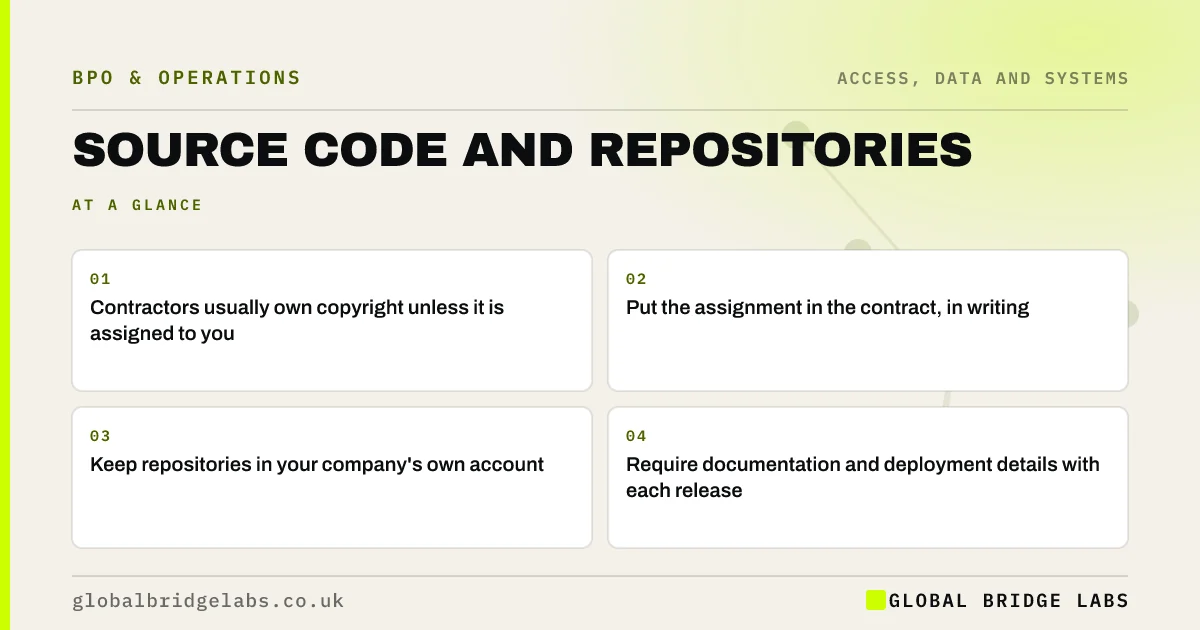
- Contractors usually own copyright unless it is assigned to you.
- Put the assignment in the contract, in writing.
- Keep repositories in your company's own account.
- Require documentation and deployment details with each release.
Want a checklist for code ownership in a development contract? Message us on WhatsApp.
Chat on WhatsApp →Why is code ownership a never-outsource issue?
Because without ownership you cannot change provider, sell the business cleanly or fix urgent problems yourself. Buyers and investors check who owns the code. A developer can build it; the business must own it and be able to access it at any time.
What does copyright law say?
Under the Copyright, Designs and Patents Act 1988, work made by an employee in the course of employment belongs to the employer. Work made by a contractor or agency belongs to them unless there is a written assignment. A licence to use the code is weaker than ownership.
What should you control?
The essentials that let anyone else take over.
- The code repository account.
- Hosting and cloud accounts.
- Domain and DNS settings.
- Deployment instructions and credentials.
- Licences for third-party components.
How do you check you could switch developers?
Ask a second developer to review the repository and documentation and say whether they could deploy a change. If not, fix the gaps while the relationship is good. Test the handover before you need it.
What does this look like in practice?
A pattern we see: a business's app lives in a former developer's personal repository. Moving it to a company account and documenting deployment takes days; recovering it after a dispute can take months.
Code ownership checklist
- Assign copyright to your business in writing.
- Hold repositories in a company account.
- Own hosting, domain and cloud accounts.
- Require documentation each release.
- Test that another developer could take over.
Next step
Check your development contract for the word 'assign'. If it only grants a licence, ask for an assignment now.
Message us on WhatsApp, or book a 30-minute consultation.
Chat on WhatsApp →Sources and further reading
- How copyright protects your work · GOV.UK
- Register a trade mark · GOV.UK
Frequently asked questions
Who owns the code a contractor writes?
In the UK, copyright in code written by an independent contractor or agency usually belongs to them unless the contract assigns it to you in writing. Code written by employees in the course of their job belongs to the employer.
Should I own the code repository?
Yes. Keep the repository in an account your business owns and administers, with developers added as users. This means you can access the code, change providers and show buyers or investors that the business controls its software.
What is the difference between a licence and an assignment?
An assignment transfers ownership of the copyright to you. A licence only gives you permission to use the code on certain terms, while the developer keeps ownership. For bespoke work central to your business, an assignment is usually the safer choice.
Written by

Global Bridge Labs (GBL) is a UK–Sri Lanka partner for social media, websites and BPO. Everything here comes from client delivery, not theory.