On this page
- 01Key takeaways
- 02Why should founders own investor relations?
- 03What goes in a good investor update?
- 04What investor admin can be outsourced?
- 05How should bad news be handled?
- 06What does this look like in practice?
- 07Investor relations checklist
- 08Next step
- 09Sources and further reading
- 10Frequently asked questions
Key takeaways
Investor relations in a small business is the founders' job. Investors back people as much as plans, and they expect to hear from the founders directly, especially when news is bad. An outsourced team can prepare the numbers for updates, maintain the share register and cap table, and manage meeting admin. The message and the relationship stay with you.
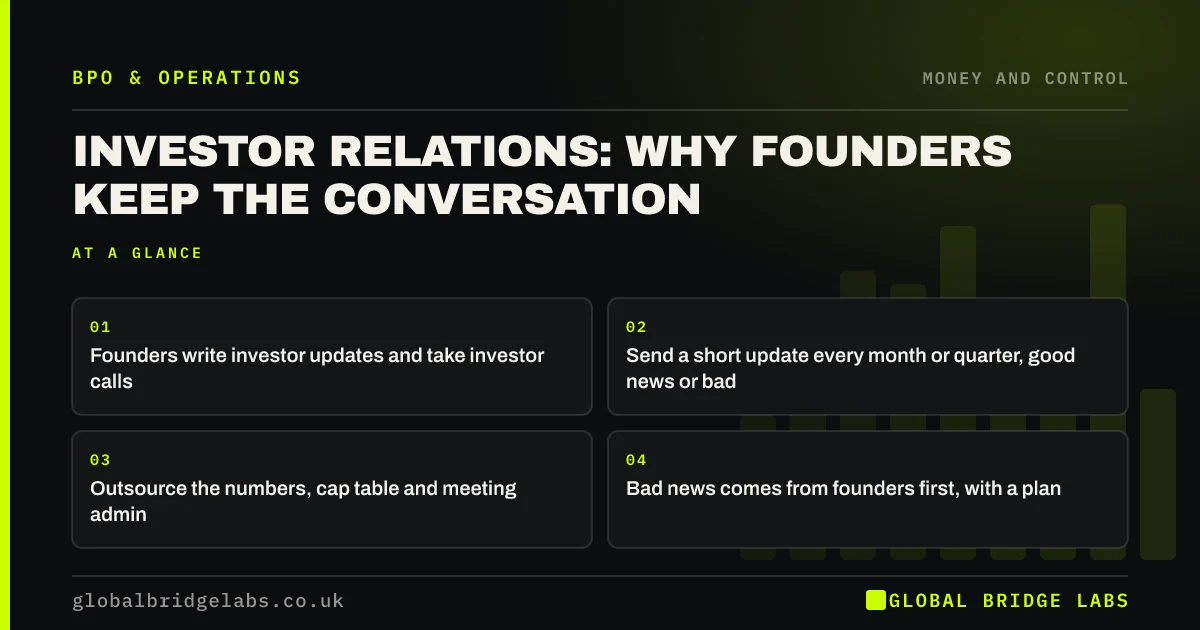
- Founders write investor updates and take investor calls.
- Send a short update every month or quarter, good news or bad.
- Outsource the numbers, cap table and meeting admin.
- Bad news comes from founders first, with a plan.
Want your investor update numbers prepared each month? Message us on WhatsApp.
Chat on WhatsApp →Why should founders own investor relations?
Because trust is the asset. Investors judge whether founders are candid, in control and learning. An update that reads like it came from a provider tells them the founders are distant. And when the business needs more money, the investors most likely to help are those who have heard from the founders all along.
What goes in a good investor update?
Keep it to one page and send it on a schedule.
- Headline numbers: revenue, cash and runway.
- Progress against the goals you shared last time.
- What went wrong and what you are doing about it.
- Specific asks: introductions, hires, advice.
What investor admin can be outsourced?
Preparing the numbers and charts, maintaining the cap table and share register, tracking investor documents and consents, scheduling meetings and filing records such as share allotments at Companies House on time. These are precise, deadline-driven tasks that suit a provider working to your instructions.
How should bad news be handled?
Early, directly and with a plan. Call key investors before the written update, explain what happened, what you have learned and what you need. Investors are rarely surprised by problems; they are surprised by silence.
What does this look like in practice?
A pattern we see: founders skip updates when numbers are poor, and investors assume the worst. Founders who send a short update every month, with numbers prepared by an outsourced finance team, keep goodwill through difficult quarters.
Investor relations checklist
- Set an update schedule and keep to it.
- Founders write the narrative.
- Outsource numbers, cap table and filings.
- Call key investors before sharing bad news.
- Include specific asks in every update.
Next step
If you have not sent an investor update in three months, send a short one this week. Numbers, progress, problems and asks.
Message us on WhatsApp, or book a 30-minute consultation.
Chat on WhatsApp →Sources and further reading
- Companies Act 2006, Part 10, Chapter 2: general duties of directors · legislation.gov.uk
- Confirmation statement guidance · Companies House
Frequently asked questions
How often should you update investors?
Monthly for early-stage companies with active investors, or quarterly for more established businesses. Consistency matters more than frequency: a short, regular update with numbers, progress, problems and asks builds trust, especially when results are disappointing.
Can you outsource investor relations?
You can outsource the admin: preparing numbers and charts, maintaining the cap table and share register, scheduling meetings and filing documents. The relationship and the message should stay with the founders, because investors judge the people as much as the numbers.
What should an investor update include?
Key numbers such as revenue, cash and runway, progress against previously shared goals, honest commentary on what went wrong and what you are doing about it, and specific requests for help, such as introductions or advice.
Written by

Global Bridge Labs (GBL) is a UK–Sri Lanka partner for social media, websites and BPO. Everything here comes from client delivery, not theory.