On this page
Key takeaways
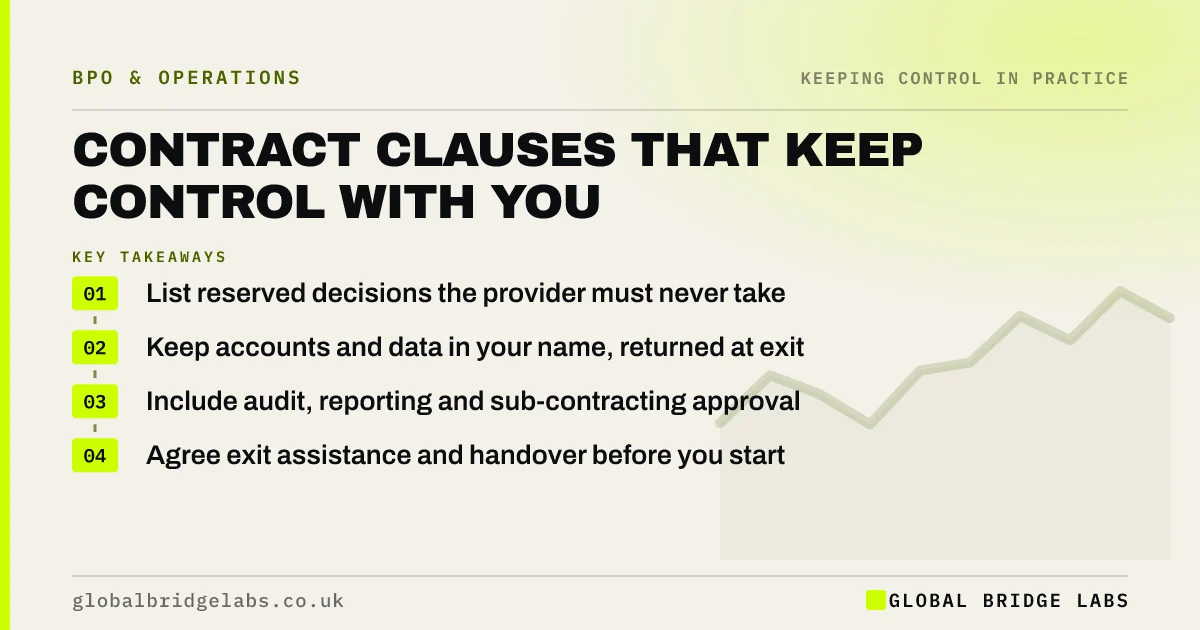
Outsourcing contract control clauses make sure the decisions, data and keys stay yours. The essential ones are reserved decisions, system access and account ownership, data protection and return, audit and reporting, intellectual property, sub-contracting approval and exit assistance. Agree them before signing; they are hard to add later.
- List reserved decisions the provider must never take.
- Keep accounts and data in your name, returned at exit.
- Include audit, reporting and sub-contracting approval.
- Agree exit assistance and handover before you start.
Want a short list of control clauses to raise with your provider? Message us on WhatsApp.
Chat on WhatsApp →Why do control clauses matter?
Because a contract is where boundaries become enforceable. Without them, the provider's standard terms decide who owns data, what happens at exit and whether you can check their work. With them, you can switch providers, satisfy regulators and keep decisions where they belong.
Which clauses keep control?
Ask for these in every outsourcing contract.
- Reserved decisions and red lines.
- Accounts and systems held in your name.
- UK GDPR processor terms and data return.
- Reporting, audit and inspection rights.
- Intellectual property assigned to you.
- Your approval for sub-contractors.
- Exit assistance and handover.
What should the exit clause say?
That the provider will return all data and documents in a usable format, hand over process documentation, support transition for an agreed period at agreed rates, and remove its access on the exit date. An exit plan agreed at the start is far easier than one negotiated in a dispute.
Are there legal minimums?
Yes, for some arrangements. UK GDPR requires specific processor terms. FCA-regulated firms must meet SYSC 8 expectations, including access for the regulator. TUPE may apply where staff transfer. Take legal advice for anything regulated or large.
What does this look like in practice?
A pattern we see: small businesses sign a provider's standard terms without an exit clause, then struggle to get their data back. Raising five or six control clauses before signing is usually accepted by good providers without fuss.
Control clauses checklist
- Attach your keep list as reserved decisions.
- Confirm account and data ownership.
- Include processor terms and audit rights.
- Require approval of sub-contractors.
- Agree exit assistance and data return.
Next step
Open your largest outsourcing contract and search for 'exit' and 'return of data'. If neither appears, raise them at the next review.
Message us on WhatsApp, or book a 30-minute consultation.
Chat on WhatsApp →Sources and further reading
- Contracts and liabilities between controllers and processors · Information Commissioner's Office
- FCA Handbook SYSC 8: Outsourcing · Financial Conduct Authority
Frequently asked questions
What clauses should an outsourcing contract include?
Scope and service levels, reserved decisions, account and data ownership, UK GDPR processor terms, confidentiality, reporting and audit rights, intellectual property assignment, approval of sub-contractors, liability, termination and exit assistance with data return.
What is an exit clause in an outsourcing contract?
It sets out what happens when the contract ends: returning data and documents in a usable format, handing over process documentation, supporting the transition for an agreed period and removing the provider's access. It prevents being trapped with a provider.
What are reserved matters in outsourcing?
They are decisions the client keeps and the provider must not take without approval, such as releasing payments, agreeing contract terms, offering discounts above limits or speaking publicly for the business. Listing them in the contract makes the boundary enforceable.
Written by

Global Bridge Labs (GBL) is a UK–Sri Lanka partner for social media, websites and BPO. Everything here comes from client delivery, not theory.