On this page
- 01Key takeaways
- 02Why must investment decisions stay with the owners?
- 03What analysis can be outsourced?
- 04How do you compare investment options?
- 05When should owners take outside advice?
- 06What does this look like in practice?
- 07Capital allocation checklist
- 08Next step
- 09Sources and further reading
- 10Frequently asked questions
Key takeaways
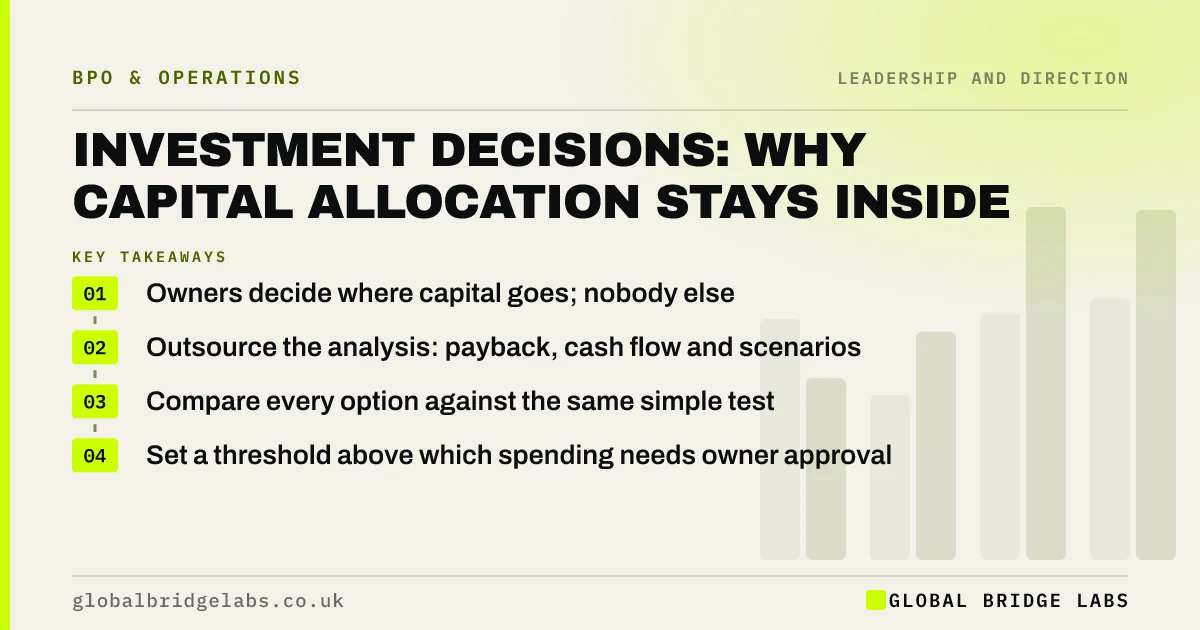
Capital allocation in a small business means deciding where spare cash goes: new equipment, hires, a new location, paying down debt or paying out to owners. These decisions shape the business for years and must stay with the owners. An outsourced finance team can prepare the numbers: payback, cash flow impact and scenarios.
- Owners decide where capital goes; nobody else.
- Outsource the analysis: payback, cash flow and scenarios.
- Compare every option against the same simple test.
- Set a threshold above which spending needs owner approval.
Want a simple investment case template? Message us on WhatsApp.
Chat on WhatsApp →Why must investment decisions stay with the owners?
Because they commit the business's money and often its future. A new machine, a second site or a large hire cannot easily be undone, and the owners carry the risk if the cash runs short. Directors must also weigh creditors' interests when cash is tight. A provider can advise, but only owners can weigh the trade-offs against their own goals.
What analysis can be outsourced?
The number work that makes a decision better informed.
- Payback period and return on investment.
- Cash flow impact over 12 to 24 months.
- Best, expected and worst case scenarios.
- Financing options compared.
- Post-investment tracking against the case.
How do you compare investment options?
Use one simple, consistent case for each: what it costs, what it returns, when it pays back, what happens to cash at the lowest point, and what could go wrong. Comparing options side by side stops the loudest idea winning by default.
When should owners take outside advice?
For large or unfamiliar commitments: borrowing secured on assets, buying property, buying a business or taking investment. An accountant or adviser can test the case. The decision and the personal guarantees, if any, remain the owners'.
What does this look like in practice?
A pattern we see: owners approve spending one item at a time and only see the total at year end. A short investment case for anything above a threshold, prepared by an outsourced finance team, lets them compare options before committing.
Capital allocation checklist
- Set an approval threshold for capital spending.
- Use one case format for every option.
- Show payback, cash low point and risks.
- Decide as owners, with advice for large items.
- Track results against the case after 12 months.
Next step
List the investments you are considering this year and write a one-paragraph case for each. If you cannot compare them, you need a standard format first.
Message us on WhatsApp, or book a 30-minute consultation.
Chat on WhatsApp →Sources and further reading
- Companies Act 2006, Part 10, Chapter 2: general duties of directors · legislation.gov.uk
- The Green Book: appraisal and evaluation in central government · HM Treasury
Frequently asked questions
Who should make investment decisions in a small business?
The owners or directors. Investment decisions commit cash and often shape the business for years, so they belong with the people who carry the risk. Accountants and outsourced finance teams can prepare the analysis, but they should not make the call.
How do small businesses decide what to invest in?
By comparing each option on the same basis: cost, expected return, payback period, effect on cash flow and main risks. Ranking options side by side against the business's goals helps owners choose, rather than approving whichever idea is proposed first.
Can an outsourced finance team help with investment decisions?
Yes, by building payback and cash flow models, running scenarios, comparing financing options and tracking results afterwards. They make the decision better informed. The decision itself, and any personal guarantees, stay with the owners.
Written by

Global Bridge Labs (GBL) is a UK–Sri Lanka partner for social media, websites and BPO. Everything here comes from client delivery, not theory.