On this page
- 01Key takeaways
- 02Why should payment authority never be outsourced?
- 03How should payment roles be split?
- 04What belongs in a bank mandate review?
- 05What can a provider see and do?
- 06What does this look like in practice?
- 07Payment authority checklist
- 08Next step
- 09Sources and further reading
- 10Frequently asked questions
Key takeaways
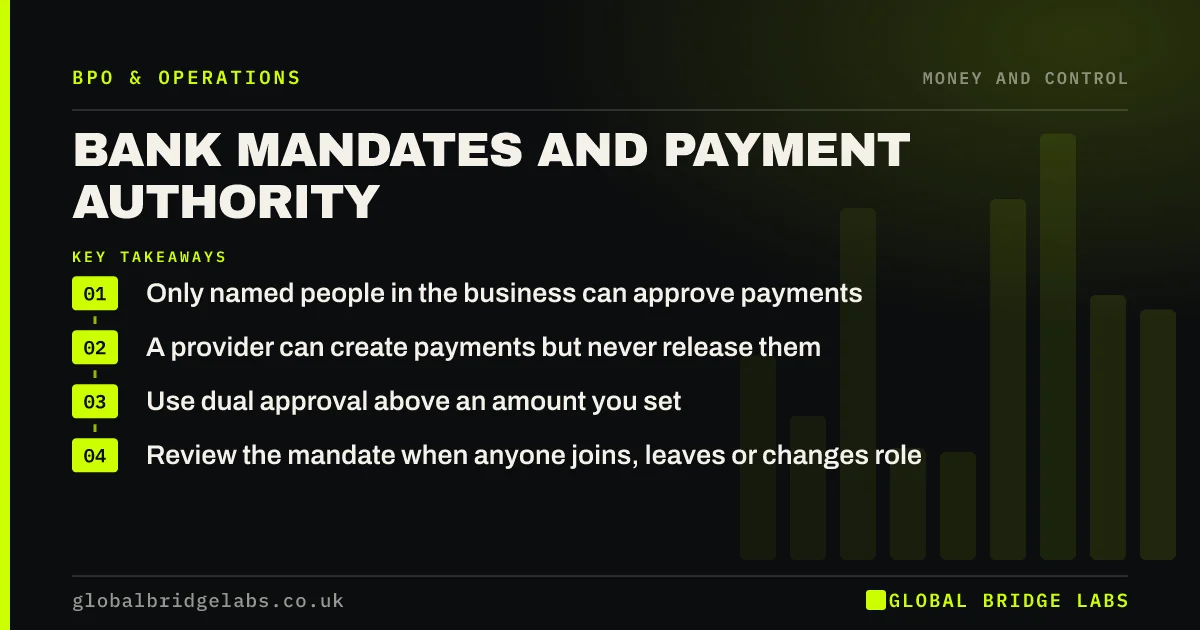
Your bank mandate says who can operate the business account and release payments. Signatories and payment approvers should always be named people in your business, never an outsourced provider. A provider can prepare payment batches and upload them for approval. Use dual authorisation above a set amount, and review the mandate whenever someone joins or leaves.
- Only named people in the business can approve payments.
- A provider can create payments but never release them.
- Use dual approval above an amount you set.
- Review the mandate when anyone joins, leaves or changes role.
Want your payment process set up so a provider prepares and you approve? Message us on WhatsApp.
Chat on WhatsApp →Why should payment authority never be outsourced?
Because whoever can release payments controls your cash. A provider with approval rights could pay a fraudulent invoice, overpay a supplier or empty an account by mistake, and recovering money after it leaves is slow and uncertain. Keeping release rights in-house also means every payment has been seen by someone who cares about the business.
How should payment roles be split?
Most business banking platforms let you set separate roles for creating and approving payments. Use them.
- Provider: matches invoices, prepares and uploads the batch.
- Manager: checks the batch against approved invoices.
- Director: releases payments, with a second approver above a limit.
- Nobody: approves a payment they created.
What belongs in a bank mandate review?
Check the list of signatories and online banking users against current staff, confirm each person's limits and roles, remove anyone who has left, and make sure at least two people can approve, so payments do not stop when one is on holiday. Keep a record of the review.
What can a provider see and do?
A provider can usually have view access to statements for reconciliation and create-only access for payments. They should never be able to add new payees without approval or change supplier bank details. These limits should be set in the bank's system, not just agreed in writing.
What does this look like in practice?
A pattern we see: one director holds the only approval rights and payments stall during their holiday. Adding a second approver and moving batch preparation to a provider keeps payments on time without widening who can release money.
Payment authority checklist
- List every signatory and online banking user.
- Separate create and approve roles.
- Set dual approval above a chosen amount.
- Give providers create-only and view access.
- Review the mandate when people change.
Next step
Log in to your business banking and list who can approve payments today. If anyone outside the business appears, or anyone who has left, fix it this week.
Message us on WhatsApp, or book a 30-minute consultation.
Chat on WhatsApp →Sources and further reading
- Small Business Guide: cyber security · National Cyber Security Centre
- Cyber security breaches survey 2025/2026 · DSIT and Home Office
Frequently asked questions
Should an outsourced bookkeeper be able to make payments?
They can prepare and upload payments, but should not be able to release them. Use your bank's separate roles so the bookkeeper creates payment batches and a named person in your business approves them, with a second approver above a set amount.
What is a bank mandate?
A bank mandate is the instruction to your bank setting out who can operate the business account, sign or approve payments and within what limits. It should list named people in your business and be reviewed whenever someone joins, leaves or changes role.
What is dual authorisation for payments?
Dual authorisation means two people must approve a payment before it is released, usually above a set amount. It reduces the risk of fraud and error, and most UK business banking platforms support it with separate roles for creating and approving payments.
Written by

Global Bridge Labs (GBL) is a UK–Sri Lanka partner for social media, websites and BPO. Everything here comes from client delivery, not theory.