On this page
Key takeaways
Succession planning in a small business decides who could step into each key role, including the owner's, and what they need to learn first. Owners must lead it, because it involves judgements about people and the future of the business. Outsourced teams can document processes, build knowledge bases and keep records that make any handover easier.
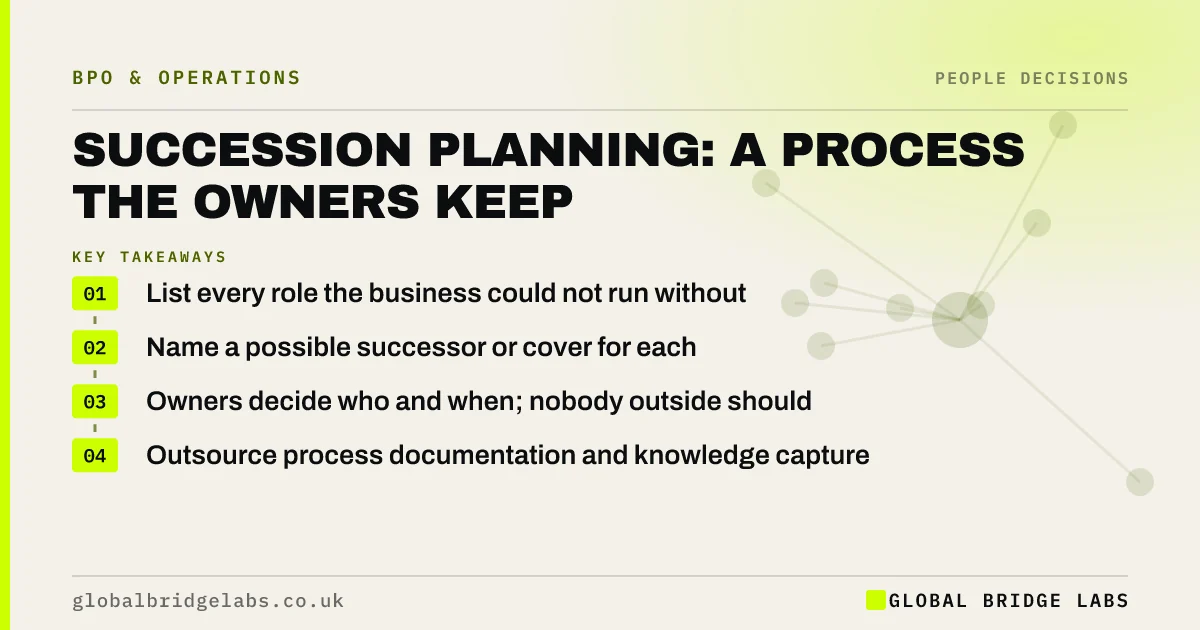
- List every role the business could not run without.
- Name a possible successor or cover for each.
- Owners decide who and when; nobody outside should.
- Outsource process documentation and knowledge capture.
Want key processes documented so they do not depend on one person? Message us on WhatsApp.
Chat on WhatsApp →Why must owners lead succession planning?
Because it involves confidential judgements about people's potential, the owner's own plans and the long-term future of the business. These conversations need trust and discretion. An adviser can structure the process; only the owners can decide who is ready and when to tell them.
How do you start a succession plan?
Begin with risk, not titles.
- List roles where one person holds critical knowledge.
- Rate how hard each would be to replace.
- Name an internal successor or external cover.
- Write what each successor needs to learn.
- Set a timeline and review it yearly.
What can be outsourced?
Capturing knowledge so it does not leave with a person: documenting processes, recording video walkthroughs, building an internal knowledge base and keeping contract, supplier and customer records complete. This work makes succession possible; it does not decide it.
What about the owner's own succession?
Plan it years ahead. Whether you intend to sell, pass the business to family or hand it to managers, a business that runs without the owner is worth more and is easier to transfer. Reducing owner-only admin is the first step.
What does this look like in practice?
A pattern we see: a long-serving manager leaves and nobody knows how key processes work. Businesses that documented those processes in advance, often with outsourced help, recover in weeks instead of months.
Succession planning checklist
- List roles with single-person knowledge.
- Name a successor or cover for each.
- Document key processes and records.
- Plan the owner's own succession.
- Review the plan every year.
Next step
Ask: if your most knowledgeable person left tomorrow, what would stop? Document that first.
Message us on WhatsApp, or book a 30-minute consultation.
Chat on WhatsApp →Sources and further reading
- Being a company director · GOV.UK
- Business population estimates for the UK and regions 2025 · Department for Business and Trade
Frequently asked questions
What is succession planning in a small business?
It is planning who could step into each key role, including the owner's, if the current person leaves, retires or is unavailable, and what they need to learn first. It also covers documenting knowledge so the business does not depend on one person.
Who should be involved in succession planning?
The owners lead it, because it involves confidential judgements about people and the future of the business. Advisers such as accountants or solicitors help with ownership transfer, and managers contribute knowledge about roles and skills.
Can outsourcing help with succession planning?
Yes. Documenting processes, building knowledge bases and keeping records complete reduce dependence on individuals. Outsourcing routine work also frees owners and managers to develop successors, which is often what small businesses lack time for.
Written by

Global Bridge Labs (GBL) is a UK–Sri Lanka partner for social media, websites and BPO. Everything here comes from client delivery, not theory.