On this page
- 01Key takeaways
- 02Why must safeguarding leadership stay inside?
- 03What can external support provide?
- 04Can safeguarding admin be outsourced?
- 05Who is ultimately responsible?
- 06What does this look like in practice?
- 07Safeguarding lead checklist
- 08Next step
- 09Sources and further reading
- 10Frequently asked questions
Key takeaways
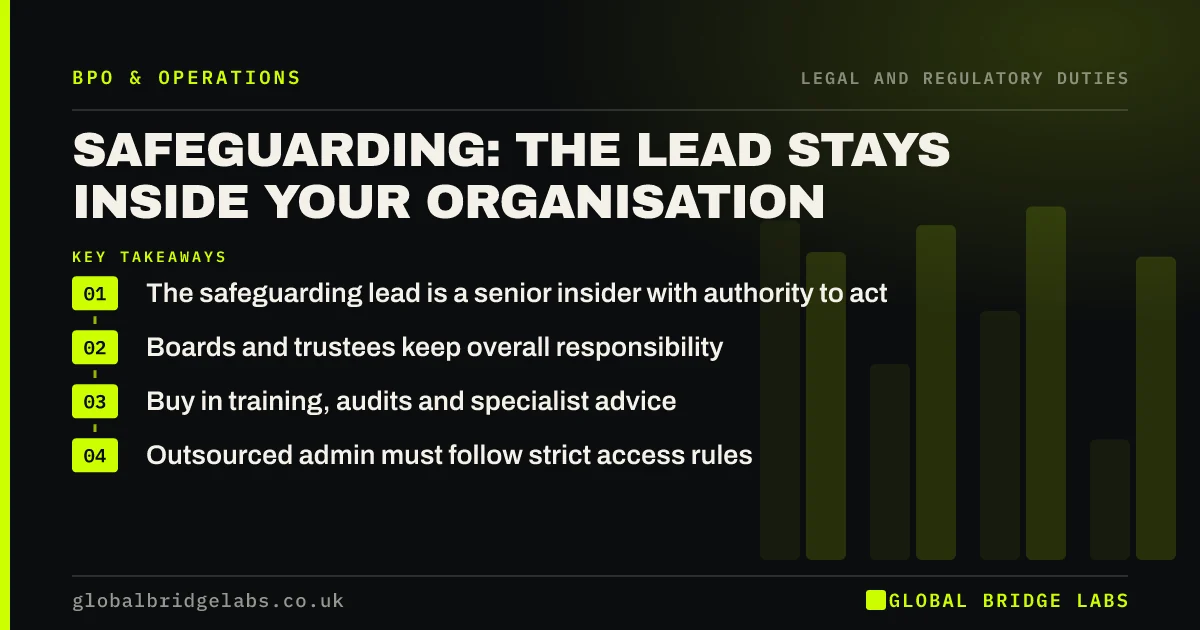
A designated safeguarding lead should be a senior person inside the organisation, with the authority and knowledge to act on concerns about children or adults at risk. In schools and colleges, statutory guidance expects the lead to come from the senior leadership team. External specialists can train, audit and advise; outsourced teams can keep records under strict controls.
- The safeguarding lead is a senior insider with authority to act.
- Boards and trustees keep overall responsibility.
- Buy in training, audits and specialist advice.
- Outsourced admin must follow strict access rules.
Want admin support that respects safeguarding rules? Message us on WhatsApp.
Chat on WhatsApp →Why must safeguarding leadership stay inside?
Because concerns need immediate, informed action by someone who knows the people involved and can make decisions, such as referring to the local authority or police and changing staff arrangements. An external adviser cannot be present when a child or adult discloses harm, or hold the authority to act on the spot.
What can external support provide?
Specialist expertise that small organisations rarely hold.
- Safeguarding training for staff and volunteers.
- Policy reviews and audits.
- Advice on complex cases.
- Supervision for the safeguarding lead.
Can safeguarding admin be outsourced?
Some can, such as tracking training renewals, DBS check dates and policy acknowledgements. Records of concerns are highly sensitive and should stay in tightly controlled systems with access limited to people who need it. Check sector guidance before moving anything.
Who is ultimately responsible?
The board, trustees or proprietors, depending on the organisation. They appoint the lead, make sure policies work and review safeguarding regularly. Charity trustees, for example, are expected to take reasonable steps to protect people who come into contact with the charity.
What does this look like in practice?
A pattern we see: a small organisation names a part-time administrator as safeguarding lead because they keep the records. Moving the role to a senior person, with admin support behind them, gives the lead the authority the role needs.
Safeguarding lead checklist
- Appoint a senior insider as lead.
- Name a deputy.
- Buy in training and supervision.
- Restrict access to concern records.
- Have the board review safeguarding yearly.
Next step
Check that your safeguarding lead has the seniority to act without waiting for permission. If not, change the appointment.
Message us on WhatsApp, or book a 30-minute consultation.
Chat on WhatsApp →Sources and further reading
- Keeping children safe in education · Department for Education
- The essential trustee: what you need to know, what you need to do (CC3) · Charity Commission
Frequently asked questions
Can the designated safeguarding lead be external?
Statutory guidance for schools and colleges expects the designated safeguarding lead to be a member of the senior leadership team. Other organisations should also appoint a senior insider who can act quickly. External specialists can support the lead with training, advice and supervision.
What does a safeguarding lead do?
They receive and act on concerns, make referrals to local authorities or police where needed, keep secure records, make sure staff are trained, and advise leaders on safeguarding policy and practice.
Who is responsible for safeguarding in a charity?
The trustees are responsible for making sure the charity has suitable safeguarding policies and procedures and takes reasonable steps to protect people. They usually appoint a safeguarding lead to manage day-to-day concerns.
Written by

Global Bridge Labs (GBL) is a UK–Sri Lanka partner for social media, websites and BPO. Everything here comes from client delivery, not theory.