On this page
Key takeaways
Fraud prevention in a small business rests on a few checks that must stay in-house: verifying any change of bank details by phone to a known number, approving payments separately from preparing them, controlling admin access and reviewing unusual transactions. Outsourced teams follow these checks and flag concerns; the business owns them and makes the final call.
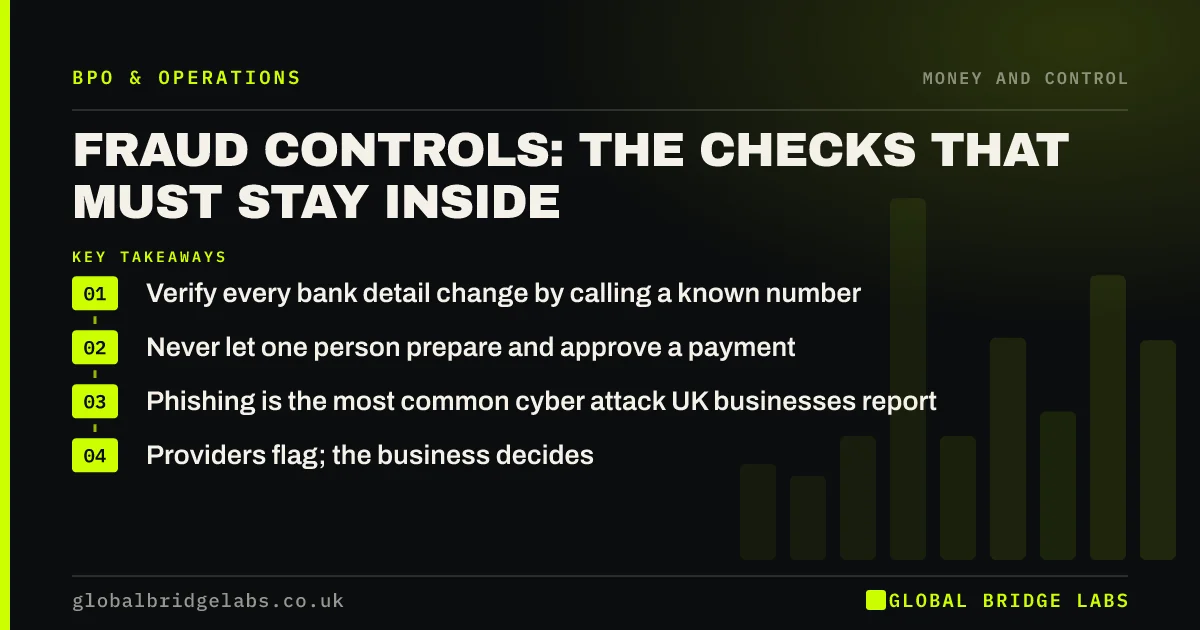
- Verify every bank detail change by calling a known number.
- Never let one person prepare and approve a payment.
- Phishing is the most common cyber attack UK businesses report.
- Providers flag; the business decides.
Want your payment process checked for fraud gaps? Message us on WhatsApp.
Chat on WhatsApp →Why must fraud checks stay in the business?
Because fraudsters target whoever can move money or change payee details, and an outsourced team is another route in. Keeping the final checks inside means a criminal must fool both the provider and someone who knows your suppliers and staff. It also keeps responsibility for losses where the authority is.
Which frauds hit small businesses most?
The UK government's Cyber Security Breaches Survey consistently finds phishing is the most common type of attack businesses identify. In finance, it often appears as fake supplier invoices, bank detail change requests and emails impersonating a director asking for an urgent payment.
- Fake bank detail change requests from 'suppliers'.
- Emails impersonating a director asking for urgent payment.
- Fake invoices for goods never ordered.
- Payroll diversion through changed employee bank details.
Which checks stay in-house?
The ones that need knowledge or authority only the business has.
- Approving bank detail changes after a call-back.
- Releasing payments, with dual approval above a limit.
- Approving new suppliers.
- Granting and removing system access.
- Reviewing the monthly exceptions report.
What should an outsourced team do?
Follow the checks every time, never act on urgency alone, flag any request that changes payee details or bypasses the normal process, and keep an audit trail. A good provider trains staff to recognise these frauds and will thank you for strict rules.
What does this look like in practice?
A pattern we see: an email from a 'supplier' asks to update bank details before a large payment. Where the rule is a call-back to the number already on file, approved by a manager, the fraud stops at the first step.
Fraud controls checklist
- Call back on a known number for any bank change.
- Separate payment preparation and approval.
- Use dual approval above a limit.
- Turn on email authentication and multi-factor login.
- Review exceptions monthly.
Next step
Ask your team, and your provider, what they would do if a supplier emailed new bank details today. If the answer is not 'call the number on file', write the rule this week.
Message us on WhatsApp, or book a 30-minute consultation.
Chat on WhatsApp →Sources and further reading
- Cyber security breaches survey 2025/2026 · DSIT and Home Office
- Email security and anti-spoofing · National Cyber Security Centre
Frequently asked questions
How can a small business prevent payment fraud?
Verify any change of bank details by calling the supplier or employee on a number you already hold, separate preparing and approving payments, use dual approval above a set amount, turn on multi-factor authentication and email security, and review unusual transactions monthly.
What is the most common fraud against small businesses?
Phishing is the most common cyber attack UK businesses report in the government's Cyber Security Breaches Survey. In finance, it often leads to fake bank detail changes, fake invoices and emails impersonating a director to request urgent payments.
Can outsourcing increase fraud risk?
It can add another route for fraudsters if controls are weak. With clear rules, restricted access, call-back checks and payment approval kept in-house, outsourcing need not increase risk, and a trained provider can add an extra layer of checking.
Written by

Global Bridge Labs (GBL) is a UK–Sri Lanka partner for social media, websites and BPO. Everything here comes from client delivery, not theory.