On this page
Key takeaways
Outsourcing red lines are the short list of things a provider must never do without your explicit approval: commit money, change bank details, speak publicly for you, contact key clients, change prices or delete data. Write them down before you sign, put them in the contract and the process instructions, and test that the provider's systems enforce them.
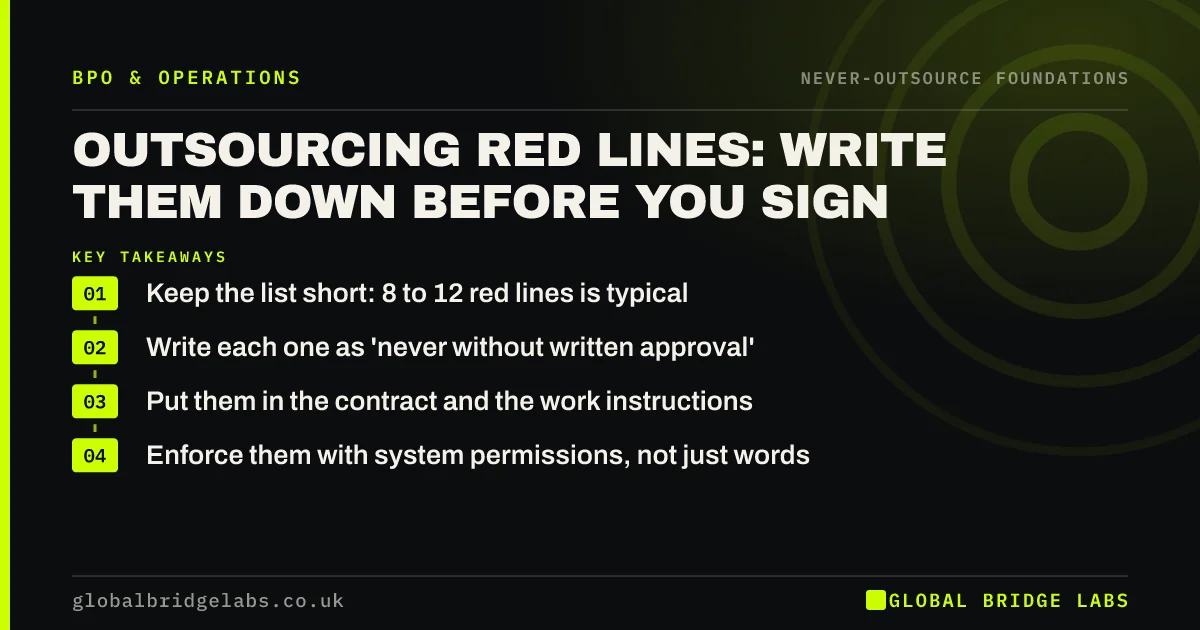
- Keep the list short: 8 to 12 red lines is typical.
- Write each one as 'never without written approval'.
- Put them in the contract and the work instructions.
- Enforce them with system permissions, not just words.
Want a starter list of red lines for your process? Message us on WhatsApp.
Chat on WhatsApp →Why write red lines down?
Because what feels obvious to you is not obvious to a new team. A provider trying to be helpful may offer a discount to save a customer, approve a payment to hit a deadline or reply to a journalist. Written red lines turn assumptions into instructions and give both sides a clear basis for the relationship.
What are common outsourcing red lines?
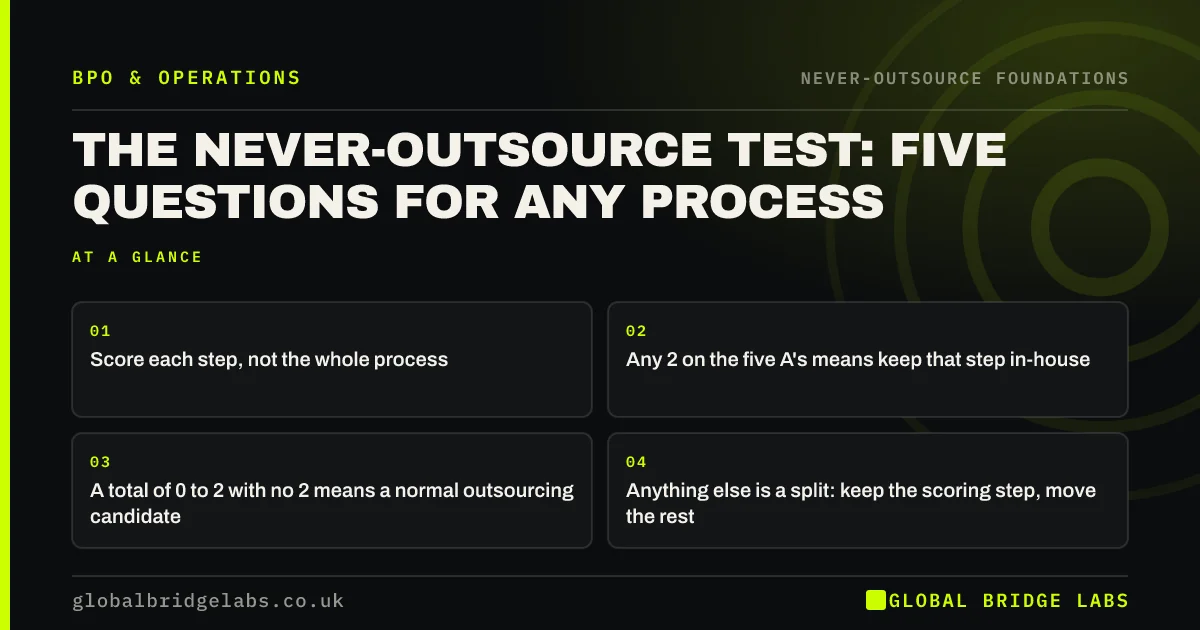
Most come from the five A's: authority, access, accountability, advantage and asset.
- Never approve or release payments.
- Never change supplier or customer bank details.
- Never offer discounts, refunds or credit above agreed limits.
- Never speak to media or post publicly for the business.
- Never sign or agree contract terms.
- Never export, delete or share customer data outside agreed systems.
- Never contact named key clients without approval.
Where do red lines go in the contract?
In the scope schedule as explicit exclusions, in the data processing terms for anything involving personal data, and in the process documents the team actually uses. Link breaches to escalation and, for serious ones, termination rights.
How do you enforce them day to day?
With system permissions first: payment-only access without approval rights, read-only views of bank details, no admin rights on social accounts. Then with sampling and a monthly check of any exceptions. A red line enforced only by trust will be crossed eventually, usually by accident.
What does this look like in practice?
A pattern we see: an outsourced customer service team gives a 20% goodwill credit to calm an angry customer, well meant but outside the owner's policy. Once a written limit and an escalation route are in place, those cases come to a manager within the hour instead.
Red lines checklist
- Draft 8 to 12 red lines using the five A's.
- Agree them with the provider before signing.
- Put them in the contract and work instructions.
- Set system permissions to match.
- Review exceptions monthly.
Next step
Write the three things you would be most upset to find a provider had done without asking. They are your first red lines.
Message us on WhatsApp, or book a 30-minute consultation.
Chat on WhatsApp →Sources and further reading
- Contracts and liabilities between controllers and processors · Information Commissioner's Office
- Small Business Guide: cyber security · National Cyber Security Centre
Frequently asked questions
What are red lines in outsourcing?
They are actions an outsourced provider must never take without your written approval, such as releasing payments, changing bank details, agreeing contract terms, offering discounts above a limit or speaking publicly for the business. They are written into the contract and the work instructions.
How do you stop an outsourced team overstepping?
Write clear limits, set system permissions so the team cannot act beyond them, give them a fast escalation route for exceptions and review a sample of their decisions. Most overstepping happens because a team is trying to help and has no quick way to ask.
Should red lines be in the contract?
Yes. Put them in the scope schedule as exclusions and in the data processing terms where personal data is involved, then repeat them in the process documents the team uses daily. A red line that only exists in an email is easy to forget.
Written by

Global Bridge Labs (GBL) is a UK–Sri Lanka partner for social media, websites and BPO. Everything here comes from client delivery, not theory.