On this page
Key takeaways
Who owns a business phone number? In practice, whoever holds the account with the telecoms provider. Keep every number your customers know, landline, mobile or freephone, in an account in your company's name. An outsourced call answering team can receive calls by forwarding or routing, but the number itself should never sit in their account.
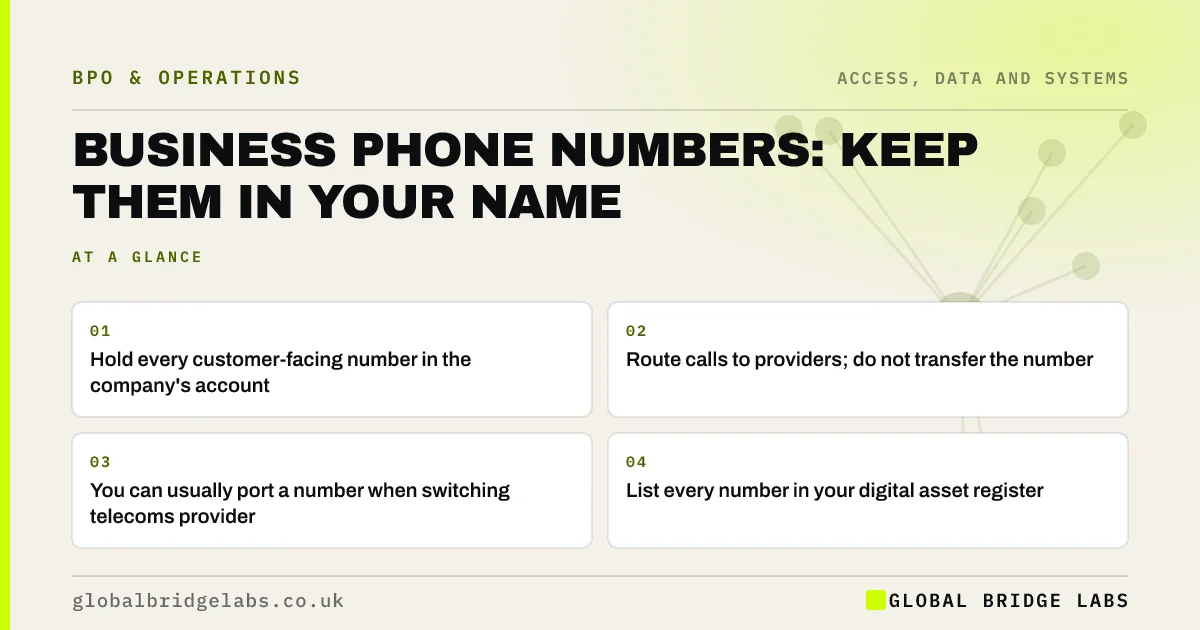
- Hold every customer-facing number in the company's account.
- Route calls to providers; do not transfer the number.
- You can usually port a number when switching telecoms provider.
- List every number in your digital asset register.
Want calls answered by a UK-hours team without giving up your number? Message us on WhatsApp.
Chat on WhatsApp →Why does phone number ownership matter?
Because your number is on your website, vans, invoices and Google Business Profile, and customers use it for years. If a call answering provider or former employee holds the account, changing provider can mean losing the number and the calls that come with it.
How should outsourced answering work?
Keep the number with your telecoms provider and route calls to the answering team by forwarding, a cloud phone system or a routing plan. You can then change the answering team or bring calls back in-house by changing the routing, not the number.
What about tracking and campaign numbers?
Call tracking numbers are often leased from the tracking provider and may not be portable. Use them for campaigns, but keep your main number in your own account and visible on your website and listings.
What should you check today?
For each number, check the account holder name, who can change routing, the contract end date and whether the number can be ported. Store this in your digital asset register with the other accounts you own.
What does this look like in practice?
A pattern we see: an answering service provides a number that the business prints everywhere, then finds it cannot take the number when it moves. Keeping the number in the company's account and forwarding calls avoids this.
Phone number checklist
- List every customer-facing number.
- Check the account holder for each.
- Move numbers into the company's name.
- Route calls to providers rather than transferring numbers.
- Record numbers in the asset register.
Next step
Look at your main number's latest bill. If it is not addressed to your company, ask the provider how to transfer the account.
Message us on WhatsApp, or book a 30-minute consultation.
Chat on WhatsApp →Sources and further reading
- Electronic Commerce (EC Directive) Regulations 2002 · legislation.gov.uk
- Small organisations guide to cyber security · National Cyber Security Centre
Frequently asked questions
Who owns a business phone number?
Numbers are allocated to telecoms providers, but the account holder normally has the right to use the number and to port it to another provider. Make sure the account for every customer-facing number is in your company's name, not a provider's or an employee's.
Can I keep my number if I outsource call answering?
Yes. Keep the number with your own telecoms account and forward or route calls to the answering service. If you change answering provider, you change the routing and keep the number your customers know.
Can I take my business number to a new provider?
Usually, yes. Most UK geographic, mobile and many non-geographic numbers can be ported to a new provider by the account holder. Check your contract for any notice periods or charges, and confirm portability before printing a new number widely.
Written by

Global Bridge Labs (GBL) is a UK–Sri Lanka partner for social media, websites and BPO. Everything here comes from client delivery, not theory.