On this page
Key takeaways
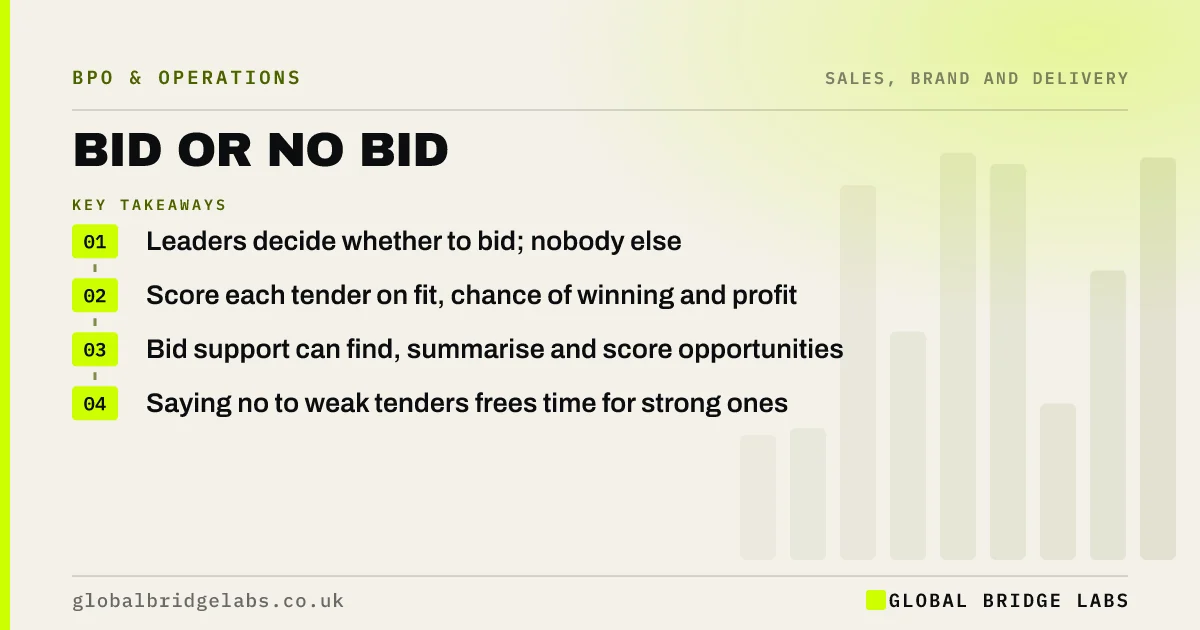
The bid no bid decision decides whether a tender is worth the effort, and it must stay with the business. Only leaders can judge whether you can win, deliver and profit. Bid support teams can find tenders, summarise requirements and prepare a scoring sheet. Bidding for everything wastes time; a clear no is often the best decision.
- Leaders decide whether to bid; nobody else.
- Score each tender on fit, chance of winning and profit.
- Bid support can find, summarise and score opportunities.
- Saying no to weak tenders frees time for strong ones.
Want tenders found and summarised for your bid decisions? Message us on WhatsApp.
Chat on WhatsApp →Why must the business decide?
Because bidding commits time and, if you win, commits the business to deliver for years at the price you set. A bid writer or support team does not carry that risk. Leaders know capacity, margins and appetite for a particular client or sector.
Which questions decide a bid?
A short scoring sheet keeps decisions consistent.
- Does it fit our strategy and strengths?
- Do we know the buyer or have relevant references?
- Can we deliver with current or planned capacity?
- Is the price likely to give an acceptable margin?
- Can we meet every mandatory requirement?
What can bid support prepare?
Finding opportunities on portals such as Find a Tender, summarising requirements and deadlines, checking mandatory criteria, pre-filling the scoring sheet and, after a yes, managing the bid timetable and drafting standard sections. The Procurement Act 2023 changed public tender rules, so check current guidance.
When should you say no?
When you cannot meet a mandatory requirement, the timescale is unrealistic, the margin looks thin, or the tender seems written for a competitor. Recording why you declined helps you spot better opportunities next time.
What does this look like in practice?
A pattern we see: a small firm bids for everything and wins little. A one-page scoring sheet, filled in by a support team and decided by the owner, cuts the number of bids and raises the win rate.
Bid no bid checklist
- Use a one-page scoring sheet.
- Check mandatory requirements first.
- Leaders make the bid decision.
- Record reasons for every no.
- Review win rates quarterly.
Next step
Look at your last five bids. If you lost most of them, score them now against the questions above and see which you should have declined.
Message us on WhatsApp, or book a 30-minute consultation.
Chat on WhatsApp →Sources and further reading
Frequently asked questions
What is a bid no bid decision?
It is the decision on whether to respond to a tender or request for proposals, based on fit with the business, the chance of winning, ability to deliver and likely profit. It is made before investing time in writing a bid.
Who should make the bid no bid decision?
The owners or senior leaders, because winning commits the business to delivering at the bid price. Bid support teams can find opportunities, summarise requirements and complete a scoring sheet to inform the decision.
What criteria should you use to decide whether to bid?
Strategic fit, relationship with the buyer, relevant experience and references, capacity to deliver, likely margin, and whether you meet every mandatory requirement. Scoring each tender on the same criteria keeps decisions consistent.
Written by

Global Bridge Labs (GBL) is a UK–Sri Lanka partner for social media, websites and BPO. Everything here comes from client delivery, not theory.