On this page
Key takeaways
A payroll sign-off process means a named person in your business checks and approves each payroll before anyone is paid. Payroll calculation, filing and payslips outsource well, but the employer stays responsible to HMRC and The Pensions Regulator. The sign-off checks starters, leavers, pay changes and totals, and usually takes under an hour a month.
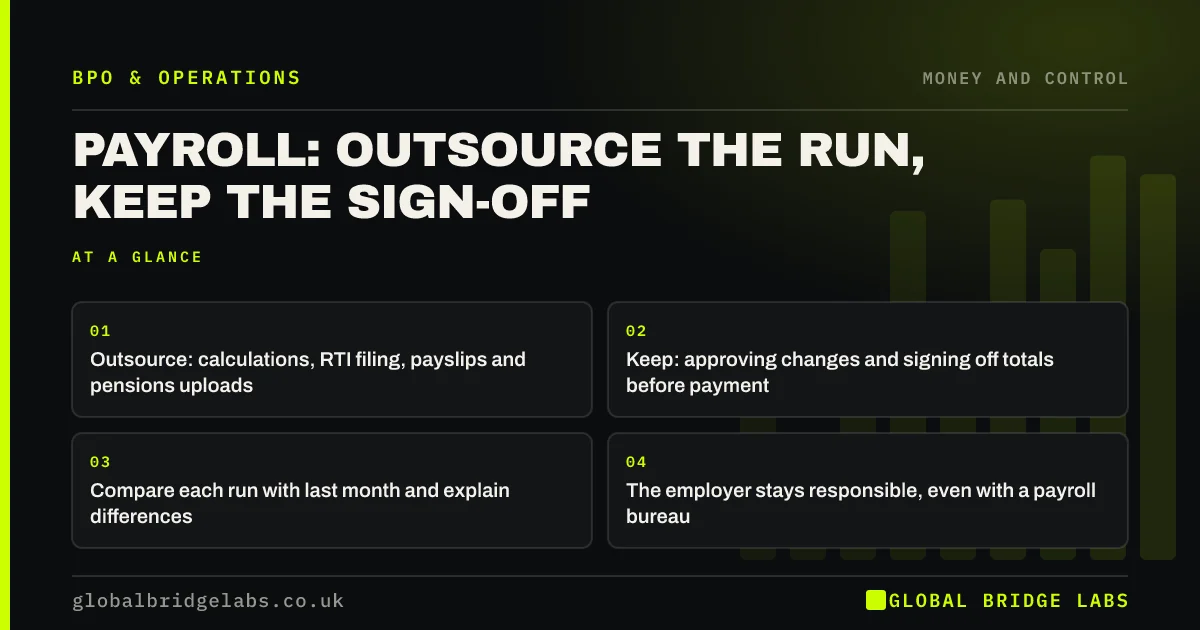
- Outsource: calculations, RTI filing, payslips and pensions uploads.
- Keep: approving changes and signing off totals before payment.
- Compare each run with last month and explain differences.
- The employer stays responsible, even with a payroll bureau.
Want payroll run for you with a clean sign-off pack? Message us on WhatsApp.
Chat on WhatsApp →Why keep payroll sign-off in-house?
Because payroll is the biggest regular payment most SMEs make, and errors land on staff and on the employer. HMRC holds the employer responsible for PAYE reporting even when a bureau files it, and pension duties stay with the employer. Sign-off also catches fraud, such as a fictitious employee or a changed bank account.
What should you check before approving?
Use the same short list every month.
- Starters and leavers match what HR expects.
- Pay rises, bonuses and deductions are approved.
- Gross pay total versus last month, with differences explained.
- Any employee bank detail changes were verified.
- Pension contributions are included.
What does the payroll provider do?
Calculates pay, tax, National Insurance and deductions, submits Real Time Information to HMRC, produces payslips, handles statutory payments and uploads pension contributions. It should send a sign-off pack: a summary, a variance report against last month and a list of changes.
Want to see a sample payroll sign-off pack? Message us on WhatsApp.
Chat on WhatsApp →Who should sign off payroll?
A director or senior manager who did not prepare the changes. In a very small business, the owner signs off. Where possible, the person approving pay changes during the month should not be the only person approving the final run.
What does this look like in practice?
A pattern we see: a leaver is paid for an extra month because nobody told the bureau. A monthly sign-off that compares headcount and totals with the previous run catches this before money leaves.
Payroll sign-off checklist
- Agree a monthly cut-off for changes.
- Receive a sign-off pack with variances.
- Check starters, leavers and pay changes.
- Verify any bank detail changes.
- Approve in writing before payment.
Next step
Ask your payroll provider for a variance report against last month with your next run. If they cannot produce one, that is the first improvement.
Message us on WhatsApp, or book a 30-minute consultation.
Chat on WhatsApp →Sources and further reading
- Running payroll · GOV.UK
- Automatic enrolment and pension duties for employers · The Pensions Regulator
Frequently asked questions
Who is responsible for payroll if it is outsourced?
The employer. HMRC holds the employer responsible for PAYE and National Insurance reporting and payments, and The Pensions Regulator holds the employer responsible for auto-enrolment duties, even when a payroll bureau does the work. That is why the employer should sign off each run.
What should I check before approving payroll?
Check starters and leavers, approved pay changes and deductions, the total gross pay against last month with differences explained, any employee bank detail changes, and that pension contributions are included. A variance report from the provider makes this quick.
How long does payroll sign-off take?
With a good sign-off pack from your provider, usually under an hour a month for an SME. The pack should summarise totals, compare them with the previous run and list every change, so the approver only investigates what has moved.
Written by

Global Bridge Labs (GBL) is a UK–Sri Lanka partner for social media, websites and BPO. Everything here comes from client delivery, not theory.