On this page
Key takeaways
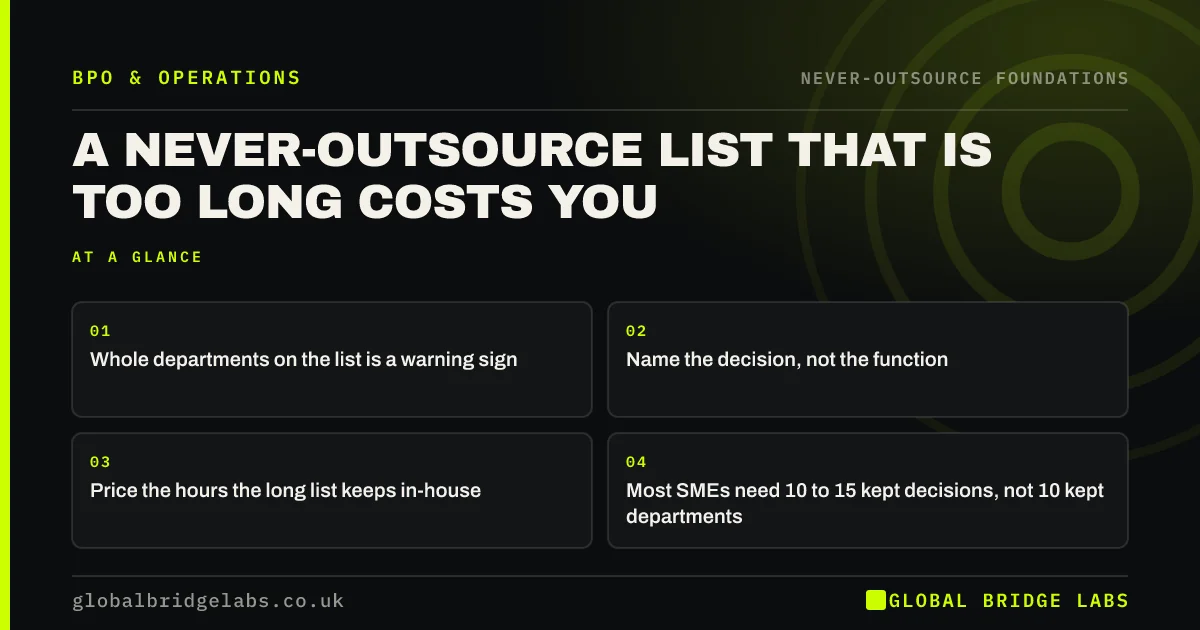
Keeping too much in-house costs you owner time, growth and resilience. A never-outsource list that names whole departments, such as 'finance' or 'customer service', usually protects a handful of decisions and traps dozens of hours of admin. Shorten it by naming the decision inside each department and letting the work around it move.
- Whole departments on the list is a warning sign.
- Name the decision, not the function.
- Price the hours the long list keeps in-house.
- Most SMEs need 10 to 15 kept decisions, not 10 kept departments.
Think your never list might be too long? Message us on WhatsApp for a second view.
Chat on WhatsApp →Why do never-outsource lists grow too long?
Because a bad experience, a horror story or simple habit gets generalised. One provider mishandled a customer, so 'customer service stays'. One payment went wrong, so 'finance stays'. The specific risk was a decision or a control, but the whole function gets locked in.
What does an over-long list cost?
Mainly owner and manager time. Ten hours a week of admin kept in-house is 520 hours a year; at an illustrative £50 an hour of owner time, that is £26,000 of capacity, against indicative managed offshore rates of £9–£18 an hour. It also costs resilience, because kept admin often depends on one person.
How do you shorten the list safely?
Take each item and ask what exactly must stay. Rewrite 'finance' as 'approving payments, setting credit limits, reviewing monthly numbers'. Rewrite 'customer service' as 'complaints above a value, key client calls, goodwill above a limit'. Then score the rest of the function with the never-outsource test.
When is a long list right?
Early-stage businesses still finding their model, very small teams with little admin, and some regulated firms may rightly keep more. The test is whether each item protects a specific risk you can name. If it does, keep it.
What does this look like in practice?
A pattern we see: an owner's list has 'finance, HR, customer service and sales' on it. Rewritten as decisions, it becomes 12 items. The functions stay under the owner's control, but most of the hours in them can move.
Shorter list checklist
- Circle any whole function on the list.
- Rewrite each as specific decisions and duties.
- Score the remaining work with the five A's.
- Estimate the hours the old list kept in-house.
- Keep only items tied to a named risk.
Next step
Write your current 'we would never outsource' list and count the whole functions on it. Each one is worth an hour of rewriting.
Message us on WhatsApp, or book a 30-minute consultation.
Chat on WhatsApp →Sources and further reading
- Employee earnings in the UK (Annual Survey of Hours and Earnings) · Office for National Statistics
- Labour productivity · Office for National Statistics
Frequently asked questions
Can you keep too much in-house?
Yes. Keeping whole functions in-house when only a few decisions inside them need protecting ties up owner and manager time, slows growth and often makes the business depend on one or two people. Keep the decisions and duties, and let the admin around them move.
Why are businesses reluctant to outsource?
Common reasons are fear of losing control, a past bad experience, worries about quality and data, and habit. Most of these concerns relate to specific decisions or controls, which can be kept in-house while the surrounding work is outsourced with clear limits and checks.
How do I know if my never-outsource list is too long?
If it names whole departments rather than specific decisions, it is probably too long. A useful list for an SME usually has 10 to 15 items such as approving payments, hiring decisions and key client relationships, each with a named owner and a reason.
Written by

Global Bridge Labs (GBL) is a UK–Sri Lanka partner for social media, websites and BPO. Everything here comes from client delivery, not theory.