On this page
- 01Key takeaways
- 02Why use a decision rights matrix?
- 03What does a decision rights matrix look like?
- 04How is it different from a RACI matrix?
- 05How do you keep it current?
- 06What does this look like in practice?
- 07Decision rights checklist
- 08Next step
- 09Sources and further reading
- 10Frequently asked questions
Key takeaways
A decision rights matrix lists the recurring decisions in a process and, for each, who decides, who recommends and who is informed, with limits in numbers. For outsourced work, it shows exactly what the provider can decide alone, what needs your approval and how fast you will respond. It complements a RACI matrix, which covers tasks rather than decisions.
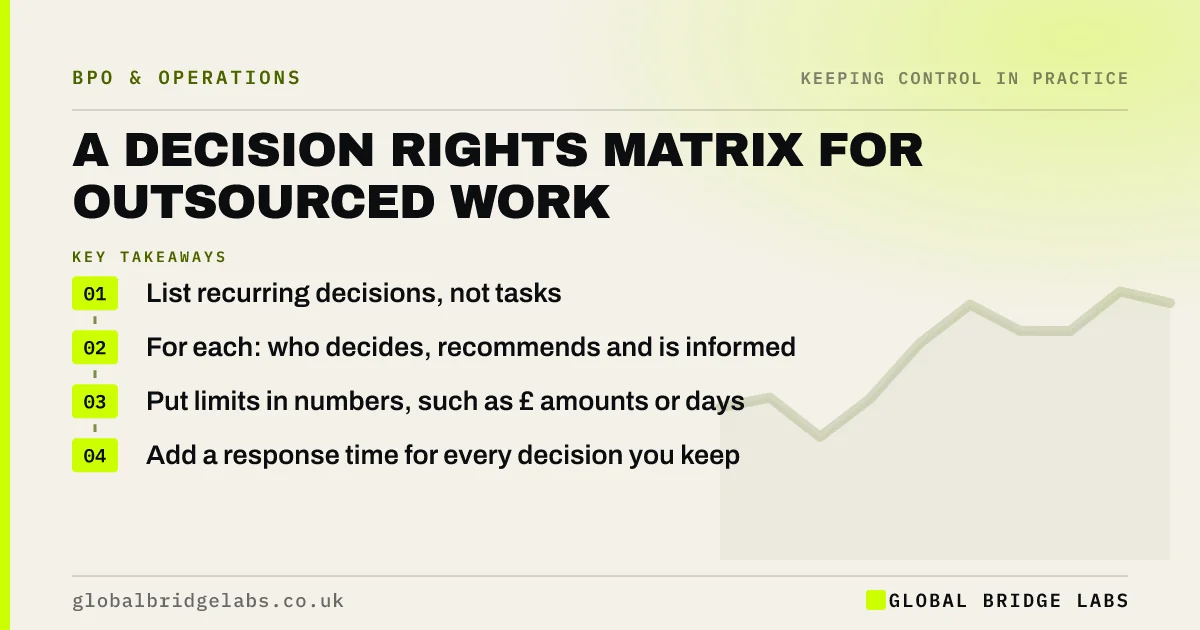
- List recurring decisions, not tasks.
- For each: who decides, recommends and is informed.
- Put limits in numbers, such as £ amounts or days.
- Add a response time for every decision you keep.
Want a decision rights matrix built for one of your processes? Message us on WhatsApp.
Chat on WhatsApp →Why use a decision rights matrix?
Because most outsourcing friction comes from unclear decisions, not unclear tasks. A provider unsure whether it can approve a refund either asks about everything, which slows work, or decides too much, which loses control. A matrix answers the question once.
What does a decision rights matrix look like?
One row per decision, with clear limits. For example:
- Refund under the set limit: provider decides, manager informed weekly.
- Refund over the limit: provider recommends, manager decides same day.
- New supplier: provider recommends, director decides.
- Bank detail change: provider prepares, director decides after call-back.
- Public reply to a complaint: provider drafts, owner decides.
How is it different from a RACI matrix?
A RACI matrix assigns who is responsible, accountable, consulted and informed for tasks. A decision rights matrix focuses on choices and their limits. Many SMEs use both: RACI for the workflow, decision rights for the moments that commit the business.
How do you keep it current?
Review it quarterly in the first year and then yearly. Raise limits when the provider has proved reliable, lower them if errors appear, and add rows when new decisions come up.
What does this look like in practice?
A pattern we see: providers escalate everything in the first month because they are unsure. A one-page matrix with clear limits cuts escalations sharply and gets the right ones to the right person.
Decision rights checklist
- List the recurring decisions in the process.
- Assign decide, recommend and inform.
- Set limits in numbers.
- Add response times for kept decisions.
- Review quarterly in year one.
Next step
List the five decisions your provider asks you about most often. Write a limit for each, and you have the start of your matrix.
Message us on WhatsApp, or book a 30-minute consultation.
Chat on WhatsApp →Sources and further reading
- The Sourcing and Consultancy Playbooks · Cabinet Office
- Senior Managers and Certification Regime · Financial Conduct Authority
Frequently asked questions
What is a decision rights matrix?
It is a table listing recurring decisions and, for each, who makes the decision, who recommends, who must be informed, and any limits such as amounts or timescales. It clarifies authority between a business and its staff or providers.
What is the difference between RACI and decision rights?
A RACI matrix assigns roles for tasks: responsible, accountable, consulted and informed. A decision rights matrix focuses on decisions and their limits, showing who can commit the business to what. Many organisations use both together.
How do you set limits for an outsourced team?
Start with conservative limits based on the risk of each decision, such as a small refund amount, and raise them once the team has shown reliable judgement. Put every limit in numbers and pair each kept decision with a response time.
Written by

Global Bridge Labs (GBL) is a UK–Sri Lanka partner for social media, websites and BPO. Everything here comes from client delivery, not theory.