On this page
Key takeaways
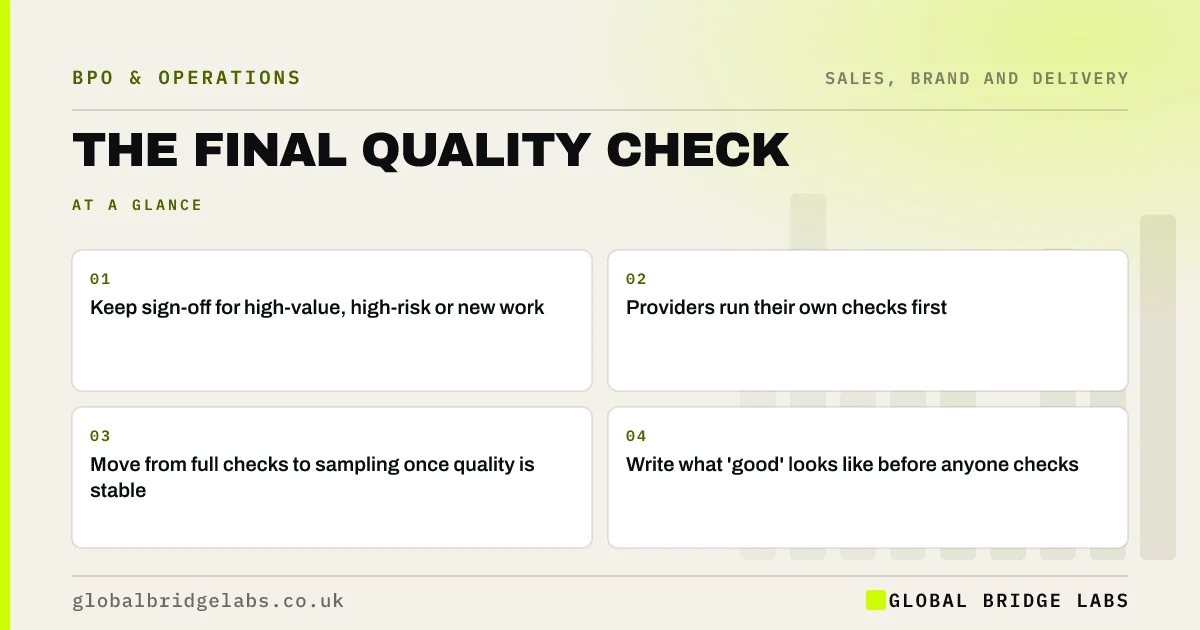
The final quality check before delivery, the last look before work reaches a customer, should stay in-house for anything high-value, high-risk or new. Outsourced teams can produce the work and run their own checks; a named person in your business signs off. For stable, routine work, move from checking everything to sampling once quality is proven.
- Keep sign-off for high-value, high-risk or new work.
- Providers run their own checks first.
- Move from full checks to sampling once quality is stable.
- Write what 'good' looks like before anyone checks.
Want a sampling plan for outsourced work? Message us on WhatsApp.
Chat on WhatsApp →Why should the last look stay inside?
Because the customer judges your business, not your provider, and the final check is where your standards are applied. It also keeps your people close to the quality of what you deliver. Without it, quality drifts slowly and nobody notices until customers do.
What should the final check cover?
Check against written criteria, not instinct.
- Accuracy of facts, numbers and names.
- Completeness against the brief.
- Tone and brand standards.
- Legal or regulatory requirements.
- Anything promised to the customer.
When can you move to sampling?
When the work is routine, error rates have been low for several weeks and mistakes would be cheap to correct. Sample a set number each week, say 10%, and return to full checks if errors rise. High-risk work keeps full sign-off.
What should the provider check first?
Their own work, against the same criteria, before it reaches you. The HSE notes that human errors are predictable and best reduced by good design of tasks and checks, so give the provider checklists, not just instructions.
What does this look like in practice?
A pattern we see: an owner checks every piece of outsourced work for months and becomes the bottleneck. Written criteria, provider self-checks and weekly sampling keep quality high and free the owner.
Final quality check list
- Write acceptance criteria.
- Ask providers to self-check first.
- Sign off high-risk work in full.
- Sample routine work weekly.
- Return to full checks if errors rise.
Next step
Pick one outsourced output and write five criteria for 'good'. Use them for your next check.
Message us on WhatsApp, or book a 30-minute consultation.
Chat on WhatsApp →Sources and further reading
- Human factors: managing human failures · Health and Safety Executive
- Consumer Rights Act 2015 · legislation.gov.uk
Frequently asked questions
Who should do the final quality check on outsourced work?
A named person in your business, for anything high-value, high-risk or new. The provider should check its own work first against the same written criteria. For stable routine work, sampling a proportion each week is usually enough.
How much outsourced work should you check?
Check everything at first. Once error rates have been low for several weeks, move to sampling, such as around 10% of routine items each week. Keep full checks for high-risk work, and go back to full checks if errors increase.
How do you stop quality slipping with an outsourced team?
Write clear acceptance criteria, give the team checklists, sample their work regularly, share feedback quickly and track error rates over time. Quality usually slips gradually when nobody inside the business is looking.
Written by

Global Bridge Labs (GBL) is a UK–Sri Lanka partner for social media, websites and BPO. Everything here comes from client delivery, not theory.