On this page
- 01Key takeaways
- 02What are a director's general duties?
- 03What can directors delegate?
- 04What does good supervision look like?
- 05When do directors face personal risk?
- 06What does this look like in practice?
- 07Director delegation checklist
- 08Next step
- 09Sources and further reading
- 10Frequently asked questions
Key takeaways
Director duties delegation has a clear limit. Directors can delegate tasks to staff, accountants and outsourced providers, but they cannot delegate their duties under the Companies Act 2006, including reasonable care, skill and diligence and independent judgement. Delegating well means choosing capable people, giving clear instructions and supervising the results.
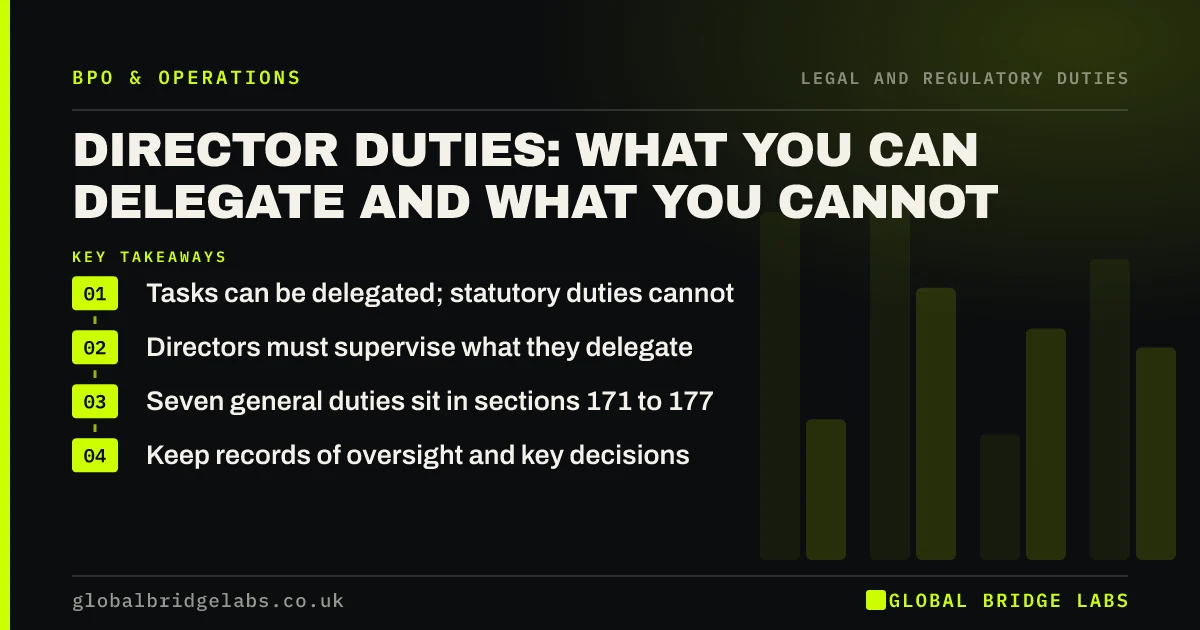
- Tasks can be delegated; statutory duties cannot.
- Directors must supervise what they delegate.
- Seven general duties sit in sections 171 to 177.
- Keep records of oversight and key decisions.
Want to delegate admin without losing oversight? Message us on WhatsApp.
Chat on WhatsApp →What are a director's general duties?
The Companies Act 2006 sets out seven: act within powers, promote the success of the company, exercise independent judgement, exercise reasonable care, skill and diligence, avoid conflicts of interest, not accept benefits from third parties, and declare interests in transactions. These stay with each director personally.
What can directors delegate?
Almost all the work, provided they stay in control of it.
- Bookkeeping, payroll and filings preparation.
- Customer service and back-office admin.
- IT support and security monitoring.
- Research and analysis for decisions.
What does good supervision look like?
Choosing a competent provider, setting clear instructions and limits, receiving regular reports, checking a sample of the work and acting when something looks wrong. Courts have found directors in breach for leaving everything to others without asking questions.
When do directors face personal risk?
When they fail to supervise and the company suffers loss, when they continue trading while insolvent without considering creditors, or for some offences, such as failing to file accounts. Delegation without oversight is not a defence.
What does this look like in practice?
A pattern we see: a director hands finance entirely to an outside bookkeeper and stops reading the numbers. A monthly one-hour review of the accounts and payments keeps the director informed and the duty met.
Director delegation checklist
- Choose capable staff and providers.
- Give written instructions and limits.
- Receive regular reports.
- Sample the work and ask questions.
- Record key decisions and reasons.
Next step
For each area you have delegated, write when you last checked it. Any area you have not looked at in three months needs a review.
Message us on WhatsApp, or book a 30-minute consultation.
Chat on WhatsApp →Sources and further reading
- Companies Act 2006, Part 10, Chapter 2: general duties of directors · legislation.gov.uk
- Being a company director · GOV.UK
Frequently asked questions
Can a company director delegate their duties?
Directors can delegate tasks and many powers, but not their statutory duties under the Companies Act 2006. They remain responsible for exercising reasonable care, skill and diligence, which includes supervising the people and providers they delegate to.
What are the seven duties of a director?
To act within powers, promote the success of the company, exercise independent judgement, exercise reasonable care, skill and diligence, avoid conflicts of interest, not accept benefits from third parties, and declare interests in proposed transactions or arrangements.
Is a director liable if the accountant makes a mistake?
The company is usually responsible to HMRC or Companies House, and directors may face consequences if they failed to supervise or provide accurate information. The company may have a claim against the accountant under the engagement terms.
Written by

Global Bridge Labs (GBL) is a UK–Sri Lanka partner for social media, websites and BPO. Everything here comes from client delivery, not theory.