On this page
- 01Key takeaways
- 02Why can't a provider set your risk appetite?
- 03What does a risk appetite statement look like?
- 04How does risk appetite guide outsourced teams?
- 05How often should risk appetite be reviewed?
- 06What does this look like in practice?
- 07Risk appetite checklist
- 08Next step
- 09Sources and further reading
- 10Frequently asked questions
Key takeaways
Risk appetite is how much risk a business is willing to take to reach its goals, set out in a few plain statements. In a small business, only the owners can set it, because it reflects their personal stake. Providers then work within it: an outsourced team knows which customers to accept, which payments to query and when to escalate.
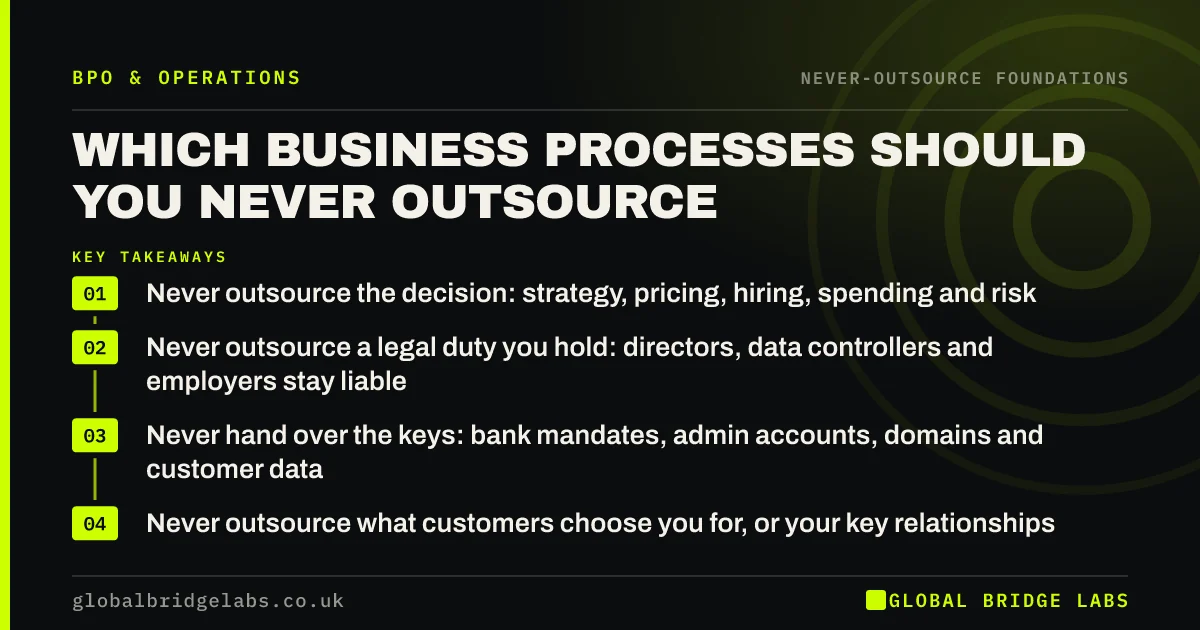
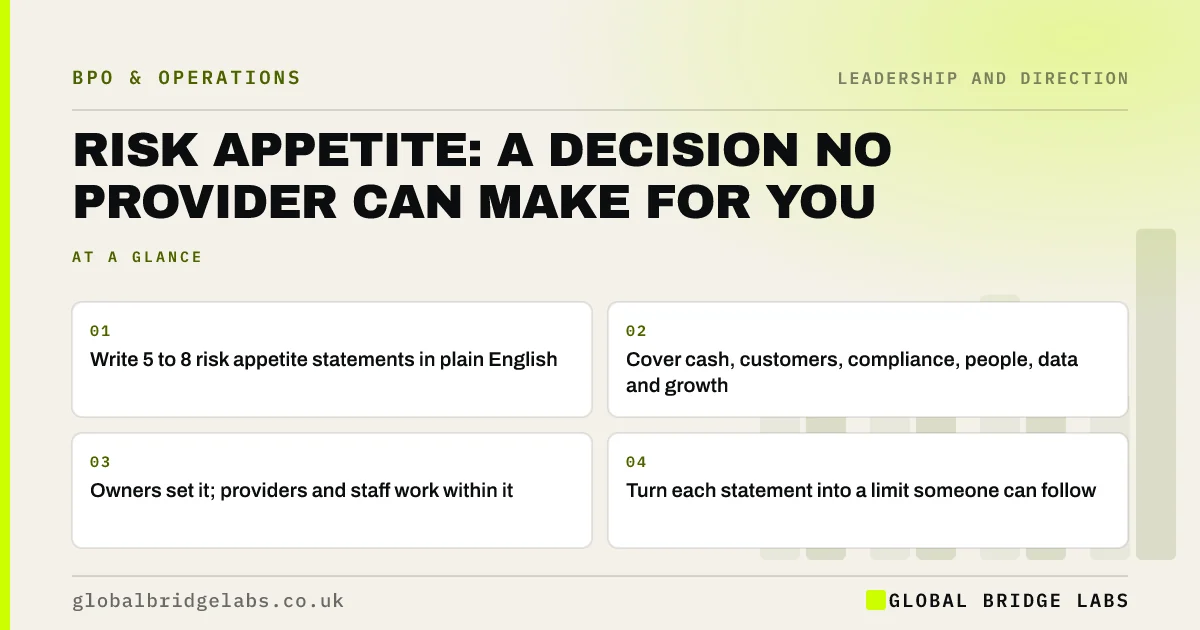
- Write 5 to 8 risk appetite statements in plain English.
- Cover cash, customers, compliance, people, data and growth.
- Owners set it; providers and staff work within it.
- Turn each statement into a limit someone can follow.
Want a risk appetite template for your business? Message us on WhatsApp.
Chat on WhatsApp →Why can't a provider set your risk appetite?
Because a provider's appetite reflects its own risks, not yours. A provider may be cautious to protect its contract, or bold because it does not carry the loss. Owners know what they can afford to lose, what would keep them awake and what the business is for. Those judgements set the limits everyone else follows.
What does a risk appetite statement look like?
Short, specific statements that someone can act on.
- Cash: we keep at least three months of fixed costs in reserve.
- Customers: no single customer above 20% of revenue.
- Compliance: zero tolerance for known breaches of law.
- Credit: new customers start on limits we set, not the sales team.
- Data: personal data never leaves approved systems.
How does risk appetite guide outsourced teams?
It becomes their rules. Credit control knows when to stop supplying, customer service knows when to escalate, finance knows which payments to query. Without it, each team guesses, and different teams guess differently. Write the limits into the work instructions and the escalation path.
How often should risk appetite be reviewed?
Once a year, and after any big change: new investment, a major client win or loss, a new regulation or a near miss. Appetite changes as the business grows, and limits that suited a start-up may be too tight or too loose later.
What does this look like in practice?
A pattern we see: an outsourced credit team extends terms to a large new customer because nobody said not to. A written statement on maximum exposure per customer turns that into a routine escalation instead of a surprise.
Risk appetite checklist
- Write 5 to 8 plain statements.
- Cover cash, customers, compliance, people, data and growth.
- Turn each into a limit.
- Put the limits into work instructions.
- Review yearly and after big changes.
Next step
Ask yourself: what is the most the business could lose this year without being in danger? The answer is the start of your risk appetite.
Message us on WhatsApp, or book a 30-minute consultation.
Chat on WhatsApp →Sources and further reading
- The Green Book: appraisal and evaluation in central government · HM Treasury
- Small Business Guide: cyber security · National Cyber Security Centre
Frequently asked questions
What is risk appetite in a small business?
It is the amount and type of risk the owners are willing to accept to reach their goals, written as a few plain statements about cash reserves, customer concentration, compliance, credit, data and growth. It guides staff and providers on what to do without asking every time.
Who sets the risk appetite?
The owners or board of directors. It reflects their personal stake, their goals and what they can afford to lose. Managers and providers contribute information about risks, but the appetite itself is a leadership decision that should never be outsourced.
What is the difference between risk appetite and risk tolerance?
Risk appetite is the overall level of risk you are willing to pursue. Risk tolerance is the acceptable variation around it for a specific measure, such as how far cash can fall below target before action is taken. In a small business, both can sit in the same short statement.
Written by

Global Bridge Labs (GBL) is a UK–Sri Lanka partner for social media, websites and BPO. Everything here comes from client delivery, not theory.