On this page
Key takeaways
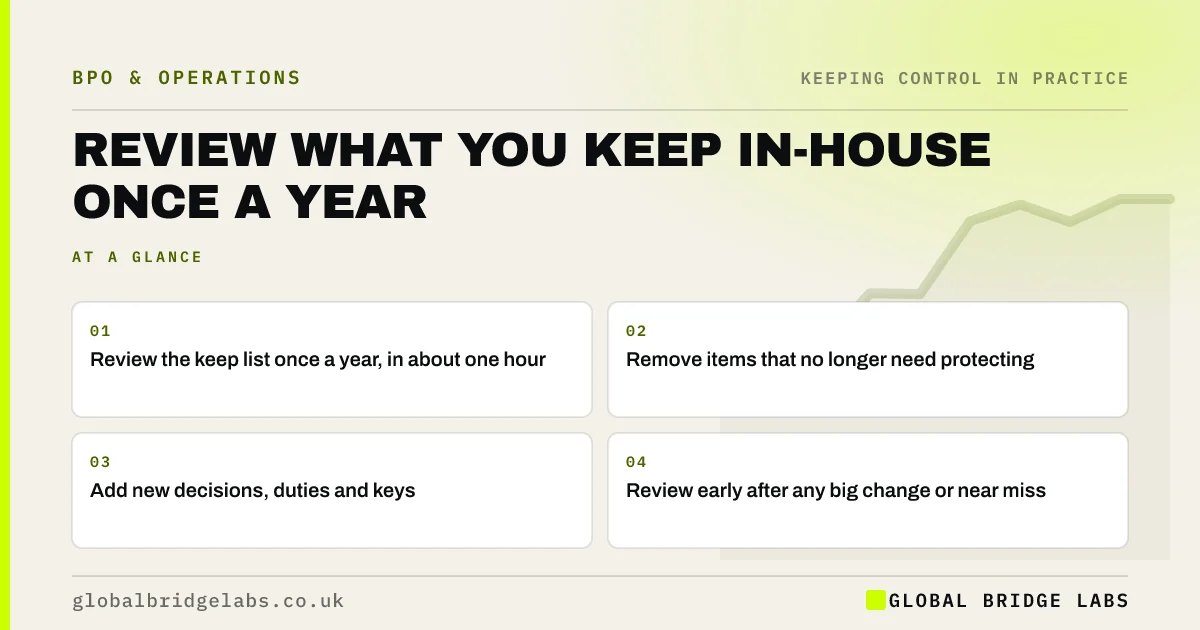
Review in-house processes annually: once a year, spend an hour checking what you keep and what you outsource. Items that no longer need protecting can move; new risks may need adding. Review earlier after a big change such as a new regulation, a major client, a new service, a near miss or a change of provider.
- Review the keep list once a year, in about one hour.
- Remove items that no longer need protecting.
- Add new decisions, duties and keys.
- Review early after any big change or near miss.
Want an outside view at your annual review? Message us on WhatsApp.
Chat on WhatsApp →Why review every year?
Because the business changes. Processes that once needed the owner may now be routine, new regulations may add duties, and provider relationships may have matured enough to raise limits. Without a review, the keep list either grows by habit or erodes by drift.
What should the review cover?
Work through the list item by item.
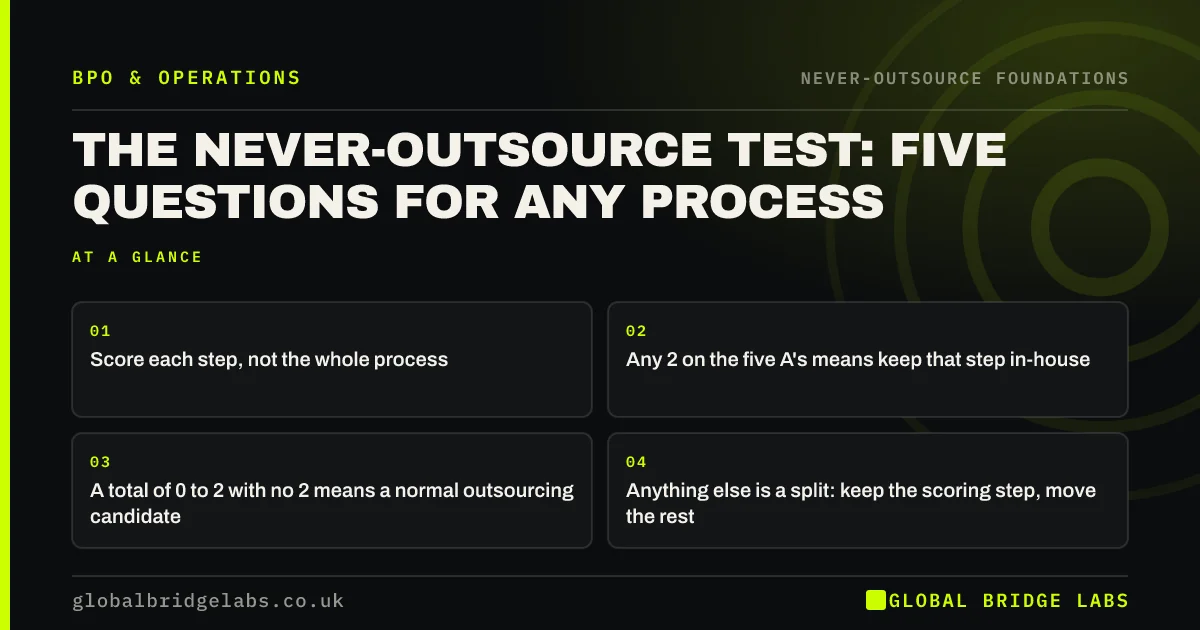
- Does each item still score a 2 on the five A's?
- Is the owner still right, with a deputy?
- Have any decisions drifted to providers?
- Are there new duties or keys to add?
- Can any limits safely rise?
What should trigger an early review?
Any of these.
- A new regulation or regulator contact.
- A major client win or loss.
- A new service or location.
- A near miss, breach or fraud attempt.
- A new or changed provider.
Who should take part?
The owners, the managers who own kept items and, for part of the meeting, your main providers. Providers often know which escalations are unnecessary and which limits cause delays.
What does this look like in practice?
A pattern we see: an annual review finds a decision that drifted to a provider and two kept items that no longer need the owner. Both corrections take minutes once someone looks.
Annual review checklist
- Book an hour at the same time each year.
- Re-score each kept item.
- Check owners and deputies.
- Look for drift to providers.
- Record changes and the next review date.
Next step
Put a one-hour keep list review in the diary for the same month every year, starting with the next quarter.
Message us on WhatsApp, or book a 30-minute consultation.
Chat on WhatsApp →Sources and further reading
- The Sourcing and Consultancy Playbooks · Cabinet Office
- The Green Book: appraisal and evaluation in central government · HM Treasury
Frequently asked questions
How often should you review what you outsource?
At least once a year, plus earlier reviews after significant changes such as new regulation, a major client change, a new service, a near miss or a new provider. A short annual review keeps the boundary between kept and outsourced work current.
What should an annual outsourcing review include?
Re-scoring each kept decision or duty, checking owners and deputies, looking for decisions that have drifted to providers, adding new duties or keys, and deciding whether any limits can safely change.
Should providers join the annual review?
For part of it, yes. Providers can point out unnecessary escalations, limits that cause delays and risks they have noticed. Decisions on what stays in-house, and on any changes to limits, remain with the business.
Written by

Global Bridge Labs (GBL) is a UK–Sri Lanka partner for social media, websites and BPO. Everything here comes from client delivery, not theory.