On this page
- 01Key takeaways
- 02Why do leaders own serious service recovery?
- 03What are the steps of service recovery?
- 04Which steps can an outsourced team run?
- 05How do you fix the cause?
- 06What does this look like in practice?
- 07Service recovery checklist
- 08Next step
- 09Sources and further reading
- 10Frequently asked questions
Key takeaways
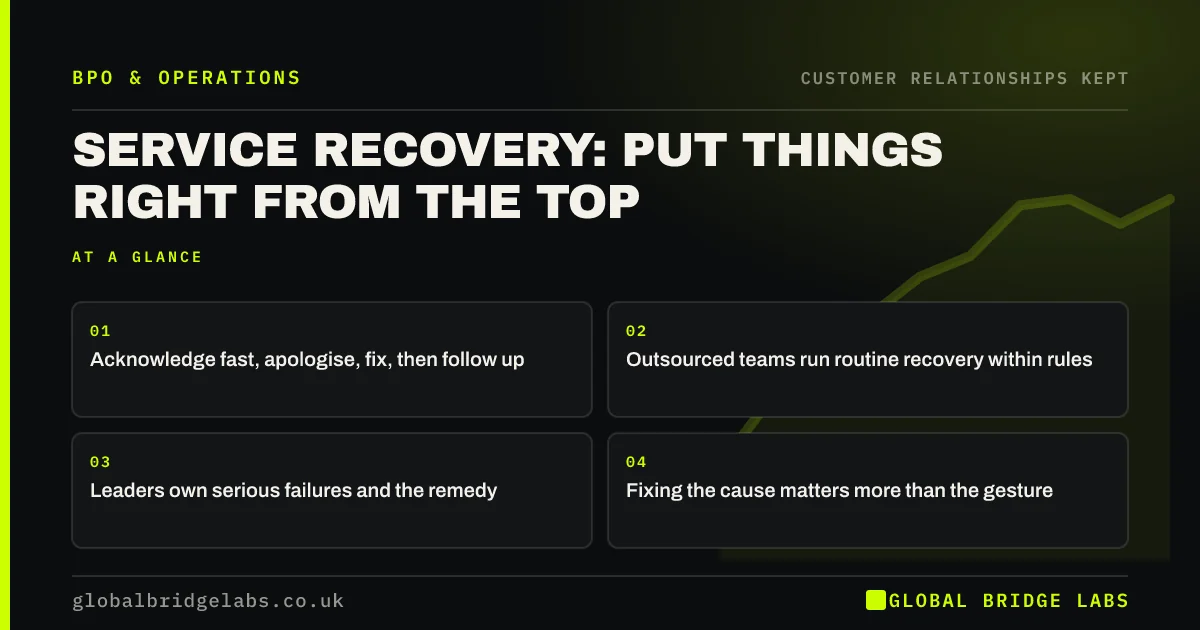
Service recovery is how a business puts things right after letting a customer down. The routine steps, acknowledging quickly, apologising, fixing and following up, can be run by an outsourced service team. Serious failures need a leader to own the apology, decide the remedy and, most importantly, fix the cause so it does not happen again.
- Acknowledge fast, apologise, fix, then follow up.
- Outsourced teams run routine recovery within rules.
- Leaders own serious failures and the remedy.
- Fixing the cause matters more than the gesture.
Want a service recovery script your team can follow? Message us on WhatsApp.
Chat on WhatsApp →Why do leaders own serious service recovery?
Because serious failures reveal something the business must change, and only leaders can change it. A customer who receives a senior apology and sees the problem fixed may remain loyal; one who receives a scripted reply and the same failure again will leave and tell others.
What are the steps of service recovery?
Most good recovery follows the same pattern.
- Acknowledge the problem quickly.
- Apologise without blaming the customer.
- Fix the immediate problem.
- Offer a fair remedy where deserved.
- Follow up to check it worked.
- Fix the cause inside the business.
Which steps can an outsourced team run?
Acknowledgement, apology, routine fixes, remedies within limits and follow-up calls. With a clear script and authority, a trained team can recover most everyday failures quickly. The UK Customer Satisfaction Index from the Institute of Customer Service tracks how complaint handling affects satisfaction, and speed is a recurring factor.
How do you fix the cause?
Log every recovery with its cause, review the causes monthly and assign each recurring one to a named owner with a deadline. This is the step most often skipped, and the one that only the business can do.
What does this look like in practice?
A pattern we see: the same failure is apologised for every week because nobody owns the cause. Once causes are logged and reviewed monthly by a manager, recurring failures fall and the service team spends less time apologising.
Service recovery checklist
- Write a short recovery script.
- Give the team authority within limits.
- Escalate serious failures to a leader.
- Log the cause of every failure.
- Fix recurring causes monthly.
Next step
List last month's three most common service failures. Assign each to someone who can fix the cause, not just the symptom.
Message us on WhatsApp, or book a 30-minute consultation.
Chat on WhatsApp →Sources and further reading
- UK Customer Satisfaction Index · Institute of Customer Service
- Stop trying to delight your customers (Dixon, Freeman and Toman, 2010) · Harvard Business Review
Frequently asked questions
What is service recovery?
Service recovery is what a business does to put things right after a service failure: acknowledging the problem, apologising, fixing it, offering a fair remedy and following up. Good recovery can keep a customer's trust; poor recovery often loses the customer.
Can service recovery be outsourced?
Routine recovery can, with a script, authority within limits and fast escalation. Serious failures should be owned by a leader, who decides the remedy and makes sure the cause is fixed inside the business.
What is the most important step in service recovery?
Fixing the cause. Quick acknowledgement and a sincere apology matter, but if the same failure keeps happening, customers lose faith. Logging causes and assigning each recurring one to an owner is what stops repeat failures.
Written by

Global Bridge Labs (GBL) is a UK–Sri Lanka partner for social media, websites and BPO. Everything here comes from client delivery, not theory.