On this page
- 01Key takeaways
- 02Why do acquisition decisions stay with the buyer?
- 03What should advisers do in due diligence?
- 04What admin can be outsourced during a deal?
- 05Which post-deal decisions stay in-house?
- 06What does this look like in practice?
- 07Acquisition decision checklist
- 08Next step
- 09Sources and further reading
- 10Frequently asked questions
Key takeaways
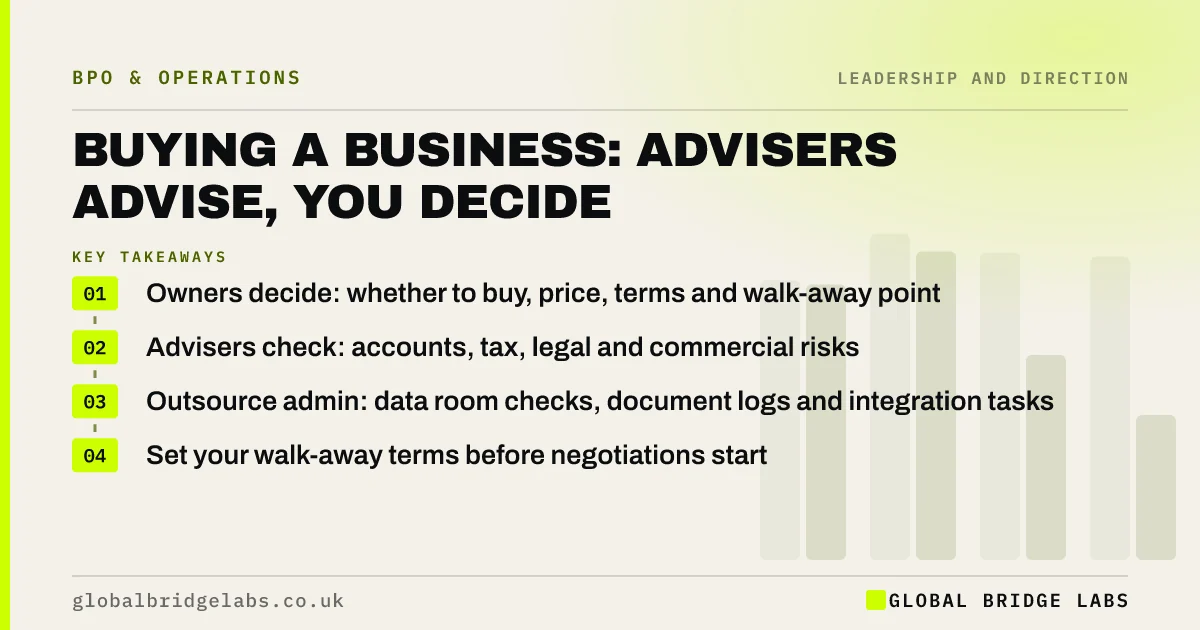
In the acquisition decision process, advisers check the numbers, contracts and risks, but the buyer decides whether to buy, at what price and on what terms. Those decisions, plus the plan for the people and customers you acquire, never leave the owners. Outsourced teams can also help with data rooms, document checks and integration admin.
- Owners decide: whether to buy, price, terms and walk-away point.
- Advisers check: accounts, tax, legal and commercial risks.
- Outsource admin: data room checks, document logs and integration tasks.
- Set your walk-away terms before negotiations start.
Planning an acquisition and need admin capacity? Message us on WhatsApp.
Chat on WhatsApp →Why do acquisition decisions stay with the buyer?
Because the buyer inherits everything: the staff, the customers, the liabilities and the culture. Advisers are paid to find risks, and some are paid on completion, which can tilt their view. Only the owners can judge whether the target fits their strategy and whether they can run it.
What should advisers do in due diligence?
Accountants review the financials and tax position; solicitors review contracts, property, employment and disputes; specialists check areas such as IT or regulation. They should report risks clearly and price them, so the buyer can decide whether to walk away, renegotiate or seek protection in the contract.
- Financial and tax due diligence.
- Legal and employment due diligence, including TUPE.
- Commercial checks on customers and suppliers.
- IT and data protection checks.
What admin can be outsourced during a deal?
Logging documents received, checking the data room against the request list, chasing missing items, building contract and customer registers, and, after completion, integration tasks such as moving supplier and customer records. This frees owners to focus on negotiation and people.
Which post-deal decisions stay in-house?
How you communicate with acquired staff and customers, who leads the acquired business, what changes and when. These shape whether the people and customers you paid for stay. Outsourced teams can run the integration plan; owners must lead it.
What does this look like in practice?
A pattern we see: buyers spend weeks on price and days on integration. Those who plan the first 90 days of communication with staff and customers before completion keep more of both.
Acquisition decision checklist
- Write your walk-away terms before talks begin.
- Appoint accountants and solicitors for due diligence.
- Ask advisers to price each risk they find.
- Outsource document logging and chasing.
- Plan staff and customer communication before completion.
Next step
Before any acquisition talks, write one page on why you want to buy and what would make you walk away. Share it with your advisers so they test against it.
Message us on WhatsApp, or book a 30-minute consultation.
Chat on WhatsApp →Sources and further reading
- Business transfers, takeovers and TUPE · GOV.UK
- Companies Act 2006, Part 10, Chapter 2: general duties of directors · legislation.gov.uk
Frequently asked questions
Who makes the decision to buy a company?
The buyer's owners or board. Accountants, solicitors and other advisers carry out due diligence and report risks, but the decision on whether to proceed, the price, the terms and the walk-away point stays with the buyer, who inherits the business afterwards.
What do advisers do when buying a business?
Accountants review financial records and tax, solicitors review contracts, property, employees and disputes, and specialists check areas such as IT or regulation. They report risks and help negotiate protections such as warranties and indemnities in the purchase agreement.
Does TUPE apply when you buy a business?
TUPE usually applies when you buy a business's assets and take on its activities, transferring employees on their existing terms. In a share purchase, the employer does not change, so TUPE does not normally apply. Take legal advice on your specific deal.
Written by

Global Bridge Labs (GBL) is a UK–Sri Lanka partner for social media, websites and BPO. Everything here comes from client delivery, not theory.