On this page
- 01Key takeaways
- 02What is an intelligent client?
- 03Why is this the part you never outsource?
- 04What does the intelligent client need to know?
- 05How much time does it take?
- 06What does this look like in practice?
- 07Intelligent client checklist
- 08Next step
- 09Sources and further reading
- 10Frequently asked questions
Key takeaways
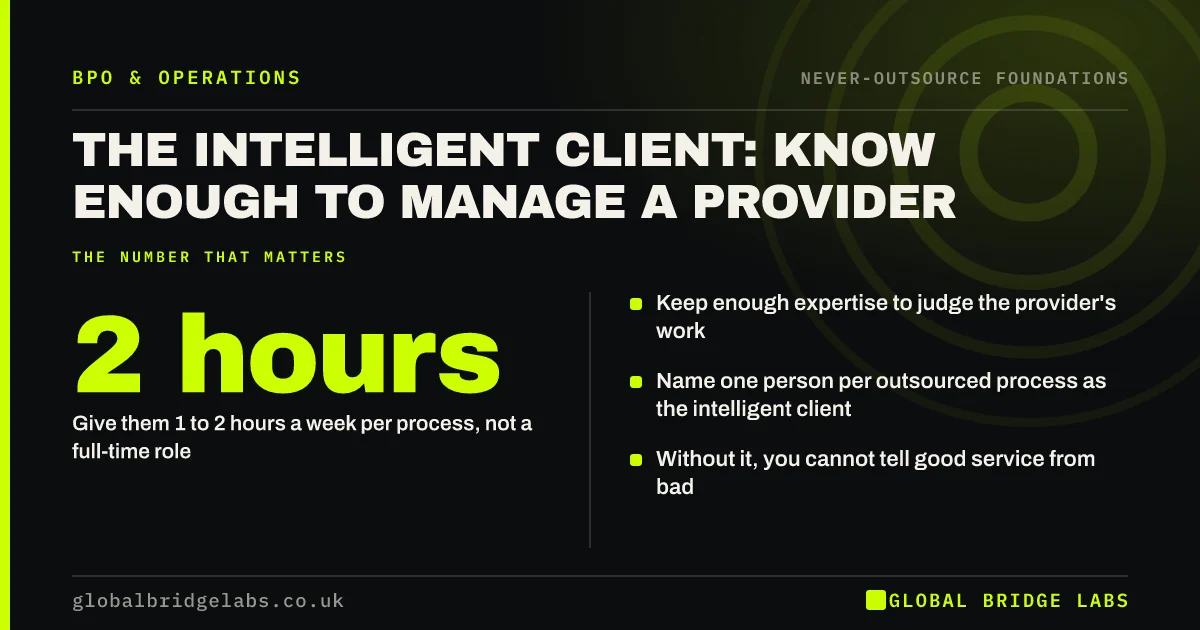
An intelligent client function is the knowledge a business keeps in-house so it can specify, check and challenge outsourced work. You never outsource the ability to judge whether the work is good. In an SME this is not a department; it is one or two people who understand each outsourced process well enough to spot when it goes wrong.
- Keep enough expertise to judge the provider's work.
- Name one person per outsourced process as the intelligent client.
- Give them 1 to 2 hours a week per process, not a full-time role.
- Without it, you cannot tell good service from bad.
Want to know how much knowledge to keep for each process? Message us on WhatsApp.
Chat on WhatsApp →What is an intelligent client?
The term comes from UK public sector outsourcing, where the Cabinet Office's Sourcing Playbook stresses that buyers need the capability to manage what they buy. For an SME, an intelligent client is the person who can write a good brief, read the provider's reports critically, sample the work and ask the right question when a number looks odd.
Why is this the part you never outsource?
Because if the provider is also the only one who can judge the provider, you have no control. Errors go unnoticed, costs creep and you cannot switch because nobody knows how the process should work. Businesses that lose this knowledge become dependent on whoever runs the process.
What does the intelligent client need to know?
Not how to do every task, but what good looks like and why. That covers the outcome the process must deliver, the rules and laws that apply, the key measures and their normal range, and the exceptions that need a decision.
- The process outcome and service levels.
- Legal and regulatory requirements.
- Normal ranges for the key numbers.
- Which exceptions need an internal decision.
How much time does it take?
As a GBL rule of thumb, 1 to 2 hours a week per stable outsourced process: a short review meeting, a sample check and reading the monthly report. Expect more during the first three months of a new process. If it takes much more, the process or the provider needs attention.
What does this look like in practice?
A pattern we see: when the one person who understood credit control leaves, nobody can tell whether the outsourced team's collection rate is good. Businesses that cross-train a second person and keep a one-page 'what good looks like' sheet avoid that blind spot.
Intelligent client checklist
- Name an intelligent client for each outsourced process.
- Write a one-page 'what good looks like' sheet.
- Sample the work each month.
- Read reports against normal ranges.
- Cross-train a second person.
Next step
For each process you outsource, write the name of the person who could tell you, within a week, that it had started going wrong. Any blank is a risk.
Message us on WhatsApp, or book a 30-minute consultation.
Chat on WhatsApp →Sources and further reading
- The Sourcing and Consultancy Playbooks · Cabinet Office
- The Green Book: appraisal and evaluation in central government · HM Treasury
Frequently asked questions
What is an intelligent client function?
It is the in-house capability to specify, oversee and challenge outsourced work. In a small business it is usually one or two people who understand what each outsourced process should achieve, the rules that apply and the numbers that show whether it is working.
How much knowledge should you keep when outsourcing?
Enough to judge the work, not to do it all. Keep knowledge of the outcome, the rules, the key measures and the exceptions that need a decision. A short reference sheet and a second trained person protect that knowledge if your main contact leaves.
Who should manage an outsourced provider?
A named person who understands the process and has authority to make decisions about it, usually a manager close to the work rather than the owner. They need a regular review slot, access to reports and the ability to escalate issues quickly.
Written by

Global Bridge Labs (GBL) is a UK–Sri Lanka partner for social media, websites and BPO. Everything here comes from client delivery, not theory.