On this page
- 01Key takeaways
- 02Which financial controls stay in-house?
- 03Why do these controls stay when the work moves?
- 04What does the provider do?
- 05How do you check the provider's work?
- 06What does this look like in practice?
- 07Financial controls checklist
- 08Next step
- 09Sources and further reading
- 10Frequently asked questions
Key takeaways
Financial controls for small businesses are the checks that stop errors and fraud. When bookkeeping is outsourced, the processing moves but the key controls stay: approving payments, changing bank details, reviewing reconciliations, approving write-offs and reviewing the monthly numbers. These take a few hours a month and protect everything else.
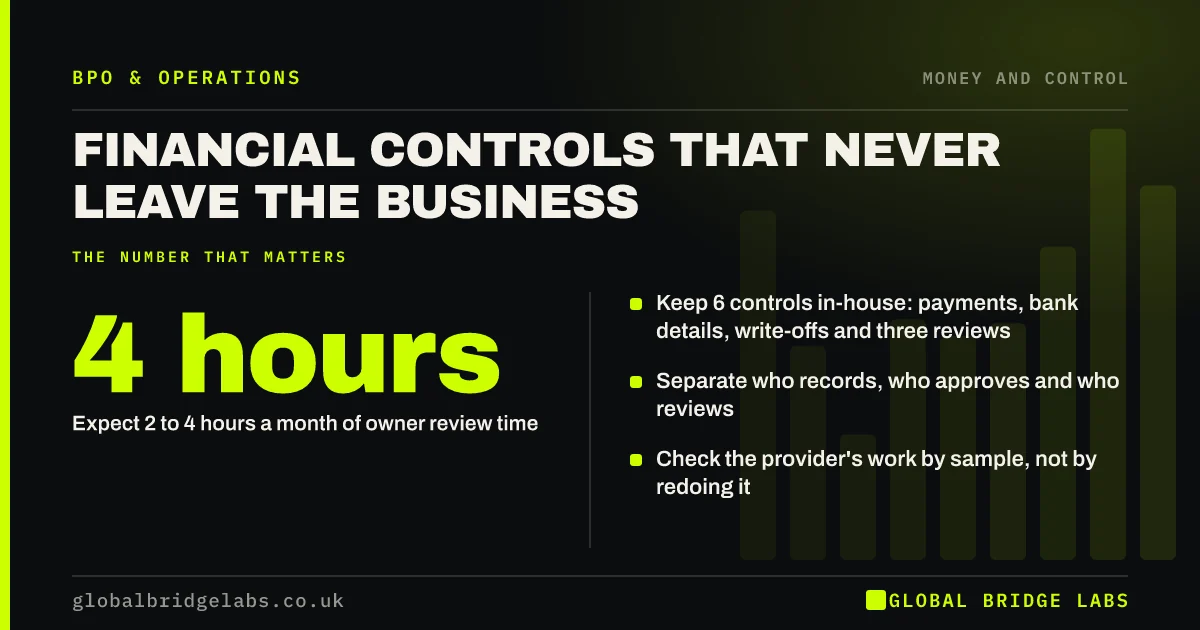
- Keep 6 controls in-house: payments, bank details, write-offs and three reviews.
- Separate who records, who approves and who reviews.
- Expect 2 to 4 hours a month of owner review time.
- Check the provider's work by sample, not by redoing it.
Want your finance controls mapped before you outsource? Message us on WhatsApp.
Chat on WhatsApp →Which financial controls stay in-house?
Six controls cover most of the risk in an SME.
- Approving and releasing payments.
- Approving new suppliers and any change of bank details.
- Approving credit notes and write-offs.
- Reviewing the monthly bank reconciliation.
- Reviewing management accounts against budget.
- Reviewing payroll before it is paid.
Why do these controls stay when the work moves?
Because a control only works if the person applying it is independent of the person doing the work. If the provider both records and approves, nobody checks the provider. Keeping approvals and reviews with the business also keeps the directors informed, which they need to meet their duties.
What does the provider do?
Records transactions, matches invoices, prepares payment batches, reconciles bank accounts, prepares management accounts and flags anything unusual. A good provider welcomes your controls, because they protect both sides when something goes wrong.
- Finance processes to outsource, and the ones to keep
- Management accounts: outsource the pack, keep the review
Want a finance provider who works within your controls? Message us on WhatsApp.
Chat on WhatsApp →How do you check the provider's work?
Sample, do not redo. Each month, pick a few transactions and trace them to the invoice and approval, check the bank reconciliation balances, and read the exceptions list. Ask questions about anything that moves unexpectedly in the management accounts.
What does this look like in practice?
A pattern we see: when bookkeeping moves out, the owner stops looking at the numbers because 'the accountant handles it'. A one-hour monthly review of the reconciliation, payments list and accounts restores control without taking the work back.
Financial controls checklist
- Keep payment approval and release in-house.
- Approve every new supplier and bank detail change.
- Approve credit notes and write-offs.
- Review the bank reconciliation monthly.
- Review management accounts monthly.
- Sample a few transactions each month.
Next step
Write down who records, who approves and who reviews each of the six controls. Any name that appears twice on one line is a gap.
Message us on WhatsApp, or book a 30-minute consultation.
Chat on WhatsApp →Sources and further reading
- Running a limited company: company and accounting records · GOV.UK
- Cyber security breaches survey 2025/2026 · DSIT and Home Office
Frequently asked questions
What financial controls should a small business have?
At minimum: approval of payments by someone other than the preparer, verification of new suppliers and bank detail changes, approval of credit notes and write-offs, monthly bank reconciliation reviewed by a manager, a monthly review of management accounts, and a payroll check before payment.
Which finance controls stay in-house when bookkeeping is outsourced?
Approving and releasing payments, approving bank detail changes and new suppliers, approving write-offs and credit notes, and reviewing reconciliations, management accounts and payroll. The provider does the processing; the business keeps the approvals and reviews.
How much time do financial controls take?
For most SMEs with outsourced bookkeeping, two to four hours a month: approving payment runs, reviewing the reconciliation and accounts, and sampling a few transactions. It is a small cost compared with the losses controls prevent.
Written by

Global Bridge Labs (GBL) is a UK–Sri Lanka partner for social media, websites and BPO. Everything here comes from client delivery, not theory.