On this page
Key takeaways
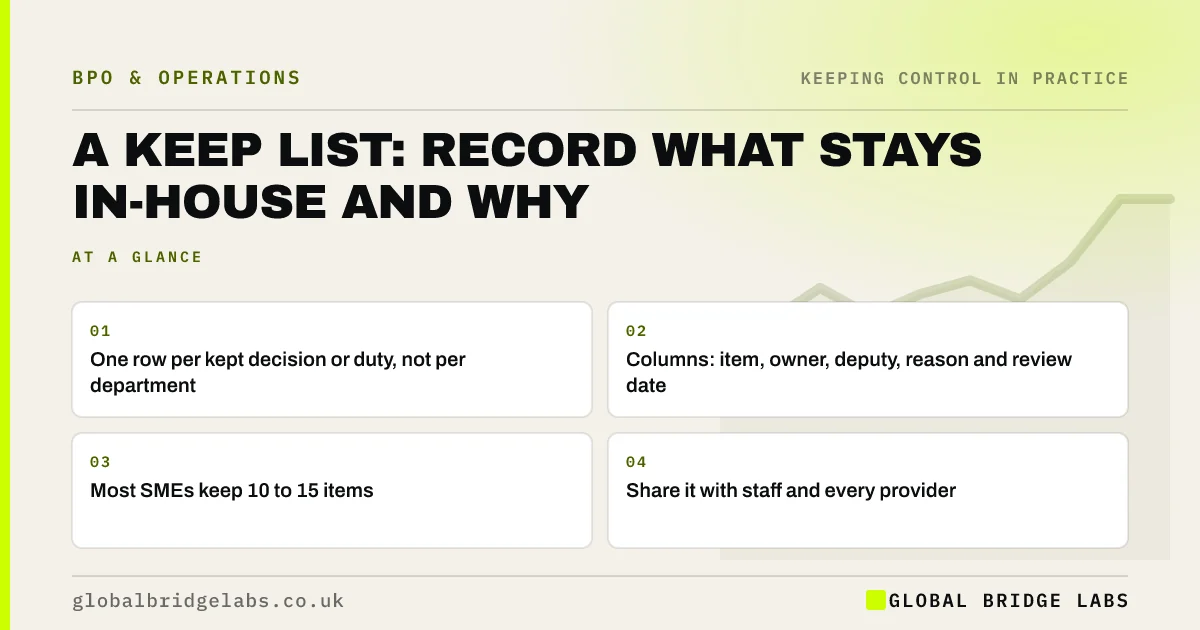
An in-house vs outsource list template, or keep list, records every decision and duty that stays inside the business, who owns it and why. It turns a vague sense of 'what we would never outsource' into a short document staff and providers can follow. Most SMEs end up with 10 to 15 items, reviewed once a year.
- One row per kept decision or duty, not per department.
- Columns: item, owner, deputy, reason and review date.
- Most SMEs keep 10 to 15 items.
- Share it with staff and every provider.
Want a keep list template you can fill in today? Message us on WhatsApp.
Chat on WhatsApp →Why write a keep list?
Because unwritten boundaries move. A new manager, a helpful provider or a busy month can shift a decision outside the business without anyone choosing to. A written list makes the boundary clear, gives each item an owner and makes outsourcing conversations faster.
What columns should the template have?
Keep it to one page.
- Item: the decision or duty kept.
- Reason: which of the five A's applies.
- Owner and deputy.
- What can move around it.
- Last reviewed and next review date.
What does a typical keep list contain?
Examples from a services SME of about 20 people.
- Approving payments over a set amount.
- Hiring and dismissal decisions.
- Pricing changes and discounts above a limit.
- Key client relationships and escalations.
- Master admin accounts and bank mandates.
- Data breach and regulator responses.
How do you use it day to day?
Share it with staff and providers, attach it to outsourcing contracts as part of the scope, and check new processes against it before handing them over. When someone asks 'can we outsource this?', the list gives a quick answer.
What does this look like in practice?
A pattern we see: owners describe their boundaries differently each time they are asked. Writing a one-page keep list ends the debate and makes handing over new processes quicker.
Keep list checklist
- List kept decisions and duties, not departments.
- Give each a reason, owner and deputy.
- Note what can move around each item.
- Share with staff and providers.
- Review yearly.
Next step
Write your first five keep list items now. Most owners can do it in ten minutes.
Message us on WhatsApp, or book a 30-minute consultation.
Chat on WhatsApp →Sources and further reading
- The Sourcing and Consultancy Playbooks · Cabinet Office
- FCA Handbook SYSC 8: Outsourcing · Financial Conduct Authority
Frequently asked questions
What is a keep list in outsourcing?
It is a short document listing the decisions and duties a business keeps in-house, with the reason, owner, deputy and review date for each. It sets clear boundaries for staff and providers and speeds up decisions about what can be outsourced.
How many items should be on a keep list?
Most SMEs end up with 10 to 15 items. If your list names whole departments or runs much longer, it may be protecting admin that could move safely while the real decisions inside it stay with you.
Should providers see the keep list?
Yes. Sharing it helps providers understand where their authority ends, what to escalate and which decisions belong to you. Attaching it to the contract scope, and repeating it in work instructions, makes the boundary formal.
Written by

Global Bridge Labs (GBL) is a UK–Sri Lanka partner for social media, websites and BPO. Everything here comes from client delivery, not theory.