On this page
Key takeaways
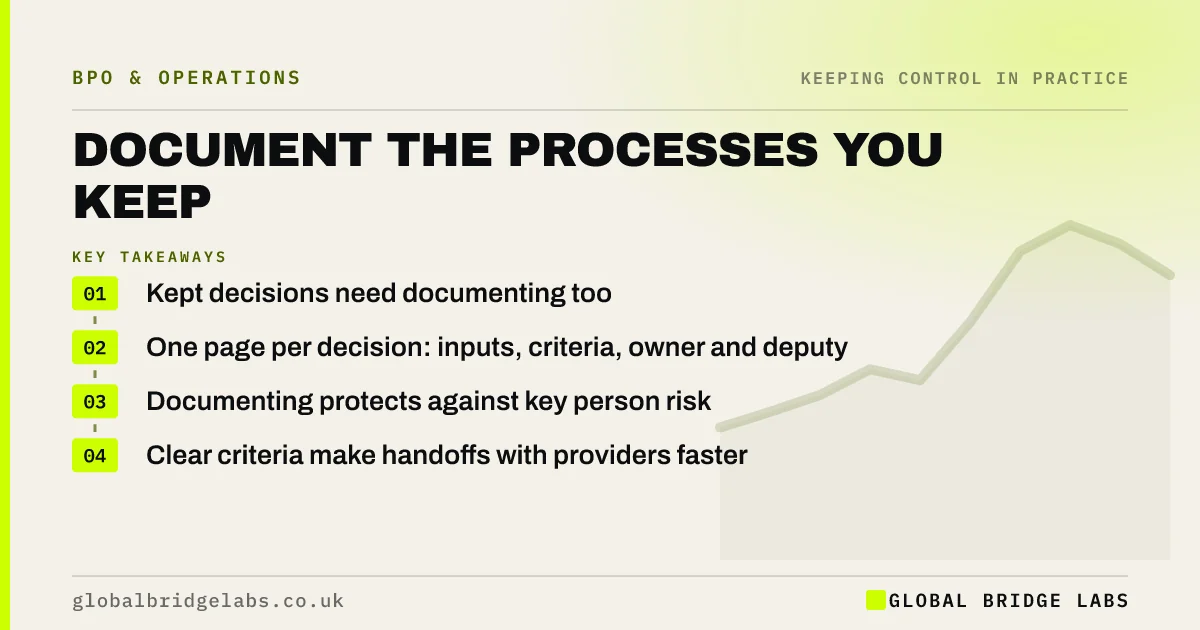
Document core processes you keep, not just the ones you outsource. Businesses usually write detailed instructions for providers and leave their own decisions undocumented, which makes kept work depend on one person and weakens handoffs. A one-page note for each kept decision, covering inputs, criteria, owner and deputy, is enough.
- Kept decisions need documenting too.
- One page per decision: inputs, criteria, owner and deputy.
- Documenting protects against key person risk.
- Clear criteria make handoffs with providers faster.
Want your kept processes documented for you? Message us on WhatsApp.
Chat on WhatsApp →Why document what you keep?
Because kept decisions are usually the most important ones, and they often live in one person's head. If that person is away or leaves, the decision stops or is made badly. Documenting them also shows providers what you need from them to decide quickly.
What should the note cover?
Keep it short and practical.
- The decision and why it is kept.
- Inputs needed and who provides them.
- Criteria and limits used to decide.
- Owner, deputy and response time.
- Where the decision is recorded.
Can documentation be outsourced?
The writing can. A provider can interview your people, draft the notes, record short videos and keep them in a knowledge base. Your owner reviews and approves each note, so the knowledge stays yours.
How do you keep it up to date?
Review each note at the annual keep list review, and update it whenever criteria or owners change. Store notes in one place that staff can find, not in personal folders.
What does this look like in practice?
A pattern we see: an owner's holiday stops payment approvals because nobody else knows the criteria. A one-page note and a named deputy keep things moving without lowering control.
Kept process documentation checklist
- List every kept decision.
- Write a one-page note for each.
- Name an owner and deputy.
- Store notes in one shared place.
- Review notes yearly.
Next step
Pick the decision that would stall first if you were away for two weeks, and write its one-page note.
Message us on WhatsApp, or book a 30-minute consultation.
Chat on WhatsApp →Sources and further reading
- Human factors: managing human failures · Health and Safety Executive
- Writing to GOV.UK standards: writing guidelines · GOV.UK
Frequently asked questions
Should you document processes you do not outsource?
Yes. Kept decisions are often the most important and most dependent on one person. A short note covering inputs, criteria, owner, deputy and where the decision is recorded protects the business when people are away or leave.
How detailed should process documentation be?
Detailed enough for a competent deputy to make the decision or do the task correctly. For most kept decisions, one page is enough. Routine tasks handed to providers may need step-by-step instructions and screenshots or videos.
Who should write process documentation?
The person who does the work knows it best, but writing can be outsourced: a provider can interview them, draft the document and record videos. The process owner should review and approve the final version.
Written by

Global Bridge Labs (GBL) is a UK–Sri Lanka partner for social media, websites and BPO. Everything here comes from client delivery, not theory.