On this page
- 01Key takeaways
- 02Why split a core process instead of keeping it whole?
- 03How do you decide which steps move?
- 04How do you design the handoffs?
- 05How do you keep control over time?
- 06What does this look like in practice?
- 07Core process split checklist
- 08Next step
- 09Sources and further reading
- 10Frequently asked questions
Key takeaways
To outsource part of a core process, map every step, mark the steps that carry the decision, know-how or relationship, and move only the admin around them. Then design the handoffs so information flows cleanly both ways. Done well, your skilled people spend more time on the core steps, and control improves because each decision becomes explicit.
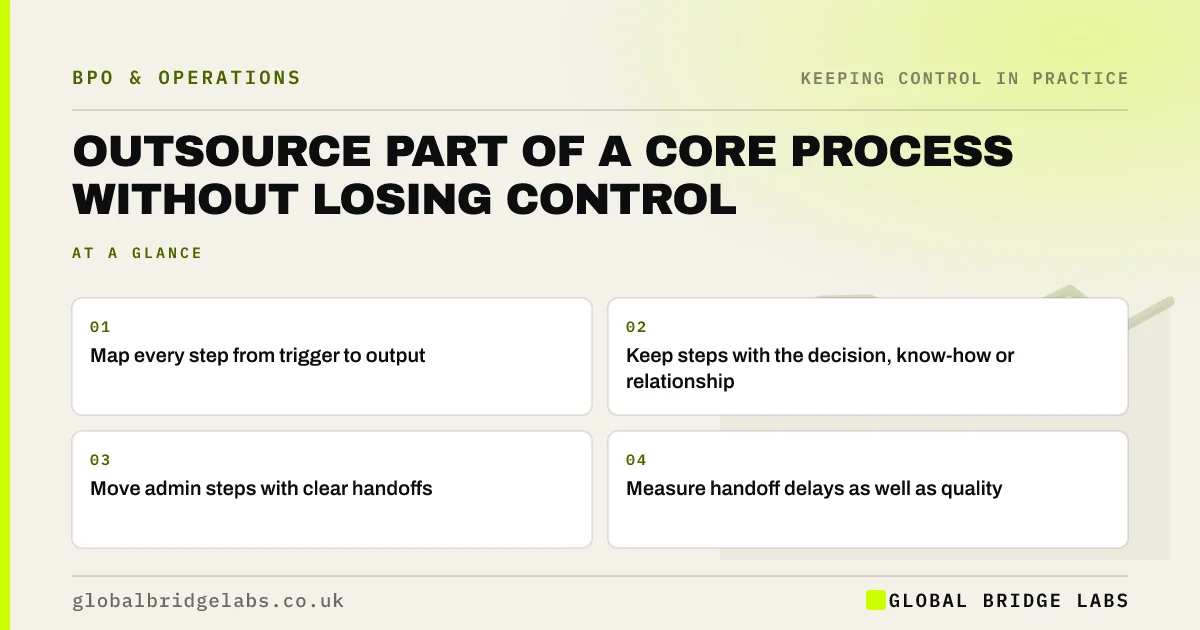
- Map every step from trigger to output.
- Keep steps with the decision, know-how or relationship.
- Move admin steps with clear handoffs.
- Measure handoff delays as well as quality.
Want a core process mapped and split with you? Message us on WhatsApp.
Chat on WhatsApp →Why split a core process instead of keeping it whole?
Because even core processes are mostly admin by hours. A surveyor's report, a consultant's project or a clinic's treatment pathway all include scheduling, document gathering, typing and updates. Keeping those with skilled staff wastes the skill the business is known for.
How do you decide which steps move?
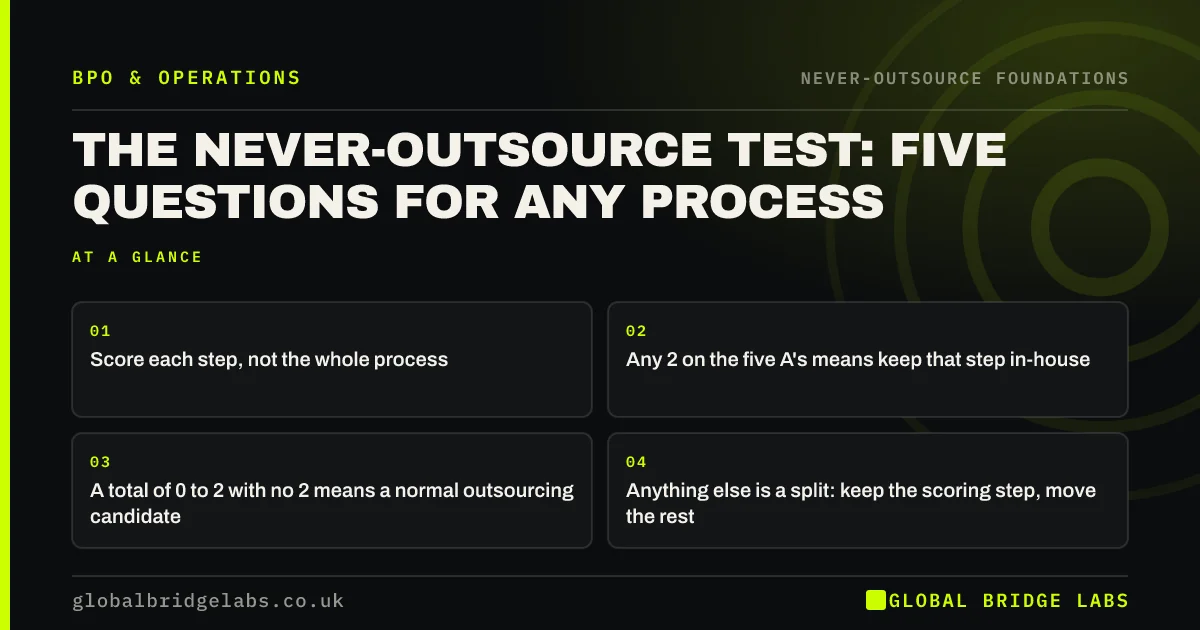
Score each step on the five A's.
- Any 2 on the never-outsource test: keep.
- Low scores and repeatable: move.
- Low scores but tightly linked to a kept step: move with a control.
- Unclear steps: document before deciding.
How do you design the handoffs?
Each handoff needs a clear trigger, a standard pack of information, a time limit and a named receiver. Use a shared system rather than email, so both sides can see status. Most failures in split processes happen at handoffs, not in the steps.
How do you keep control over time?
Name a process owner, review handoff delays and errors monthly, and keep the documentation current. Watch for scope creep, where the provider gradually takes on steps that should stay inside.
What does this look like in practice?
A pattern we see: specialists spend much of their week on scheduling and paperwork. Moving those steps to an outsourced team, with clean handoffs, gives them more time for the expert work customers pay for.
Core process split checklist
- Map the process step by step.
- Score each step on the five A's.
- Keep decision and know-how steps.
- Design handoffs with triggers and time limits.
- Review handoffs monthly.
Next step
Pick your most important process and ask the expert who runs it which steps they wish someone else did. Start there.
Message us on WhatsApp, or book a 30-minute consultation.
Chat on WhatsApp →Sources and further reading
- Designing services that deliver (Shostack, 1984) · Harvard Business Review
- The Sourcing and Consultancy Playbooks · Cabinet Office
Frequently asked questions
Can you outsource part of a core business process?
Yes. Most core processes include admin steps such as scheduling, document collection, data entry and updates that can be outsourced. Keep the steps that carry the decision, the specialist know-how or the customer relationship, and design clear handoffs between the two.
What is the risk of splitting a process?
The main risk is at the handoffs, where information can be delayed or lost. Clear triggers, a standard information pack, time limits, a shared system and a named process owner reduce that risk.
How do you decide which steps to keep?
Ask whether each step carries legal accountability, competitive advantage, authority over money or people, access to critical systems, or valuable know-how. Steps that clearly meet any of these stay; routine steps that do not can move.
Written by

Global Bridge Labs (GBL) is a UK–Sri Lanka partner for social media, websites and BPO. Everything here comes from client delivery, not theory.