On this page
- 01Key takeaways
- 02What is brand credibility on a website?
- 03How does website design influence brand credibility?
- 04What does the research say about design and credibility?
- 05Which parts of a website carry the most credibility?
- 06What are the five credibility signals?
- 07Does better credibility increase enquiries?
- 08What does improving credibility cost?
- 09When is design not the credibility problem?
- 10What does this look like in practice?
- 11Website credibility checklist
- 12Guides on the principles of website credibility
- 13Guides on visual credibility signals
- 14Guides on brand identity online
- 15Guides on credible copy and content
- 16Guides on proof and third-party signals
- 17Guides on legitimacy and transparency
- 18Guides on errors that cost credibility
- 19Credibility guides by sector
- 20Guides on testing and measuring credibility
- 21Guides on credibility in practice
- 22Next step
- 23Sources and further reading
- 24Frequently asked questions
Key takeaways
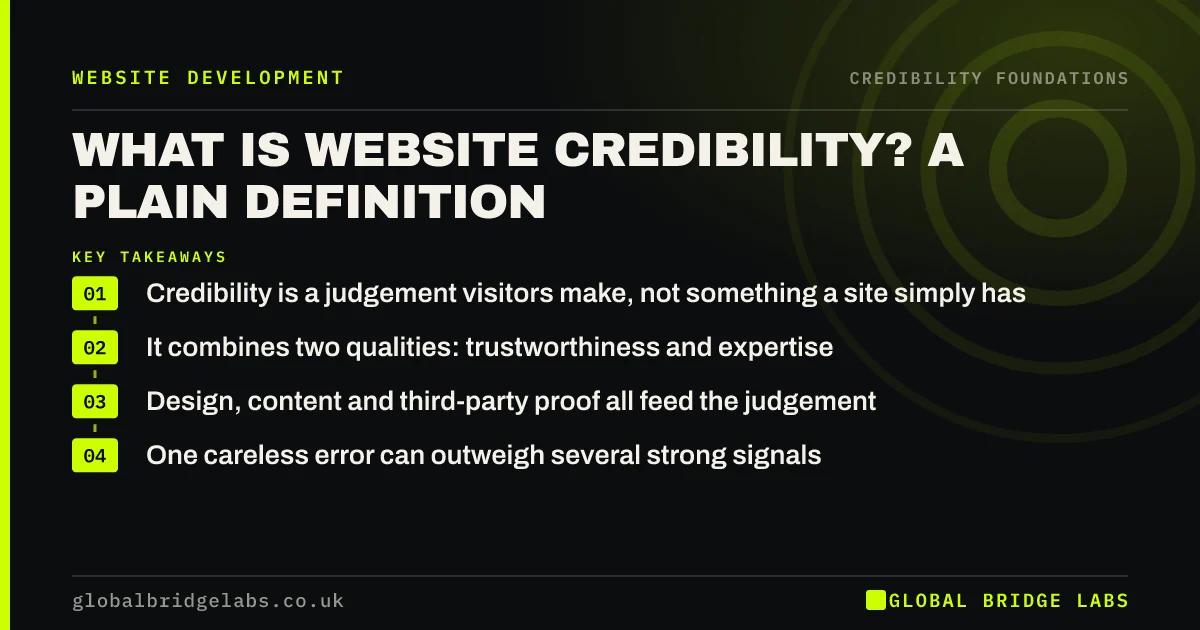
Website design influences brand credibility because visitors use how a site looks and works as evidence of how the business behind it operates. They judge in a fraction of a second, then look for proof: real people, real customers, current content and clear contact routes. Design wins the first glance; substance has to win the second.
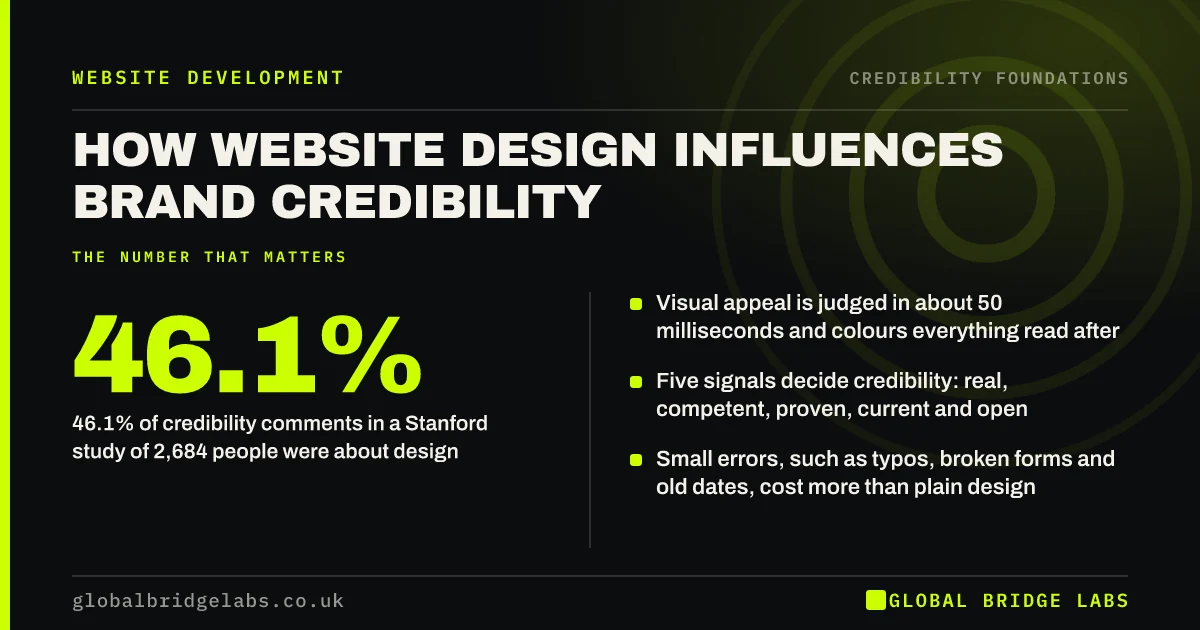
- 46.1% of credibility comments in a Stanford study of 2,684 people were about design.
- Visual appeal is judged in about 50 milliseconds and colours everything read after it.
- Five signals decide credibility: real, competent, proven, current and open.
- Small errors, such as typos, broken forms and old dates, cost more than plain design.
- Most credibility fixes are content and proof, not a full redesign.
Want your site scored on the five credibility signals? Message us on WhatsApp.
Chat on WhatsApp →What is brand credibility on a website?
Website credibility is the degree to which visitors believe a business is real, competent and honest, based on what they see and experience on its website. It is a judgement made by the visitor, not a property of the site, so the same page can look credible to one buyer and doubtful to another.
Brand credibility is the wider belief that a business can deliver what it promises. For most UK small and medium-sized enterprises (SMEs), the website is where that belief is formed or tested, because it is the one place every referral, advert and search result sends people to check.
How does website design influence brand credibility?
Website design influences brand credibility in three ways. It sets the first impression, which visitors form before reading a word. It signals care and competence, because a polished, working site suggests a business that takes the same care with clients. And it controls whether proof, people and contact details are easy to find, or hidden.
- First impression: layout, imagery and polish decide whether visitors stay to read.
- Signal of competence: errors and clutter read as carelessness in the business itself.
- Access to proof: design decides whether reviews, accreditations and faces are seen.
- Consistency: a site that matches the van, the invoice and the social profile feels real.
What does the research say about design and credibility?
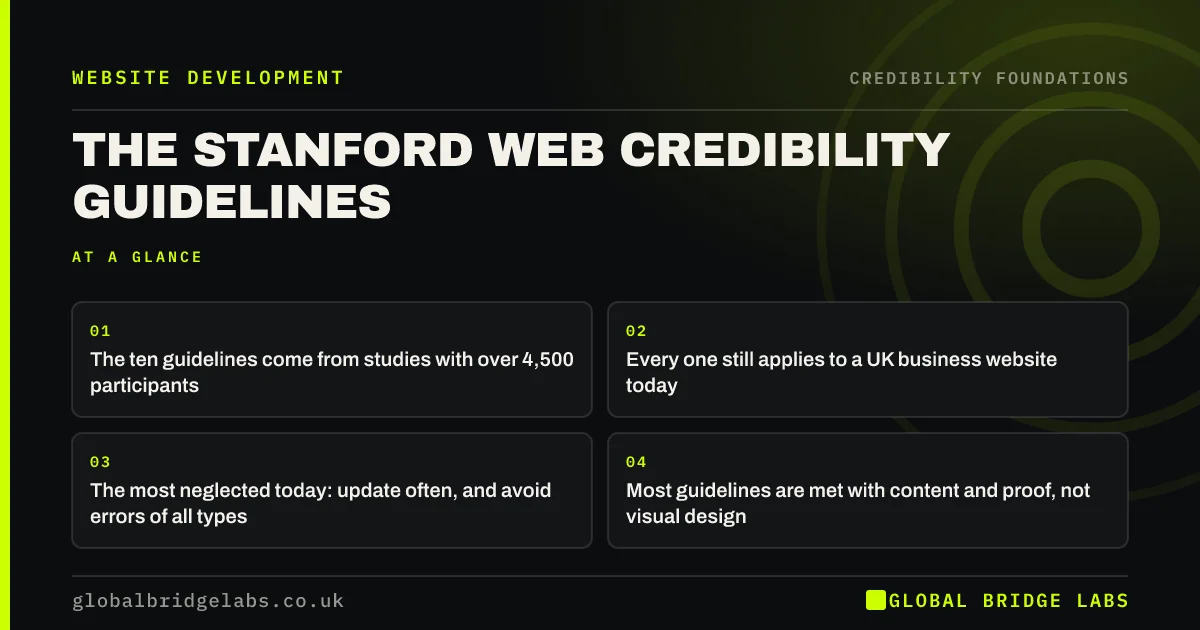
The research is consistent. In a Stanford study of 2,684 people evaluating real websites, 46.1% of credibility comments referred to the design look of the site, more than any other factor (Fogg et al., 2003). Visitors form a reliable judgement of visual appeal in about 50 milliseconds (Lindgaard et al., 2006).
A Google study found that sites with low visual complexity and a familiar layout for their category were rated most appealing within 17 to 50 milliseconds (Tuch et al., 2012). Nielsen Norman Group names design quality as one of four credibility factors, alongside up-front disclosure, comprehensive and current content, and connection to the rest of the web.
Which parts of a website carry the most credibility?
The parts that carry most credibility are the ones visitors check when they are deciding whether to contact you. In our delivery work these are, in rough order, the homepage first screen, the about and team pages, reviews and case studies, the contact page and the footer details. A weak link in any of them undoes good work elsewhere.
- Homepage first screen: a clear offer, real imagery and a visible contact route.
- About and team: named people with real photos and relevant experience.
- Proof: reviews with names and dates, case studies with numbers, accreditations.
- Contact: a phone number, a business email and an address or service area.
- Footer: company number, registered office, policies and a current year.
What are the five credibility signals?
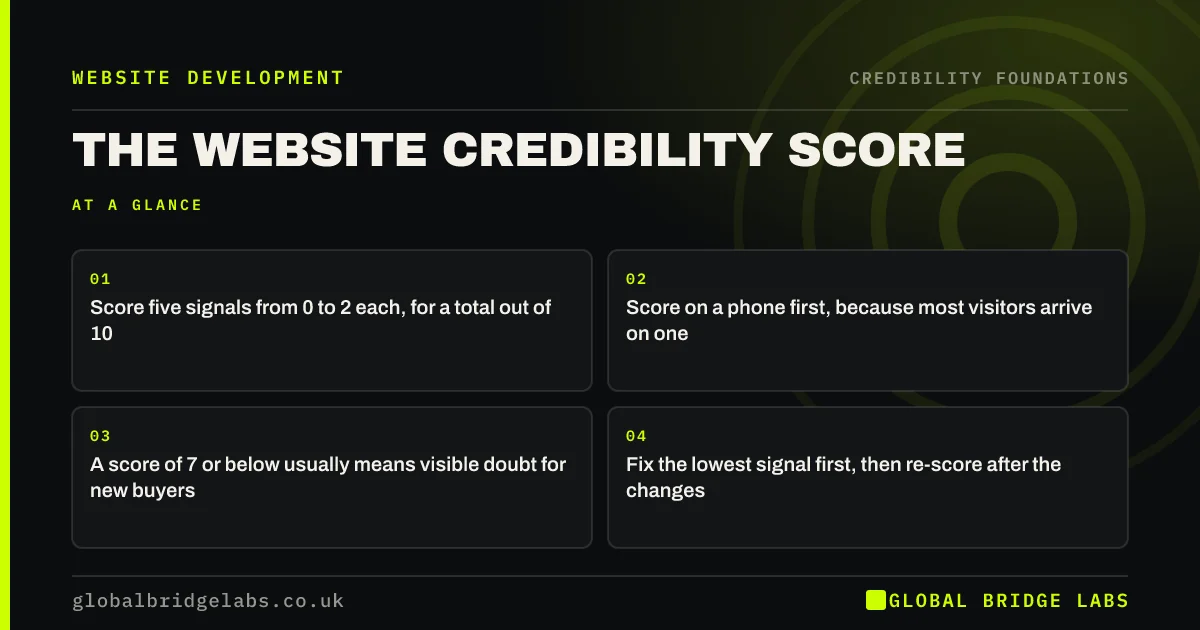
Global Bridge Labs (GBL) reviews credibility against five signals, which together make the GBL Credibility Score. Each is scored 0 to 2, where 2 means the signal is fully present, for a total out of 10. It is a working method, not an industry standard, but it turns 'the site feels off' into a list of fixes.
- Real: can a visitor verify the business exists, with people, an address and a company number?
- Competent: does the site look cared for and work without errors on every device?
- Proven: is there named, dated, third-party proof that you deliver?
- Current: are dates, prices, team and content up to date?
- Open: are prices or ranges, process, policies and contact routes easy to find?
Does better credibility increase enquiries?
Better credibility increases enquiries when doubt is what stops visitors acting. If buyers reach your service and contact pages but leave, missing proof or a careless look is a common cause. Across our client work, websites rebuilt around clarity, proof and an obvious next step have reached a 2.4× enquiry rate, with credibility one part of that work.
Trust also shapes buying decisions beyond the website. In Edelman's 2019 brand trust report, 81% of people said they must be able to trust a brand to do what is right before buying from it. The website is often the first place that trust is tested.
What does improving credibility cost?
Most credibility improvements are cheaper than a redesign because they are content, proof and fixes. In the UK market, focused fixes to an existing site typically cost £500–£3,000, a redesign of key templates on the same platform about £3,000–£12,000, and a full rebuild £5,000–£20,000 or more. A commercial photography half-day is indicatively £300–£600. These are market ranges, not a GBL price list.
The cost of doing nothing is quieter. Visitors who doubt you rarely complain; they simply contact the next business on the list.
- How much does it cost to fix bad website design?
- Website photography cost in the UK: what a shoot buys
Want a costed credibility plan for your site? Message us on WhatsApp and we will discuss your requirements.
Chat on WhatsApp →When is design not the credibility problem?
Design is not the problem when the site already looks cared for but says nothing specific. Vague claims, no proof and no prices will undermine a beautiful site. Design is also not the answer when the business itself has a reputation problem, such as poor reviews; no layout fixes that. Fix the substance first, then the presentation.
A full redesign is rarely the first step. If your Credibility Score is held back by one or two signals, such as missing proof or an out-of-date team page, fix those and re-score before spending on a new look.
What does this look like in practice?
A pattern we see on UK service business sites: a professional-looking template, stock photos of people who do not work there, a Gmail address, no company number and a blog that stopped three years ago. Each element is small, but together they tell a buyer the business may not be what it seems. Replacing the photos, adding real names and proof, moving to a domain email and removing the dead blog changes the impression without a rebuild.
Website credibility checklist
- Show real photos of your team and work, with names.
- Display your company number and registered office in the footer.
- Use an email address on your own domain.
- Add named, dated reviews and at least one case study with numbers.
- Remove or update anything dated: blog, team, prices, copyright year.
- Proofread every key page and test every form.
- Make phone, email and reply times visible on every page.
Guides on the principles of website credibility
These guides explain what credibility is, how visitors judge it and how to score your own site.
- What is website credibility? A plain definition
- The website credibility score: rate your site out of 10
- The Stanford web credibility guidelines, applied today
- Aesthetic-usability effect: why good looks feel easier
- The halo effect in web design: one good impression spreads
- The four types of website credibility, explained
- Prominence-interpretation theory: what visitors notice
- Website credibility vs trust: what is the difference?
- Design or content: which matters more for credibility?
Guides on visual credibility signals
These guides cover the visual choices that make a site look professional, from complexity and colour to logos and imagery.
- What makes a website look professional?
- Visual complexity and prototypicality: why simple wins
- Colour psychology: do some colours build more trust?
- Dark website designs: premium look or harder to read?
- Does accessibility affect how credible your brand looks?
- Does logo quality affect your website's credibility?
- Illustrations vs photos: which builds more trust?
- A design system for a small business website
- Minimalist website design: credible or just empty?
- Can a website look too polished to trust?
Guides on brand identity online
These guides cover how your brand shows up on the website: guidelines, voice, story, assets and cost.
- Brand guidelines for your website: what to include
- Do you need a favicon? The small icon buyers notice
- Tone of voice for your website: sound like a business
- Brand identity design cost in the UK
- Personal brand vs company brand: which should lead?
- Brand credibility vs brand awareness for small firms
- Your founder story on the website: when it builds trust
- Website visual refresh: new look without a rebuild
- Should a small business try to look bigger online?
- Distinctive brand assets: be recognised at a glance
Guides on credible copy and content
These guides cover the words on the page: accuracy, claims, sources, authorship and freshness.
- Spelling mistakes on your website: what they cost
- Website claims and the CAP Code: what UK firms can say
- Cite your sources: back up the numbers on your website
- Jargon on your website: why experts want plain words too
- An abandoned blog on your website: fix, freeze or delete?
- The copyright year in your footer: does it matter?
- Author bios on a business blog: show who wrote it
- E-E-A-T for small business websites, in plain terms
- AI-written website copy: does it cost you trust?
- A 'How we work' page: show the process buyers buy
Guides on proof and third-party signals
These guides cover reviews, client logos, accreditations, awards and press, and the law around them.
- Client logos on your website: permission and placement
- Showing Google reviews on your website, the right way
- Trustpilot vs Google reviews for UK small businesses
- Fake reviews law in the UK: what businesses must know
- Accreditation badges on your website: which to show
- Awards on your website: when they help and when they hurt
- 'As seen in' logos: press mentions that build trust
- Video testimonials: worth the effort for a small firm?
- Should you show negative reviews on your website?
- Review stars in Google results: who can still get them
Guides on legitimacy and transparency
These guides cover the details buyers use to check you are real: email, phone, address, domain and security.
- Professional email address vs Gmail: what buyers think
- Landline or mobile number on your website?
- Should you put your home address on your website?
- Does HTTPS make a website trustworthy?
- .co.uk vs .com: which domain do UK customers trust?
- How customers check a business is legitimate
- NAP consistency: same name, address and phone everywhere
- Checkout trust seals: do payment badges reassure buyers?
- Promise a reply time on your website, then keep it
- 'Established in': should you show years in business?
Guides on errors that cost credibility
These guides cover the faults that undo good design, from security warnings to emails that never arrive.
- Machine-translated websites: when translation hurts trust
- Placeholder text left on a live website: find and fix it
- 'Not secure' warning on your website: what it means
- Contact form emails going to spam? Fix it before leads go
- Coming soon pages: when to launch something smaller
- Domain name expired: how to stop your site disappearing
- Signs of an untrustworthy website buyers spot fast
- Inactive social media links on your website
- DMARC for small businesses: stop fake emails in your name
- When your chatbot gets it wrong: who is liable?
Credibility guides by sector
These guides apply the same signals to specific sectors, including the regulator rules that apply to each.
- How tradespeople build trust with their website
- Accountant website credibility: what clients check
- Solicitor website credibility: SRA rules and trust
- Financial adviser websites: credibility within FCA rules
- Clinic website credibility: CQC ratings, people and proof
- How to make an online shop look trustworthy
- Logistics website credibility: what shippers check
- Restaurant and hotel websites: credibility before booking
- New business website: credibility before you have reviews
- Estate agent website credibility: redress, fees and proof
Guides on testing and measuring credibility
These guides cover the tests, surveys and numbers that show whether visitors believe you.
- How to test your website's credibility with real people
- The desirability toolkit: test how your site feels
- Website trust survey questions that get honest answers
- Preference testing: choose between two designs with data
- Website trust metrics: signs credibility is working
- Mystery shop your own website: a buyer's-eye check
- How AI assistants decide which businesses to recommend
- Google's quality rater guidelines for small businesses
- Website credibility statistics, with sources
- Does website credibility affect conversion rate?
Guides on credibility in practice
These guides cover credibility in real buying situations, plus quick wins, briefs, costs and a 90-day plan.
- How B2B buyers shortlist suppliers from their websites
- Your website and public sector tenders: what buyers check
- After the cold email: what prospects check on your site
- Overseas supplier website: earning UK buyers' trust
- Paid ad landing pages: build trust in one screen
- Website credibility quick wins you can make this week
- Credibility in your website brief: what to ask for
- A 90-day plan to make your website more credible
- Website photography cost in the UK: what a shoot buys
- Website credibility myths that waste design budget
Next step
Score your site on the five signals this week, then fix the lowest one first. Most credibility gaps are content and proof, which can change in days.
Message us on WhatsApp for a website credibility review, or book a 30-minute consultation.
Chat on WhatsApp →Sources and further reading
- How do users evaluate the credibility of web sites? A study with over 2,500 participants · ACM (Fogg et al., 2003)
- Attention web designers: you have 50 milliseconds to make a good first impression · Behaviour & Information Technology (Lindgaard et al., 2006)
- The role of visual complexity and prototypicality regarding first impression of websites · Google Research (Tuch et al., 2012)
- Trustworthiness in web design: 4 credibility factors · Nielsen Norman Group
- In brands we trust? 2019 Edelman Trust Barometer special report · Edelman
Frequently asked questions
Does website design affect credibility?
Yes. In a Stanford study of 2,684 people, the design look of a site was the most-mentioned factor when judging credibility, at 46.1% of comments. Visitors use design as a quick signal of how careful and competent the business is, then look for proof to confirm it.
How quickly do visitors judge a website?
Research by Lindgaard and colleagues found visitors form a consistent judgement of visual appeal in about 50 milliseconds. That first impression is not final, but it shapes how they read everything after it, which is why a cluttered or dated first screen is costly.
What makes a website look untrustworthy?
The common causes are stock photos of people who do not work there, no named team, a free email address, no company details, spelling mistakes, broken forms, security warnings and out-of-date content. Individually small, together they make visitors doubt the business is real or careful.
Do I need a redesign to look more credible?
Usually not. Most credibility gaps are fixed with real photos, named people, visible proof, company details, a domain email and removing out-of-date content. Consider a redesign only if the site still looks careless or broken on phones after those fixes.
Written by

Global Bridge Labs (GBL) is a UK–Sri Lanka partner for social media, websites and BPO. Everything here comes from client delivery, not theory.