On this page
- 01Key takeaways
- 02What does the research say?
- 03When does design matter more?
- 04When does content matter more?
- 05How should you split your budget?
- 06When is the answer neither?
- 07What does this look like in practice?
- 08Design or content checklist
- 09Next step
- 10Sources and further reading
- 11Frequently asked questions
Key takeaways
Design matters most for the first impression; content matters most for the decision. Visitors use design to decide whether to stay and content to decide whether to believe and act. In Stanford research, design was the most-mentioned credibility factor, but information quality came next. A credible site needs both, in that order of visibility.
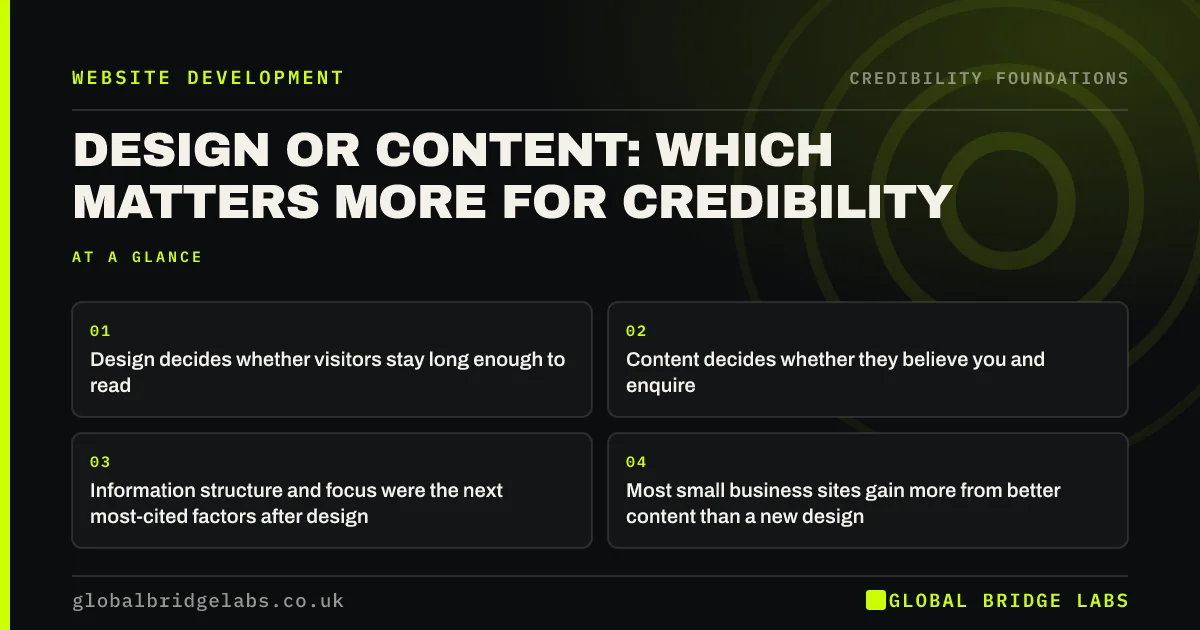
- Design decides whether visitors stay long enough to read.
- Content decides whether they believe you and enquire.
- Information structure and focus were the next most-cited factors after design.
- Most small business sites gain more from better content than a new design.
Want to know whether your site needs design or content work? Message us on WhatsApp.
Chat on WhatsApp →What does the research say?
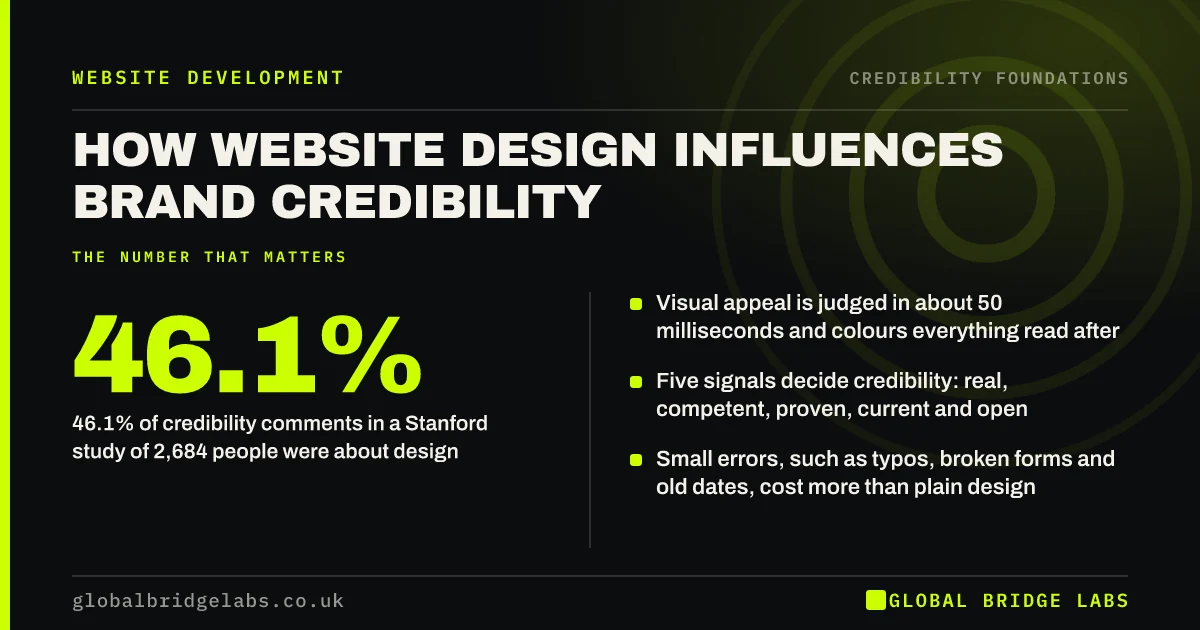
In Fogg and colleagues' 2003 study of 2,684 people, 46.1% of credibility comments mentioned the design look, 28.5% the information design or structure and 25.1% the information focus. Design was the single most noticed factor, but nearly as many comments were about how information was organised and what it said. Design gets noticed first; content gets weighed.
When does design matter more?
Design matters more when visitors are deciding quickly, such as arriving from an advert or a search result with several competitors open. In those moments, a careless look ends the visit before content is read. It also matters more for visual businesses, such as hospitality, interiors or retail, where the site is a sample of taste.
When does content matter more?
Content matters more for considered purchases: professional services, B2B suppliers, healthcare and anything expensive. Buyers read service details, proof, prices and process. Specific, accurate, current content is what persuades them. A plain site with excellent content often outperforms a stylish one with vague copy.
How should you split your budget?
Start with content, because it is cheaper and usually weaker. Write specific service pages, gather proof and fix errors. Then decide whether the design still undermines the content. If the site looks dated or broken on phones, a visual refresh on the same platform, typically within £3,000–£12,000 in the UK market, is often enough.
- Website visual refresh: new look without a rebuild
- Website copywriting for small businesses that sells
Want a costed split between content and design work? Message us on WhatsApp and we will discuss your requirements.
Chat on WhatsApp →When is the answer neither?
Sometimes the issue is not on the website at all. Poor reviews, slow replies to enquiries or prices out of line with the market will undermine credibility whatever the design or copy. Check reviews and response times before spending on either.
What does this look like in practice?
A pattern we see: an owner asks for a redesign because the site 'looks tired'. A review shows the design is acceptable but service pages are three lines each with no proof. Rewriting the five main service pages with detail and a case study each lifts enquiries before any design change.
Design or content checklist
- Check whether the site looks broken or dated on a phone (design).
- Check whether each service page answers buyers' questions (content).
- Check for proof on every key page (content).
- Fix content gaps first, then re-assess design.
Next step
Read your main service page aloud to someone outside the business. If they cannot say what you do and why you, start with content.
Message us on WhatsApp for a content and design review, or book a 30-minute consultation.
Chat on WhatsApp →Sources and further reading
- How do users evaluate the credibility of web sites? A study with over 2,500 participants · ACM (Fogg et al., 2003)
- Stanford guidelines for web credibility · Stanford Web Credibility Project
- How users read on the web · Nielsen Norman Group
Frequently asked questions
Is website design or content more important?
Both, at different moments. Design wins the first few seconds and decides whether visitors stay. Content wins the decision, because buyers read it to judge whether you can help. For most small businesses, content is the weaker of the two and the cheaper to fix.
Can good content make up for poor design?
Partly. Excellent content can carry a plain design, especially for considered purchases. But a design that looks broken, dated or careless will stop many visitors reading at all. Plain is fine; careless is not.
Does a new design improve credibility?
Only if the old design was the problem. A new design on top of vague content and missing proof usually changes little. Fix content and proof first, then redesign if the site still looks dated or broken.
Written by

Global Bridge Labs (GBL) is a UK–Sri Lanka partner for social media, websites and BPO. Everything here comes from client delivery, not theory.