On this page
- 01Key takeaways
- 02What are the quality rater guidelines?
- 03What do raters look for on a business site?
- 04What is YMYL and does it apply to you?
- 05How do raters research reputation?
- 06What are the limits of the guidelines?
- 07What does this look like in practice?
- 08Rater guidelines checklist
- 09Next step
- 10Sources and further reading
- 11Frequently asked questions
Key takeaways
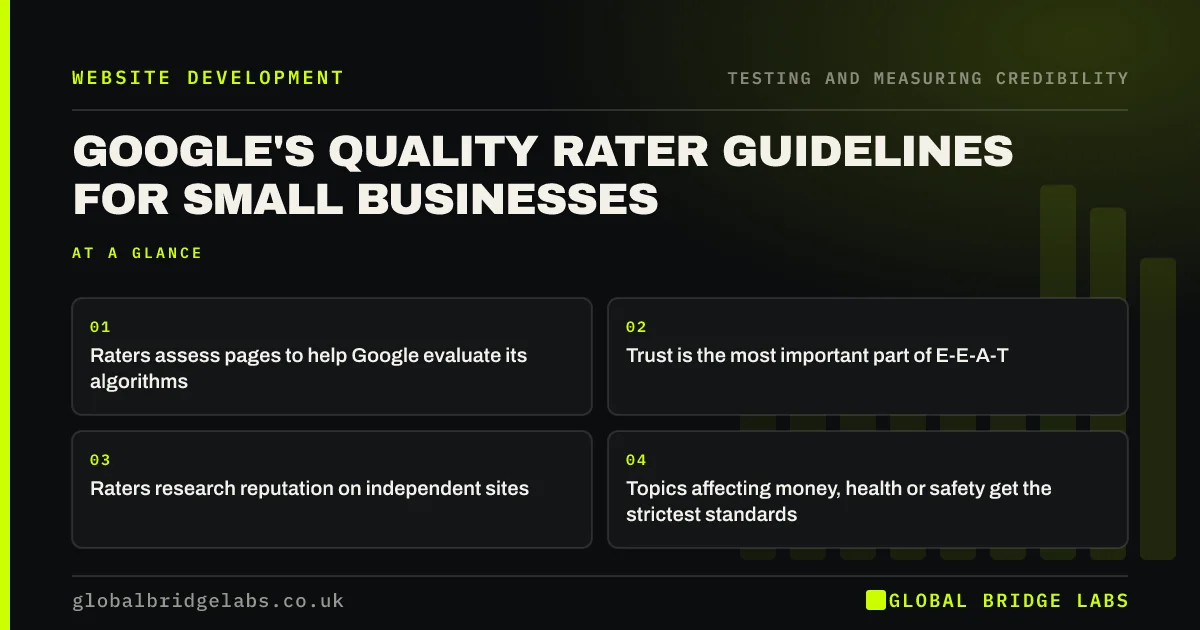
Google's Search Quality Rater Guidelines tell the human raters who evaluate search results what high- and low-quality pages look like. Raters do not change rankings directly, but the guidelines describe what Google's systems aim to reward. For a small business, the key lessons are: show who is responsible, build a good reputation, and be trustworthy above all.
- Raters assess pages to help Google evaluate its algorithms.
- Trust is the most important part of E-E-A-T.
- Raters research reputation on independent sites.
- Topics affecting money, health or safety get the strictest standards.
Want your site reviewed against the rater guidelines? Message us on WhatsApp.
Chat on WhatsApp →What are the quality rater guidelines?
The Search Quality Rater Guidelines are a public document Google gives to thousands of external raters, who assess the quality of search results. Their ratings help Google judge whether changes to its systems improve results. Google says ratings are not used to rank individual pages, but the guidelines reveal what 'quality' means to Google.
What do raters look for on a business site?
Several checks map directly to website credibility.
- Who owns the website and who is responsible for the content.
- Clear contact and customer service information, especially for shops.
- The reputation of the business and authors on independent sites.
- First-hand experience and expertise in the content.
- Signs of deception, such as misleading claims or hidden intent.
What is YMYL and does it apply to you?
YMYL stands for 'Your Money or Your Life': topics that could significantly affect people's health, financial stability or safety. Pages on these topics are held to higher standards of trust and expertise. Financial services, healthcare, legal advice and some home services fall here, so those businesses need especially clear credentials and sources.
- Financial adviser websites: credibility within FCA rules
- Clinic website credibility: CQC ratings, people and proof
Want your YMYL pages checked for trust signals? Message us on WhatsApp and we will discuss your requirements.
Chat on WhatsApp →How do raters research reputation?
Raters are instructed to look for what others say about a website or business, using independent sources such as reviews, news articles and references, not only what the business says about itself. A strong review profile and genuine third-party mentions therefore matter. Self-praise on your own site carries little weight in this process.
What are the limits of the guidelines?
The guidelines are not a ranking checklist. Following them will not guarantee positions, and Google uses many other signals. Use them as a description of what a trustworthy, useful site looks like, which also happens to be what buyers want.
What does this look like in practice?
A pattern we see: a financial adviser's guides are detailed but published anonymously, with no about page linking the firm to its FCA registration. Adding named authors, credentials and a clear 'who we are' section aligns the site with what the guidelines describe as trustworthy.
Rater guidelines checklist
- Make ownership and responsibility clear.
- Show contact and customer service details.
- Build independent reviews and mentions.
- Name qualified authors on advice content.
- Apply higher standards on YMYL topics.
Next step
Search your business name plus 'reviews' as a rater would. What you find is part of how your quality is judged.
Message us on WhatsApp for a search quality review, or book a 30-minute consultation.
Chat on WhatsApp →Sources and further reading
- Search quality rater guidelines · Google
- Our latest update to the quality rater guidelines: E-A-T gets an extra E for Experience · Google Search Central Blog
- Creating helpful, reliable, people-first content · Google Search Central
Frequently asked questions
Do Google's quality raters affect my rankings?
Not directly. Google says rater scores are used to evaluate changes to its search systems, not to rank individual pages. The guidelines show what Google's systems aim to reward, so they are a useful quality reference.
What does YMYL mean?
YMYL stands for 'Your Money or Your Life'. It covers topics that could significantly affect a person's health, financial stability, safety or wellbeing. Google's guidelines hold these pages to higher standards of trust and expertise.
What is the most important part of E-E-A-T?
Google's rater guidelines state that trust is the most important member of the E-E-A-T family. Experience, expertise and authoritativeness support trust, but an untrustworthy page has low E-E-A-T however expert it appears.
Written by

Global Bridge Labs (GBL) is a UK–Sri Lanka partner for social media, websites and BPO. Everything here comes from client delivery, not theory.