On this page
- 01Key takeaways
- 02How fast do visitors judge a website?
- 03How much does design shape credibility?
- 04What do reviews and trust do to buying?
- 05What do accessibility and security figures show?
- 06What do our own projects show?
- 07How should you use these statistics?
- 08Credibility statistics checklist
- 09Next step
- 10Sources and further reading
- 11Frequently asked questions
Key takeaways
The most reliable website credibility statistics come from a handful of studies. Visitors judge visual appeal in about 50 milliseconds. Design was the most-mentioned credibility factor, at 46.1% of comments, in a Stanford study of 2,684 people. Products with five reviews were 270% more likely to be bought than those with none. Each figure below links to its source.
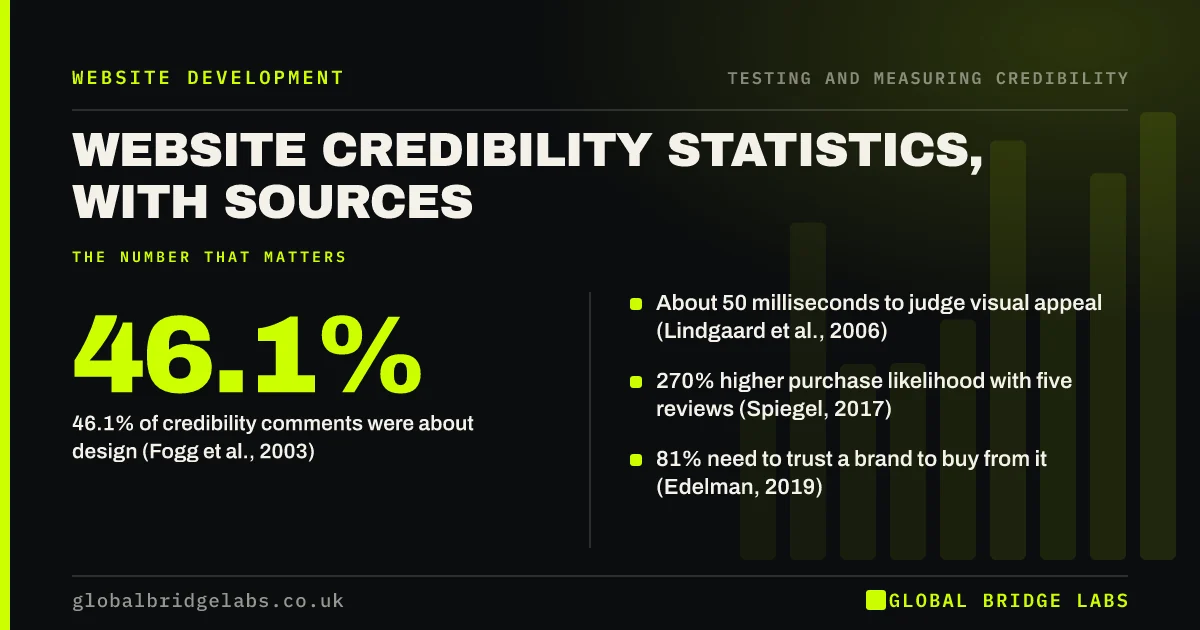
- About 50 milliseconds to judge visual appeal (Lindgaard et al., 2006).
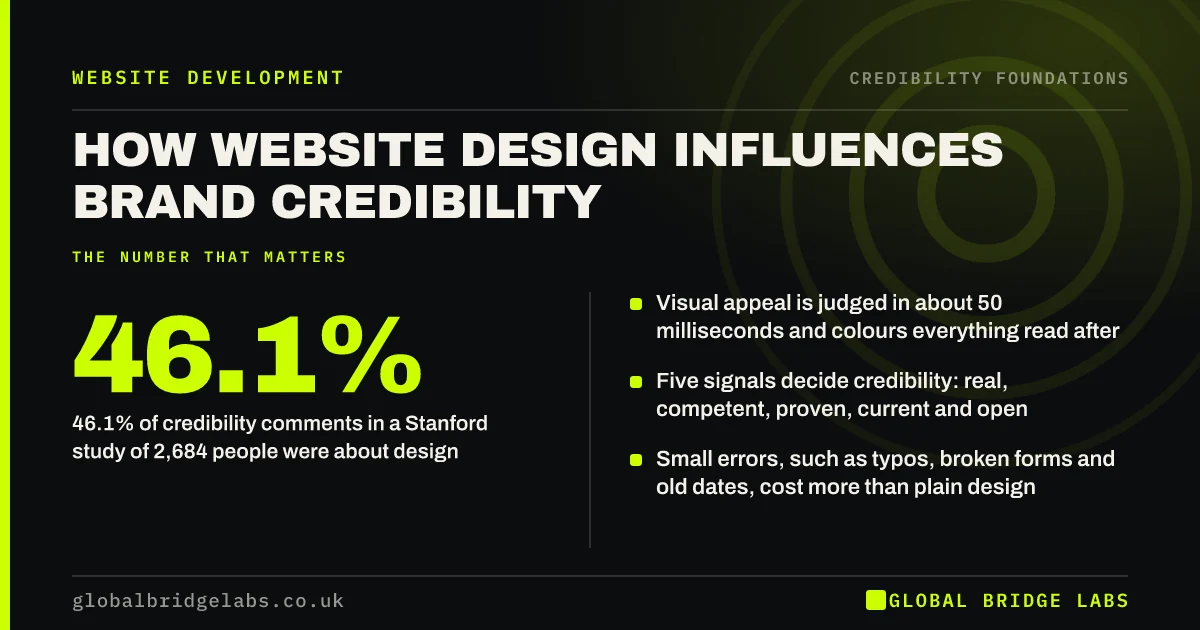
- 46.1% of credibility comments were about design (Fogg et al., 2003).
- 270% higher purchase likelihood with five reviews (Spiegel, 2017).
- 81% need to trust a brand to buy from it (Edelman, 2019).
Want these numbers applied to your own site? Message us on WhatsApp.
Chat on WhatsApp →How fast do visitors judge a website?
Visitors form a consistent judgement of a website's visual appeal in about 50 milliseconds, according to Lindgaard and colleagues (2006). A Google study found first impressions formed from screenshots shown for 17 to 50 milliseconds, with simple, familiar-looking sites rated most appealing (Tuch et al., 2012).
How much does design shape credibility?
In a Stanford study of 2,684 people evaluating real websites, 46.1% of credibility comments referred to the design look, 28.5% to information design or structure and 25.1% to information focus (Fogg et al., 2003). The Stanford guidelines for web credibility drew on research with over 4,500 people.
What do reviews and trust do to buying?
The Spiegel Research Center found the purchase likelihood for a product with five reviews was 270% greater than for a product with none, and that purchase likelihood peaked for ratings between 4.0 and 4.7 (2017). Edelman's 2019 brand trust report found 81% of people said they must trust a brand to do what is right before buying.
- Showing Google reviews on your website, the right way
- Should you show negative reviews on your website?
Want a credibility plan grounded in this research? Message us on WhatsApp and we will discuss your requirements.
Chat on WhatsApp →What do accessibility and security figures show?
WebAIM's 2026 analysis of the top one million home pages found detectable WCAG failures on 95.9% of them. Since Chrome 68 in July 2018, Chrome has marked every HTTP page 'Not secure'. Nielsen Norman Group's early research found 79% of test users scanned new pages and only 16% read word by word.
What do our own projects show?
Across our client work, websites rebuilt around clarity, proof and an obvious next step have reached a 2.4× enquiry rate, with credibility one part of that work. We present this as delivery experience, not a controlled study; results depend on the starting point, the offer and traffic.
How should you use these statistics?
Use them to prioritise, not to promise. They show that first impressions, design quality and third-party proof matter, but they come from specific studies, years and contexts. When you quote them, name the source and year, and avoid rounding them into claims they do not support.
Credibility statistics checklist
- Quote figures with source and year.
- Link to the original study.
- Use them to prioritise fixes, not as guarantees.
- Prefer recent and UK figures where available.
- Label your own data clearly.
Next step
Use the 50-millisecond figure as a test: what does your homepage say in its first glance?
Message us on WhatsApp for a credibility review, or book a 30-minute consultation.
Chat on WhatsApp →Sources and further reading
- Attention web designers: you have 50 milliseconds to make a good first impression · Behaviour & Information Technology (Lindgaard et al., 2006)
- How do users evaluate the credibility of web sites? A study with over 2,500 participants · ACM (Fogg et al., 2003)
- How online reviews influence sales · Spiegel Research Center, Northwestern University
- In brands we trust? 2019 Edelman Trust Barometer special report · Edelman
- The WebAIM Million: accessibility of the top 1,000,000 home pages · WebAIM
Frequently asked questions
How long does it take to form a first impression of a website?
Research by Lindgaard and colleagues (2006) found people form a consistent judgement of visual appeal in about 50 milliseconds. A 2012 Google study found impressions formed from exposures as short as 17 milliseconds.
What percentage of people judge credibility by design?
In Fogg and colleagues' 2003 Stanford study of 2,684 people, 46.1% of comments about website credibility referred to the design look, more than any other factor. It does not mean 46.1% of people judge only on design.
Do reviews increase sales?
Research from Northwestern University's Spiegel Research Center found products with five reviews were 270% more likely to be purchased than products with none. Purchase likelihood peaked at ratings between 4.0 and 4.7.
Written by

Global Bridge Labs (GBL) is a UK–Sri Lanka partner for social media, websites and BPO. Everything here comes from client delivery, not theory.