On this page
Key takeaways
Jargon on a business website makes it harder to understand and so harder to believe. Nielsen Norman Group's research found that even experts prefer plain language, because it is faster to read. Use the words your buyers use, explain necessary terms once and replace vague industry phrases with specific facts.
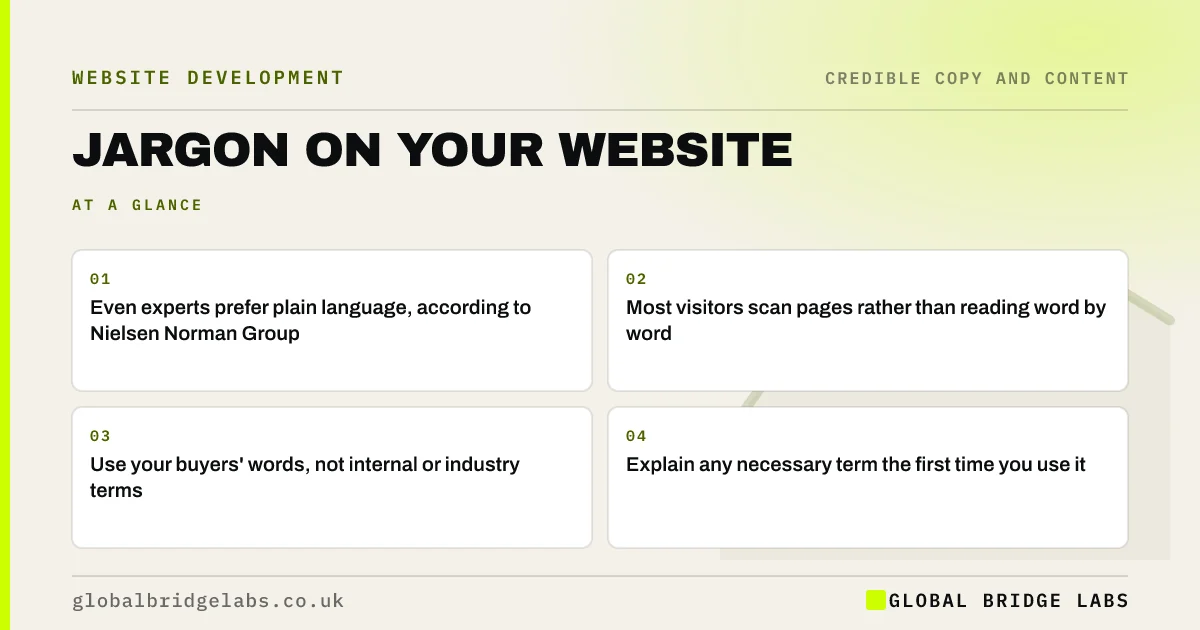
- Even experts prefer plain language, according to Nielsen Norman Group.
- Most visitors scan pages rather than reading word by word.
- Use your buyers' words, not internal or industry terms.
- Explain any necessary term the first time you use it.
Want your service pages rewritten in plain English? Message us on WhatsApp.
Chat on WhatsApp →Why does jargon hurt credibility?
Jargon hurts credibility in two ways. Visitors who do not understand it cannot judge whether you can help, so they leave. Visitors who do understand it often read it as padding, especially vague phrases like 'end-to-end solutions' or 'synergistic approach'. Either way, jargon replaces the specific information buyers use to decide.
Do expert buyers want jargon?
Usually not. Nielsen Norman Group's study 'Plain language is for everyone, even experts' found that specialists also preferred plain, concise text, because they are busy and scanning too. Correct technical terms are fine for expert audiences; vague business jargon is not. Precision is credible; padding is not.
How do you remove jargon quickly?
Work through your key pages with these rules.
- Replace 'solutions' with what you actually do.
- Replace adjectives with facts: numbers, timescales, places.
- Use the words customers use in calls and emails.
- Explain acronyms on first use.
- Keep sentences mostly under 25 words.
- Tone of voice for your website: sound like a business
- Website copywriting for small businesses that sells
Want a plain-English rewrite of your homepage and services? Message us on WhatsApp and we will discuss your requirements.
Chat on WhatsApp →When are technical terms necessary?
Technical terms are necessary when they are what buyers search for or what regulators require, such as 'Gas Safe registered' or 'lasting power of attorney'. Use them, and explain them once in plain words. The aim is not to dumb down; it is to remove words that carry no information.
What does this look like in practice?
A pattern we see: a logistics firm's homepage promises 'integrated end-to-end supply chain solutions'. Rewritten as 'We collect from your warehouse, store, pick, pack and deliver across the UK, with live tracking for every order', visitors immediately understand the service and believe it.
Plain language checklist
- Search your site for 'solutions', 'innovative' and 'bespoke'.
- Rewrite each instance as a specific fact.
- Explain every acronym on first use.
- Read pages aloud to check they sound natural.
- Ask a customer whether the homepage says what you do.
Next step
Ask a customer to describe your service in their words. Use their sentence on your homepage.
Message us on WhatsApp for a copy review, or book a 30-minute consultation.
Chat on WhatsApp →Sources and further reading
- Plain language is for everyone, even experts · Nielsen Norman Group
- How users read on the web · Nielsen Norman Group
- Writing to GOV.UK standards: writing guidelines · GOV.UK
Frequently asked questions
Should I avoid jargon on my website?
Avoid vague business jargon such as 'solutions' and 'synergy', and explain any necessary technical terms. Plain language is faster to read for everyone, including experts, and makes it easier for buyers to see what you do and believe you.
Do professionals prefer plain language?
Research by Nielsen Norman Group found that experts also prefer plain, concise language, because they are busy and scan pages too. They still expect correct technical terms, but not padding.
How do I make my website copy plainer?
Replace vague words with specific facts, use the words customers use, explain acronyms, shorten sentences and read the page aloud. If a sentence would sound odd said to a customer, rewrite it.
Written by

Global Bridge Labs (GBL) is a UK–Sri Lanka partner for social media, websites and BPO. Everything here comes from client delivery, not theory.