On this page
- 01Key takeaways
- 02Does the CAP Code apply to my website?
- 03What evidence do you need?
- 04How do you word claims credibly?
- 05What about reviews and testimonials?
- 06When is a claim just puffery?
- 07What does this look like in practice?
- 08Website claims checklist
- 09Next step
- 10Sources and further reading
- 11Frequently asked questions
Key takeaways
Marketing claims on your own website are covered by the UK Code of Non-broadcast Advertising (CAP Code), enforced by the Advertising Standards Authority (ASA). You must hold evidence for objective claims before you publish them. Claims like 'best', 'cheapest' or 'number one' need proof. Specific, provable claims are both safer and more credible.
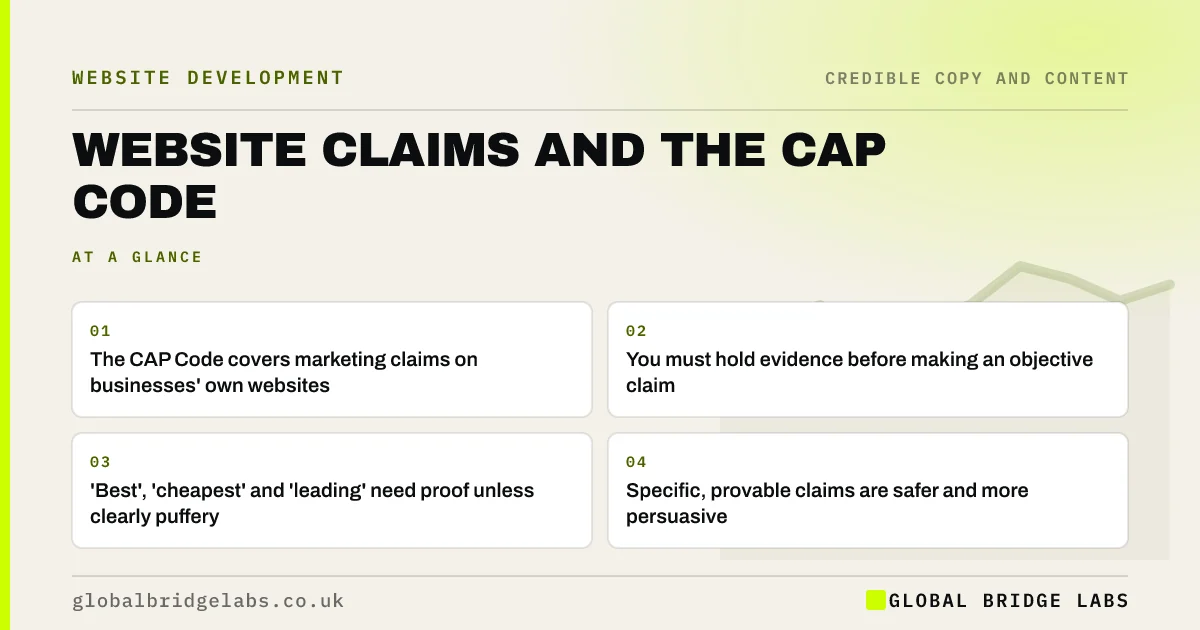
- The CAP Code covers marketing claims on businesses' own websites.
- You must hold evidence before making an objective claim.
- 'Best', 'cheapest' and 'leading' need proof unless clearly puffery.
- Specific, provable claims are safer and more persuasive.
Want your website claims checked for evidence? Message us on WhatsApp.
Chat on WhatsApp →Does the CAP Code apply to my website?
Yes. Since 2011 the ASA's remit has covered marketing communications on businesses' own websites and social media accounts, not only paid adverts. Claims about your products, services, prices and results on your website must not mislead, and objective claims must be substantiated. Editorial content, such as genuine articles, is treated differently from sales copy.
What evidence do you need?
Rule 3.7 of the CAP Code requires marketers to hold documentary evidence to prove objective claims before publishing them. The ASA's substantiation guidance says the evidence must match the claim exactly. A claim of '98% customer satisfaction' needs a survey that measured that; 'trusted by 500 businesses' needs a client list.
- Numbers: the data, its date and how it was collected.
- Comparisons: like-for-like evidence about named or implied competitors.
- 'Best' or 'number one': independent evidence, unless clearly subjective.
- Results: typical outcomes, not only the best case.
How do you word claims credibly?
Replace superlatives with specifics. 'The best plumber in Leeds' is hard to prove and easy to doubt. 'Gas Safe registered, 412 five-star Google reviews, average arrival within 2 hours in LS postcodes' is provable and more persuasive. Date your figures and say where they came from.
- Accreditation badges on your website: which to show
- Showing Google reviews on your website, the right way
Want your homepage claims rewritten as provable facts? Message us on WhatsApp and we will discuss your requirements.
Chat on WhatsApp →What about reviews and testimonials?
Testimonials must be genuine, held on file and reflect typical experience if presented that way. Since April 2025, the Digital Markets, Competition and Consumers Act 2024 also bans fake reviews and concealed incentivised reviews outright. Do not edit reviews in ways that change their meaning.
When is a claim just puffery?
The ASA accepts obvious subjective exaggeration that consumers would not take literally, known as puffery, such as 'the tastiest pies in town'. The line is whether a reasonable consumer would read it as an objective claim. When in doubt, either prove it or rephrase it as an opinion your customers express.
What does this look like in practice?
A pattern we see: a homepage says 'the UK's leading provider' because a previous agency wrote it. Nobody can say what it is based on. Replacing it with the number of clients served and a named accreditation removes the risk and gives visitors something they can check.
Website claims checklist
- List every objective claim on the site.
- Find and file the evidence for each one.
- Rewrite or remove any you cannot prove.
- Date your figures and name the source.
- Check reviews and testimonials are genuine and unedited.
Next step
Search your site for 'best', 'leading', 'number one' and '%'. Each result needs evidence or a rewrite.
Message us on WhatsApp for a website claims review, or book a 30-minute consultation.
Chat on WhatsApp →Sources and further reading
Frequently asked questions
Can I say 'best' on my website?
Only if you can prove it or it is obviously subjective puffery that no reasonable consumer would take literally. 'The best service in the UK' is likely to be treated as an objective claim needing evidence. Specific facts are safer and more persuasive.
Does the ASA regulate business websites?
Yes. Since 2011, the ASA has regulated marketing claims on businesses' own websites and social media under the CAP Code. It can rule against misleading or unsubstantiated claims and require changes.
What happens if I break the CAP Code?
The ASA can publish a ruling naming the business, require the claim to be removed or changed, and refer persistent cases to Trading Standards. The reputational damage of a public ruling often outweighs any benefit of the claim.
Written by

Global Bridge Labs (GBL) is a UK–Sri Lanka partner for social media, websites and BPO. Everything here comes from client delivery, not theory.