On this page
- 01Key takeaways
- 02What are the Stanford web credibility guidelines?
- 03What are the ten guidelines?
- 04Which guidelines matter most today?
- 05How do you apply the guidelines on a small budget?
- 06Where do the guidelines fall short?
- 07What does this look like in practice?
- 08Stanford guidelines checklist
- 09Next step
- 10Sources and further reading
- 11Frequently asked questions
Key takeaways
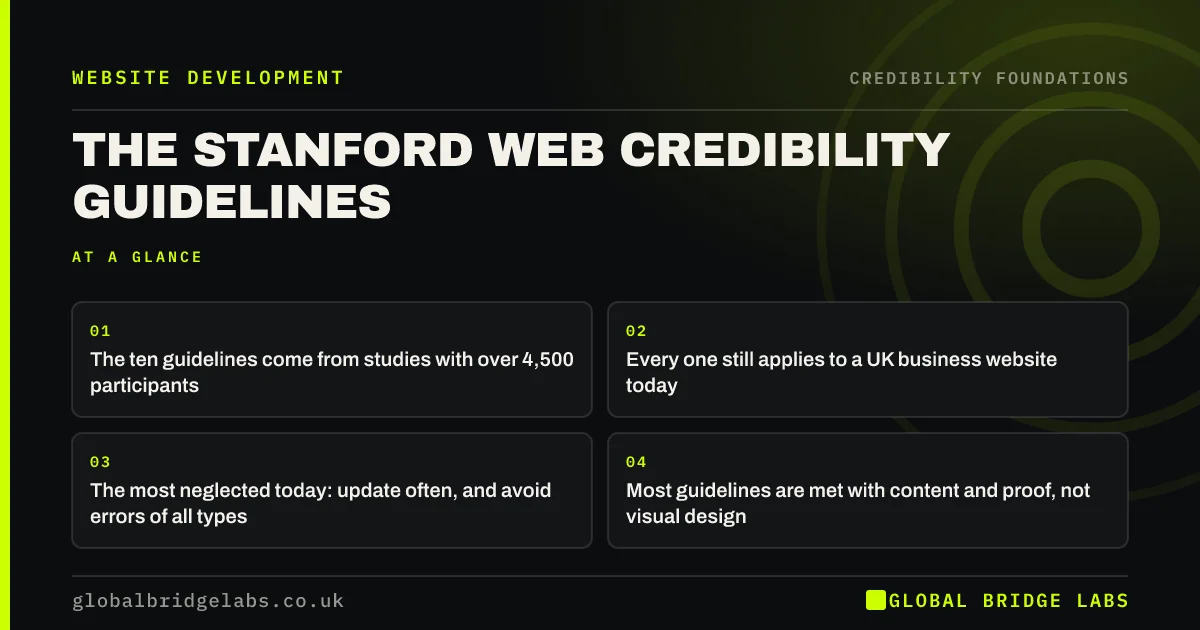
The Stanford guidelines for web credibility are ten principles from the Stanford Persuasive Technology Lab, based on research with over 4,500 people. Two decades on, all ten still apply: make claims verifiable, show a real organisation, highlight expertise, show honest people, make contact easy, look professional, be easy to use, update often, limit promotion and avoid errors.
- The ten guidelines come from studies with over 4,500 participants.
- Every one still applies to a UK business website today.
- The most neglected today: update often, and avoid errors of all types.
- Most guidelines are met with content and proof, not visual design.
Want your site checked against all ten guidelines? Message us on WhatsApp.
Chat on WhatsApp →What are the Stanford web credibility guidelines?
The Stanford guidelines for web credibility are ten evidence-based principles for making websites believable, published by B.J. Fogg's Stanford Persuasive Technology Lab. They summarise research involving more than 4,500 people and remain one of the most-cited references on how visitors judge whether a site, and the organisation behind it, deserves belief.
What are the ten guidelines?
Each guideline below is paraphrased, with what it means for a UK business site now.
- Make it easy to verify the accuracy of your claims: link sources, show data.
- Show there is a real organisation behind the site: address, company number, photos.
- Highlight the expertise in your organisation: qualifications, experience, results.
- Show honest and trustworthy people stand behind the site: named team with photos.
- Make it easy to contact you: phone, email and address on every page.
- Design the site so it looks professional for its purpose.
- Make the site easy to use and useful.
- Update the content often, and show that you have.
- Use restraint with promotional content such as pop-ups and adverts.
- Avoid errors of all types, however small they seem.
Which guidelines matter most today?
Three matter more now than when they were written. Avoiding errors, because security warnings and broken forms are more visible. Updating often, because visitors now see dates in search results and in AI answers. And showing real people, because stock photography and AI imagery have made faceless sites feel more suspicious, not less.
How do you apply the guidelines on a small budget?
Most of the ten cost time, not money. Adding a company number, real photos, named people, sources for claims and a review of out-of-date pages can be done in a week. Professional design is the one guideline that may need spending, and even that often needs a visual refresh rather than a rebuild.
- Website credibility quick wins you can make this week
- Website visual refresh: new look without a rebuild
Want the ten guidelines turned into a costed fix list? Message us on WhatsApp and we will discuss your requirements.
Chat on WhatsApp →Where do the guidelines fall short?
The guidelines predate smartphones, review platforms and AI search, so they say little about mobile layouts, review law or how AI tools summarise your business. They also treat credibility as one thing, while today's buyers often check you across several places. Use them as a foundation, then add reviews, mobile and consistency across platforms.
What does this look like in practice?
A pattern we see: a site meets the 'looks professional' guideline well but fails 'real organisation' and 'honest people'. It has a modern template, no team page and only a contact form. Adding a team section, an address and a phone number satisfies three guidelines at once.
Stanford guidelines checklist
- Link a source for every statistic you quote.
- Show company number and address.
- Name and picture the people clients will deal with.
- Put contact details on every page.
- Date your news and articles.
- Remove pop-ups that block content.
- Proofread and test every page.
Next step
Go through the ten guidelines and mark each as met, partly met or missing. Fix the missing ones first.
Message us on WhatsApp for a credibility review against the Stanford guidelines, or book a 30-minute consultation.
Chat on WhatsApp →Sources and further reading
- Stanford guidelines for web credibility · Stanford Web Credibility Project
- How do users evaluate the credibility of web sites? A study with over 2,500 participants · ACM (Fogg et al., 2003)
- Trustworthiness in web design: 4 credibility factors · Nielsen Norman Group
Frequently asked questions
Who wrote the Stanford web credibility guidelines?
They were published by the Stanford Persuasive Technology Lab, led by B.J. Fogg, as part of the Stanford Web Credibility Project. They summarise several years of research on how people judge the credibility of websites, involving more than 4,500 participants.
Are the Stanford credibility guidelines still relevant?
Yes. The underlying behaviour has not changed: visitors still look for real people, proof, contact details, current content and a careful look. The guidelines need adding to for mobile, reviews and AI search, but none of the ten has become wrong.
What is the most important Stanford guideline?
For small businesses, showing a real organisation behind the site usually matters most, because buyers know little about you. Company details, an address, real photos and named people answer the first question every new visitor has: is this business real?
Written by

Global Bridge Labs (GBL) is a UK–Sri Lanka partner for social media, websites and BPO. Everything here comes from client delivery, not theory.