On this page
- 01Key takeaways
- 02What is prominence-interpretation theory?
- 03What affects whether visitors notice something?
- 04How do you make proof prominent?
- 05Why do small errors matter so much?
- 06Where is the theory limited?
- 07What does this look like in practice?
- 08Prominence checklist
- 09Next step
- 10Sources and further reading
- 11Frequently asked questions
Key takeaways
Prominence-interpretation theory, from B.J. Fogg in 2003, says a website element affects credibility only if visitors notice it (prominence) and then judge it (interpretation). Strong proof buried in the footer has no effect. A small error in a headline has a large one. Design decides what is prominent.
- An element affects credibility only if it is noticed and then judged.
- Proof that visitors do not see has no credibility value.
- Errors in prominent places have outsized effects.
- Design controls prominence; content controls interpretation.
Want your best proof moved to where visitors look? Message us on WhatsApp.
Chat on WhatsApp →What is prominence-interpretation theory?
Prominence-interpretation theory is a model of how people assess credibility online. It states that two things happen when someone judges a website: they notice some elements (prominence) and make a judgement about each one they notice (interpretation). Credibility impact equals prominence multiplied by interpretation, so an unnoticed element contributes nothing.
What affects whether visitors notice something?
Fogg identified five factors that affect prominence: how involved the visitor is, the topic of the site, the task they are doing, their experience and individual differences. A buyer comparing three accountants is highly involved and will look further. A casual browser sees only the first screen. Design for both.
- Involvement: high-stakes buyers look deeper, so detail must hold up.
- Topic: regulated topics make visitors look for credentials.
- Task: someone checking prices notices pricing cues first.
- Experience: experienced buyers know what to look for.
- Individual differences: some people always check reviews.
How do you make proof prominent?
Put proof where visitors look while deciding: near the first screen, next to the contact button, and on service and price pages. Make it specific so it survives interpretation: a named reviewer and date, an accreditation number, a case study with a number. Visual hierarchy, contrast and position all raise prominence.
Want a prominence review of your key pages? Message us on WhatsApp and we will discuss your requirements.
Chat on WhatsApp →Why do small errors matter so much?
Small errors matter because they are often prominent and easy to interpret badly. A typo in a headline is seen by every visitor and read as carelessness. A broken form is noticed at the exact moment of decision. The theory explains why fixing a few visible faults often does more than adding new content lower down.
Where is the theory limited?
The theory explains how judgements form but does not tell you what each visitor will notice. That varies, so it has to be tested. Use a first-impression test or session recordings to see what people actually look at, rather than guessing from the layout.
What does this look like in practice?
A pattern we see: a firm's accreditations sit in a grey strip at the bottom of the page, below the footer links. In session recordings, fewer than one in ten visitors scroll that far. Moving two key badges next to the quote button puts them in front of every visitor about to decide.
Prominence checklist
- List your three strongest pieces of proof.
- Check where each one appears on a phone.
- Move them near the first screen and the contact action.
- Remove errors from headings, buttons and forms first.
- Test what visitors actually notice.
Next step
Scroll your homepage on a phone and note where your proof first appears. If it is below the third screen, move it up.
Message us on WhatsApp for a credibility review, or book a 30-minute consultation.
Chat on WhatsApp →Sources and further reading
- Prominence-interpretation theory: explaining how people assess credibility online · ACM (Fogg, 2003)
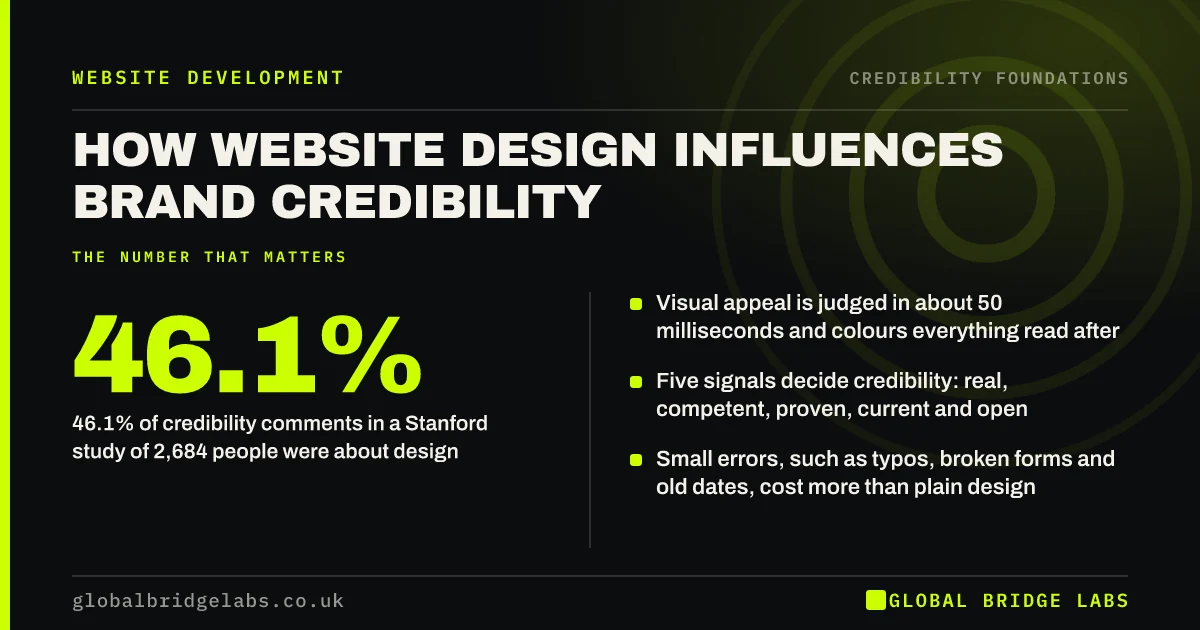
- How do users evaluate the credibility of web sites? A study with over 2,500 participants · ACM (Fogg et al., 2003)
- Visual hierarchy in UX: definition · Nielsen Norman Group
Frequently asked questions
Who created prominence-interpretation theory?
B.J. Fogg of the Stanford Persuasive Technology Lab published prominence-interpretation theory in 2003, based on research into how thousands of people evaluated the credibility of real websites. It is one of the most cited models of online credibility.
What does prominence mean in web design?
Prominence is the likelihood that a visitor notices an element. It depends on position, size, contrast and the visitor's task and involvement. Elements near the top, next to actions, or visually distinct are more prominent than those in footers or small grey text.
How do I find out what visitors notice?
Show the page to a few people for five seconds and ask what they remember, or watch session recordings to see how far they scroll and what they click. Both reveal what is prominent in practice, which is often different from what the owner expects.
Written by

Global Bridge Labs (GBL) is a UK–Sri Lanka partner for social media, websites and BPO. Everything here comes from client delivery, not theory.