On this page
- 01Key takeaways
- 02What is the GBL Credibility Score?
- 03How do you score each of the five signals?
- 04What do the scores mean?
- 05Which signal should you fix first?
- 06What are the limits of a self-score?
- 07What does this look like in practice?
- 08Credibility score checklist
- 09Next step
- 10Sources and further reading
- 11Frequently asked questions
Key takeaways
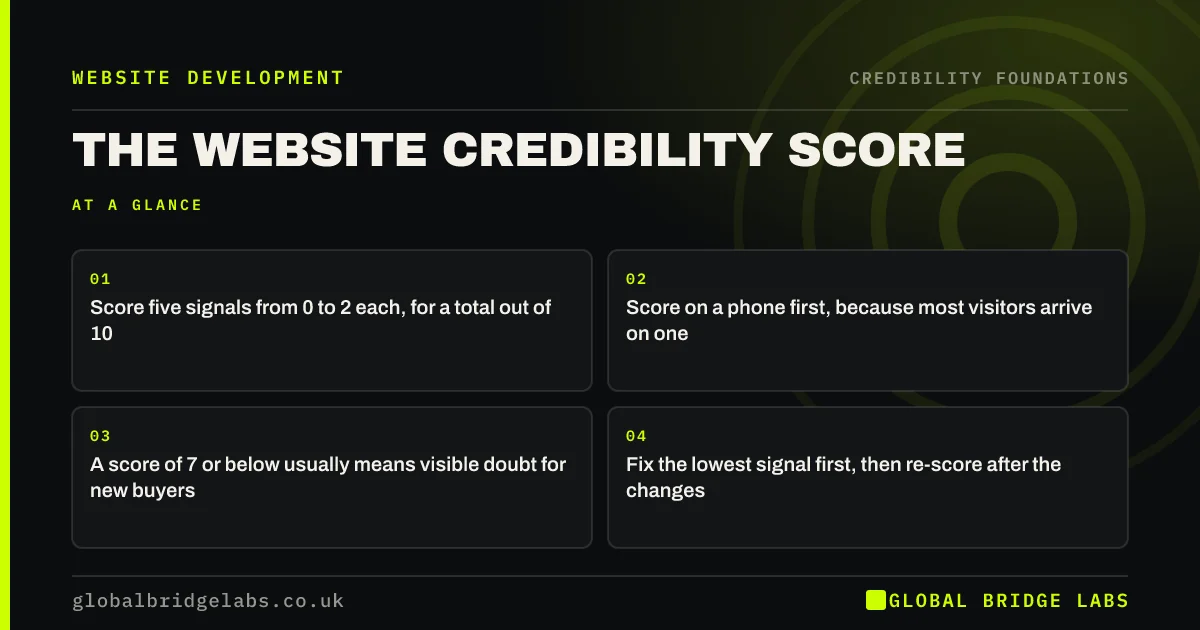
The GBL Credibility Score rates a website out of 10 on five signals: real, competent, proven, current and open. Each signal is scored 0, 1 or 2. It takes about 20 minutes with a phone and a notepad, and the lowest-scoring signal is almost always the cheapest place to start.
- Score five signals from 0 to 2 each, for a total out of 10.
- Score on a phone first, because most visitors arrive on one.
- A score of 7 or below usually means visible doubt for new buyers.
- Fix the lowest signal first, then re-score after the changes.
Want us to score your site with you? Message us on WhatsApp.
Chat on WhatsApp →What is the GBL Credibility Score?
The GBL Credibility Score is a 10-point method Global Bridge Labs (GBL) uses to rate how believable a business website looks to a first-time visitor. It is a working method built from our delivery experience and the Stanford guidelines for web credibility, not an industry standard. Its value is turning a vague feeling into specific fixes.
How do you score each of the five signals?
Score each signal 0 if it is missing, 1 if it is partly there and 2 if a stranger would find it within a minute. Be strict: if you have to explain where something is, it scores 1 at most.
- Real: named people with photos, a company number, an address or service area.
- Competent: a cared-for look, no errors, forms and links that work on a phone.
- Proven: named, dated reviews, case studies with numbers, accreditations you hold.
- Current: recent dates on news or blog, current team, prices and copyright year.
- Open: prices or ranges, how you work, policies and reply times stated clearly.
What do the scores mean?
A score of 9 or 10 means credibility is unlikely to be what holds enquiries back. A score of 7 or 8 means one or two signals are weak and some buyers will hesitate. A score of 6 or below means most new visitors have a visible reason to doubt you, and fixing it should come before spending on more traffic.
Which signal should you fix first?
Fix the lowest-scoring signal first, unless a security warning or broken form is involved, which always comes first. Real and proven are usually the cheapest to raise: photos, names, a company number and three good reviews can move a score by three or four points in a week.
- Website credibility quick wins you can make this week
- 'Not secure' warning on your website: what it means
Want your lowest signal turned into a short fix list? Message us on WhatsApp and we will discuss your requirements.
Chat on WhatsApp →What are the limits of a self-score?
You know your business too well to see it as a stranger does. Use the score as a starting point, then test it with three to five people who do not know you, using a five-minute first-impression test. Their reasons will be more useful than your score.
What does this look like in practice?
A pattern we see: an owner scores their site 8, a stranger scores it 5. The owner knew the team page existed and the reviews were real; the stranger could not find the team page and the reviews had no names. Moving both onto the homepage closed most of the gap.
Credibility score checklist
- Open the site on a phone, not your desktop.
- Score each signal 0, 1 or 2 against the definitions.
- Write one fix for every signal below 2.
- Ask three strangers to repeat the score.
- Fix the lowest signal and re-score in 30 days.
Next step
Score your site today and write the total down. That is your credibility baseline.
Message us on WhatsApp for a scored credibility review, or book a 30-minute consultation.
Chat on WhatsApp →Sources and further reading
- Stanford guidelines for web credibility · Stanford Web Credibility Project
- Trustworthiness in web design: 4 credibility factors · Nielsen Norman Group
- Why you only need to test with 5 users · Nielsen Norman Group
Frequently asked questions
How do I check my website's credibility?
Score it on five signals: real, competent, proven, current and open, from 0 to 2 each. Then ask three to five people who do not know your business to look at it on a phone and say whether they would contact you and why. Their reasons show which signal to fix.
Is there a free website credibility checker?
Automated tools check technical items such as HTTPS, speed and broken links, which are part of credibility. They cannot judge whether your photos look real or your proof is convincing. Use a tool for the technical checks and people for the rest.
How often should I re-score my website?
Re-score after any significant change and at least every six months. Credibility decays quietly: team members leave, reviews age and blog posts go stale. A twice-yearly score catches that before buyers do.
Written by

Global Bridge Labs (GBL) is a UK–Sri Lanka partner for social media, websites and BPO. Everything here comes from client delivery, not theory.