On this page
- 01Key takeaways
- 02What is a favicon?
- 03Why does a favicon affect credibility?
- 04What are Google's favicon requirements?
- 05How do you design a good favicon?
- 06When does the favicon not matter?
- 07What does this look like in practice?
- 08Favicon checklist
- 09Next step
- 10Sources and further reading
- 11Frequently asked questions
Key takeaways
Yes, every business website needs a favicon. It is the small icon shown in browser tabs, bookmarks and next to your site in Google's mobile and desktop results. Without one, Google shows a generic globe and browser tabs look blank, which makes a site look unfinished. It takes an hour to set up properly.
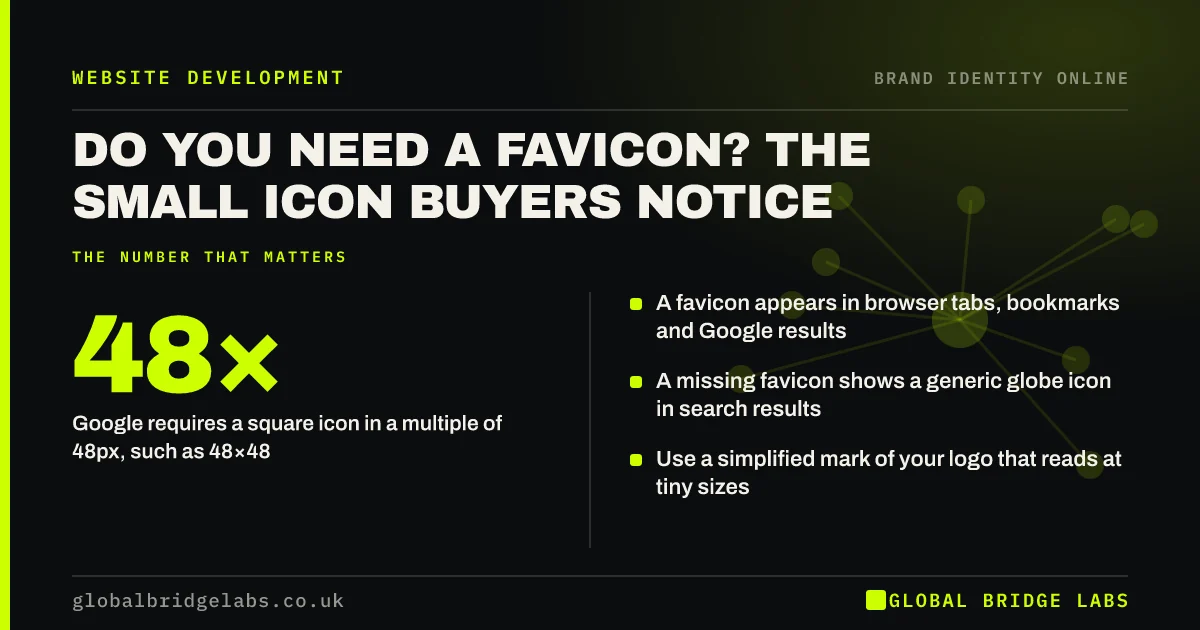
- A favicon appears in browser tabs, bookmarks and Google results.
- Google requires a square icon in a multiple of 48px, such as 48×48.
- A missing favicon shows a generic globe icon in search results.
- Use a simplified mark of your logo that reads at tiny sizes.
Want your favicon and site name checked in Google? Message us on WhatsApp.
Chat on WhatsApp →What is a favicon?
A favicon is a small square icon that represents a website in browser tabs, bookmarks, home-screen shortcuts and search results. The name comes from 'favourites icon'. Google shows it next to your site name in search results, so it is often the first piece of your brand a searcher sees.
Why does a favicon affect credibility?
A favicon affects credibility because its absence is noticeable. In Google results, a site without one shows a generic globe while competitors show their marks. In a browser with several tabs open, a blank tab looks like a site nobody finished. It is a small signal, but it sits right at the moment of choosing which result to click.
What are Google's favicon requirements?
Google's guidance says the favicon must be square, a multiple of 48 pixels on each side, such as 48×48 or 96×96, and in a supported format. It must be crawlable and represent your brand. Google also uses your site name, which you can influence with WebSite structured data, alongside the favicon in results.
- Square, and a multiple of 48px, such as 48×48, 96×96 or 192×192.
- A supported file type, such as ICO, PNG or SVG.
- Crawlable by Google, with a stable URL.
- Visually represents your brand; no inappropriate content.
Want your favicon and site name set up correctly? Message us on WhatsApp and we will discuss your requirements.
Chat on WhatsApp →How do you design a good favicon?
Use a simplified part of your logo, such as an initial or symbol, because a full logo with words becomes unreadable at 16 pixels. Check it on light and dark browser themes. Keep the colours the same as your brand so it is recognisable from your social profiles and signage.
When does the favicon not matter?
The favicon will not rescue a weak result. If your title and description in search are vague, or the site has larger credibility gaps, fix those first. Think of the favicon as a finishing detail: cheap and worth doing, but only one small signal among many.
What does this look like in practice?
A pattern we see: a site launched with the platform's default favicon, so its tab and search result show the website builder's logo rather than the business's. Replacing it with a simplified brand mark takes minutes and stops the site looking like a template.
Favicon checklist
- Create a square icon from a simplified logo mark.
- Export at 48×48 and larger multiples of 48.
- Check it on light and dark browser themes.
- Replace any website builder default icon.
- Search for your business and check how it appears.
Next step
Search your business name on a phone and look at the icon beside your result. If it is a globe or a builder's logo, fix it today.
Message us on WhatsApp for a search appearance review, or book a 30-minute consultation.
Chat on WhatsApp →Sources and further reading
- Define a favicon to show in search results · Google Search Central
- Site names in Google Search · Google Search Central
- Google Search Console · Google
Frequently asked questions
Is a favicon necessary for SEO?
A favicon is not a ranking factor, but Google shows it next to your result, so it affects how your listing looks and may affect whether people click. It is also part of how your site looks finished in browser tabs and bookmarks.
What size should a favicon be?
Google requires a square favicon that is a multiple of 48 pixels on each side, such as 48×48, 96×96 or 192×192. Provide a larger version as well for home-screen shortcuts on phones.
Why is Google not showing my favicon?
Common causes are a non-square image, a size that is not a multiple of 48 pixels, a blocked or moved file, or Google not having recrawled the homepage yet. Fix the file, then request indexing of the homepage in Google Search Console.
Written by

Global Bridge Labs (GBL) is a UK–Sri Lanka partner for social media, websites and BPO. Everything here comes from client delivery, not theory.